Department of Microbiology, Institut Pasteur, 25 rue du Dr. Roux, 75015, Paris, France.
National Center for Biotechnology Information, National Library of Medicine, National Institutes of Health, Bethesda, MD, 20894, USA.
Biol Direct. 2017 Nov 13;12(1):25. doi: 10.1186/s13062-017-0197-y.
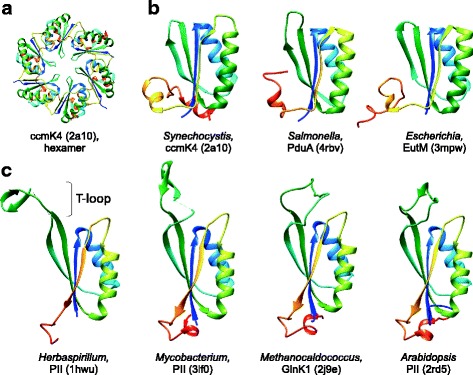
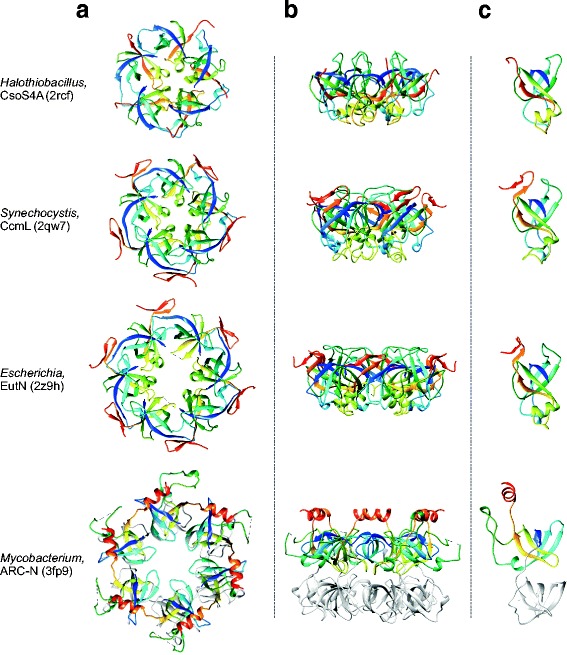
ᅟ: Bacterial microcompartments (BMC) are proteinaceous organelles that structurally resemble viral capsids, but encapsulate enzymes that perform various specialized biochemical reactions in the cell cytoplasm. The BMC are constructed from two major shell proteins, BMC-H and BMC-P, which form the facets and vertices of the icosahedral assembly, and are functionally equivalent to the major and minor capsid proteins of viruses, respectively. This equivalence notwithstanding, neither of the BMC proteins displays structural similarity to known capsid proteins, rendering the origins of the BMC enigmatic. Here, using structural and sequence comparisons, we show that both BMC-H and BMC-P, most likely, were exapted from bona fide cellular proteins, namely, PII signaling protein and OB-fold domain-containing protein, respectively. This finding is in line with the hypothesis that many major viral structural proteins have been recruited from cellular proteomes.
This article was reviewed by Igor Zhulin, Jeremy Selengut and Narayanaswamy Srinivasan. For complete reviews, see the Reviewers' reports section.
细菌微室(BMC)是类似于病毒衣壳的蛋白性细胞器,但包被着在细胞质中执行各种特殊生化反应的酶。BMC 由两种主要的壳蛋白 BMC-H 和 BMC-P 构成,它们形成二十面体组装的面和顶点,分别与病毒的主要和次要衣壳蛋白在功能上等效。尽管如此,BMC 蛋白中没有一种显示出与已知衣壳蛋白的结构相似性,这使得 BMC 的起源仍然扑朔迷离。在这里,我们通过结构和序列比较表明,BMC-H 和 BMC-P 很可能是从真正的细胞蛋白中适应而来的,分别是 PII 信号蛋白和 OB 折叠结构域蛋白。这一发现与许多主要的病毒结构蛋白是从细胞蛋白质组中招募而来的假说一致。
本文由 Igor Zhulin、Jeremy Selengut 和 Narayanaswamy Srinivasan 进行了评审。如需查看完整的评审报告,请点击“Reviews”部分。