Department of Molecular and Cell Biology, University of California, Berkeley, CA 94720.
Division of Biology and Biological Engineering, California Institute of Technology, Pasadena, CA 91125.
Proc Natl Acad Sci U S A. 2022 Dec 6;119(49):e2210539119. doi: 10.1073/pnas.2210539119. Epub 2022 Dec 1.
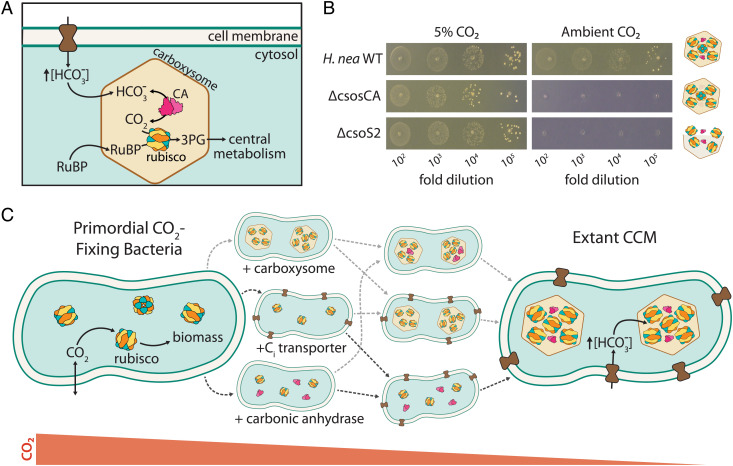
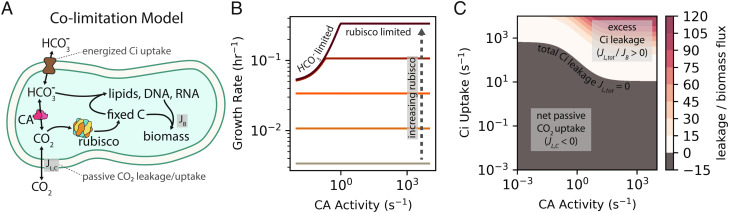
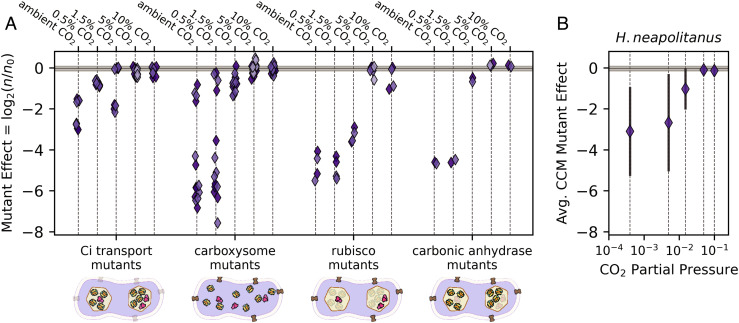
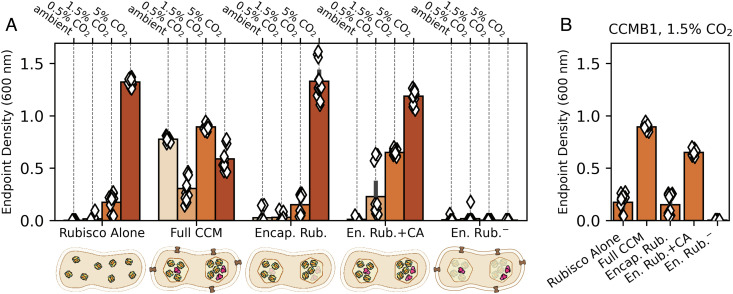
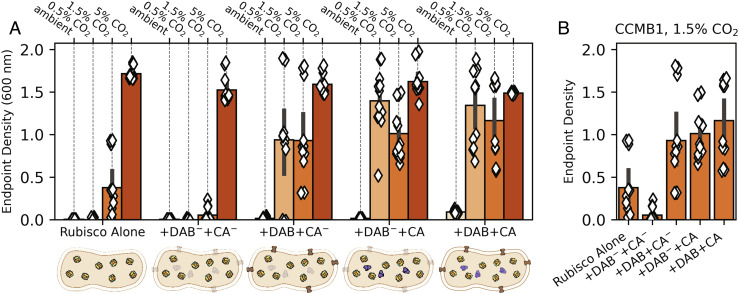
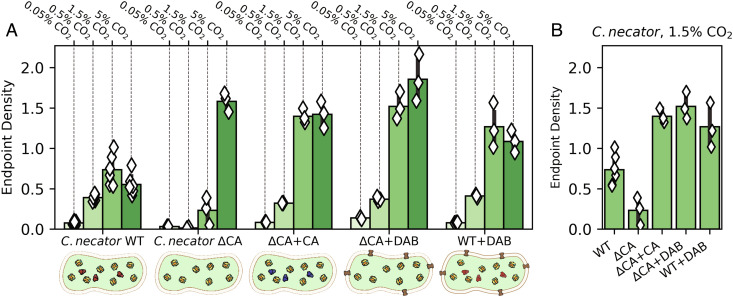
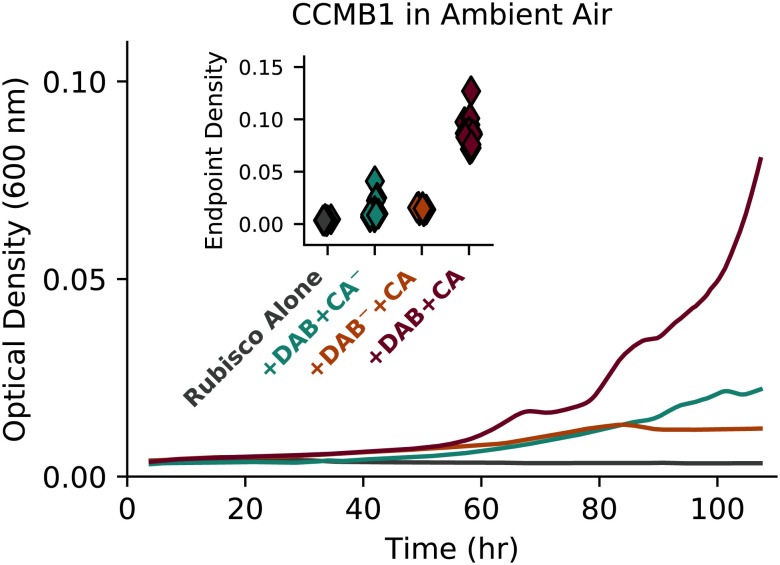
Cyanobacteria rely on CO-concentrating mechanisms (CCMs) to grow in today's atmosphere (0.04% CO). These complex physiological adaptations require ≈15 genes to produce two types of protein complexes: inorganic carbon (Ci) transporters and 100+ nm carboxysome compartments that encapsulate rubisco with a carbonic anhydrase (CA) enzyme. Mutations disrupting any of these genes prohibit growth in ambient air. If any plausible ancestral form-i.e., lacking a single gene-cannot grow, how did the CCM evolve? Here, we test the hypothesis that evolution of the bacterial CCM was "catalyzed" by historically high CO levels that decreased over geologic time. Using an reconstitution of a bacterial CCM, we constructed strains lacking one or more CCM components and evaluated their growth across CO concentrations. We expected these experiments to demonstrate the importance of the carboxysome. Instead, we found that partial CCMs expressing CA or Ci uptake genes grew better than controls in intermediate CO levels (≈1%) and observed similar phenotypes in two autotrophic bacteria, and . To understand how CA and Ci uptake improve growth, we model autotrophy as colimited by CO and HCO, as both are required to produce biomass. Our experiments and model delineated a viable trajectory for CCM evolution where decreasing atmospheric CO induces an HCO deficiency that is alleviated by acquisition of CA or Ci uptake, thereby enabling the emergence of a modern CCM. This work underscores the importance of considering physiology and environmental context when studying the evolution of biological complexity.
蓝藻依靠 CO 浓缩机制 (CCM) 在当今的大气环境(0.04% CO)中生长。这些复杂的生理适应需要 ≈15 个基因来产生两种类型的蛋白复合物:无机碳 (Ci) 转运蛋白和 100nm 大小的羧化体隔间,其中包含 Rubisco 和碳酸酐酶 (CA) 酶。破坏这些基因中的任何一个的突变都会阻止在环境空气中生长。如果任何合理的祖先形式(即缺乏单个基因)都不能生长,那么 CCM 是如何进化的?在这里,我们检验了这样一种假设,即细菌 CCM 的进化是由历史上高 CO 水平“催化”的,这些水平随着地质时间的推移而降低。我们使用细菌 CCM 的重建,构建了缺失一个或多个 CCM 成分的菌株,并评估了它们在不同 CO 浓度下的生长情况。我们预计这些实验将证明羧化体的重要性。然而,我们发现表达 CA 或 Ci 摄取基因的部分 CCM 比对照在中间 CO 水平(≈1%)下生长得更好,并且在两种自养细菌和中观察到了类似的表型。为了了解 CA 和 Ci 摄取如何改善生长,我们将自养作用建模为 CO 和 HCO 的共同限制,因为两者都是产生生物量所必需的。我们的实验和模型描绘了一个可行的 CCM 进化轨迹,即大气 CO 减少会引起 HCO 缺乏,而通过获取 CA 或 Ci 摄取来缓解这种缺乏,从而使现代 CCM 得以出现。这项工作强调了在研究生物复杂性的进化时,考虑生理学和环境背景的重要性。