Jahangiry Leila, Farhangi Mahdieh Abbasalizad, Rezaei Fatemeh
Tabriz Health Services Management Research Center, Health Education and Health Promotion Department, Tabriz University of Medical Sciences, Tabriz, Iran.
Drug Applied Research Center, Department of Community Nutrition, Faculty of Nutrition, Tabriz University of Medical Sciences, Tabriz, Iran.
J Health Popul Nutr. 2017 Nov 13;36(1):36. doi: 10.1186/s41043-017-0114-0.
There are a few studies evaluating the predictive value of Framingham risk score (FRS) for cardiovascular disease (CVD) risk assessment in patients with metabolic syndrome in Iran. Because of the emerging high prevalence of CVD among Iranian population, it is important to predict its risk among populations with potential predictive tools. Therefore, the aim of the current study is to evaluate the FRS and its determinants in patients with metabolic syndrome.
In the current cross-sectional study, 160 patients with metabolic syndrome diagnosed according to the National Cholesterol Education Adult Treatment Panel (ATP) III criteria were enrolled. The FRS was calculated using a computer program by a previously suggested algorithm.
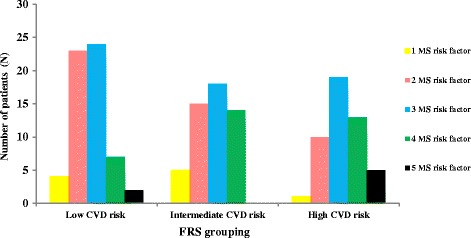
Totally, 77.5, 16.3, and 6.3% of patients with metabolic syndrome were at low, intermediate, and high risk of CVD according to FRS categorization. The highest prevalence of all of metabolic syndrome components were in low CVD risk according to the FRS grouping (P < 0.05), while the lowest prevalence of these components was in high CVD risk group (P < 0.05). According to multiple logistic regression analysis, high systolic blood pressure (SBP) and fasting serum glucose (FSG) were potent determinants of intermediate and high risk CVD risk of FRS scoring compared with low risk group (P < 0.05).
In the current study, significant associations between components of metabolic syndrome and different FRS categorization among patients with metabolic syndrome were identified. High SBP and FSG were associated with meaningfully increased risk of CVD compared with other parameters.
The study is not a trial; the registration number is not applicable.
在伊朗,针对代谢综合征患者进行心血管疾病(CVD)风险评估时,评估弗雷明汉风险评分(FRS)预测价值的研究较少。鉴于伊朗人群中CVD患病率不断上升,利用潜在预测工具预测该人群的风险十分重要。因此,本研究旨在评估代谢综合征患者的FRS及其决定因素。
在这项横断面研究中,纳入了160例根据美国国家胆固醇教育计划成人治疗小组(ATP)III标准确诊的代谢综合征患者。使用计算机程序通过先前建议的算法计算FRS。
根据FRS分类,代谢综合征患者中分别有77.5%、16.3%和6.3%处于CVD低、中、高风险。根据FRS分组,所有代谢综合征组分在CVD低风险组中的患病率最高(P < 0.05),而在CVD高风险组中这些组分的患病率最低(P < 0.05)。根据多因素逻辑回归分析,与低风险组相比,收缩压(SBP)升高和空腹血糖(FSG)升高是FRS评分中CVD中、高风险的有力决定因素(P < 0.05)。
在本研究中,确定了代谢综合征组分与代谢综合征患者不同FRS分类之间存在显著关联。与其他参数相比,SBP升高和FSG升高与CVD风险显著增加相关。
本研究并非试验;注册号不适用。