Celyad SA, Mont-Saint-Guibert, Belgium.
Celyad SA, Boston, MA, USA.
BMJ Open. 2017 Nov 12;7(11):e017075. doi: 10.1136/bmjopen-2017-017075.
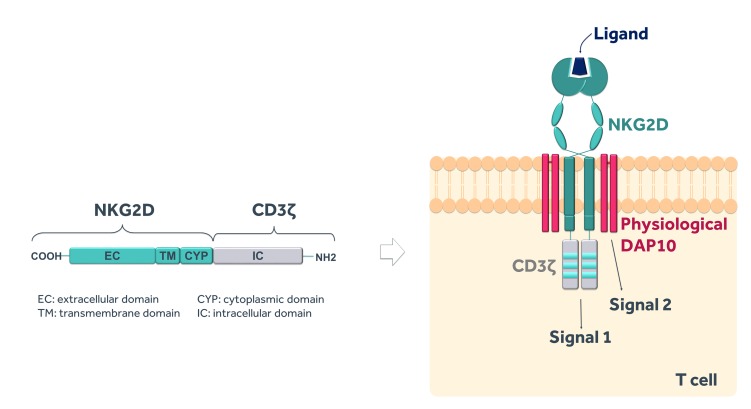
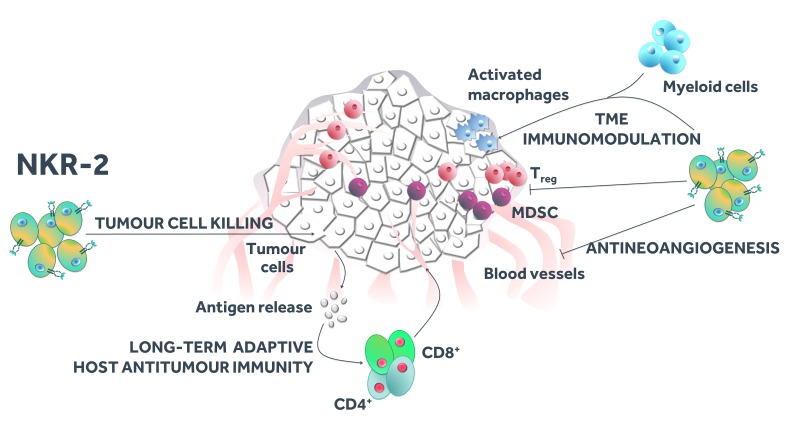
NKR-2 are autologous T cells genetically modified to express a chimeric antigen receptor (CAR) comprising a fusion of the natural killer group 2D (NKG2D) receptor with the CD3ζ signalling domain, which associates with the adaptor molecule DNAX-activating protein of 10 kDa (DAP10) to provide co-stimulatory signal upon ligand binding. NKG2D binds eight different ligands expressed on the cell surface of many tumour cells and which are normally absent on non-neoplastic cells. In preclinical studies, NKR-2 demonstrated long-term antitumour activity towards a breadth of tumour indications, with maximum efficacy observed after multiple NKR-2 administrations. Importantly, NKR-2 targeted tumour cells and tumour neovasculature and the local tumour immunosuppressive microenvironment and this mechanism of action of NKR-2 was established in the absence of preconditioning.
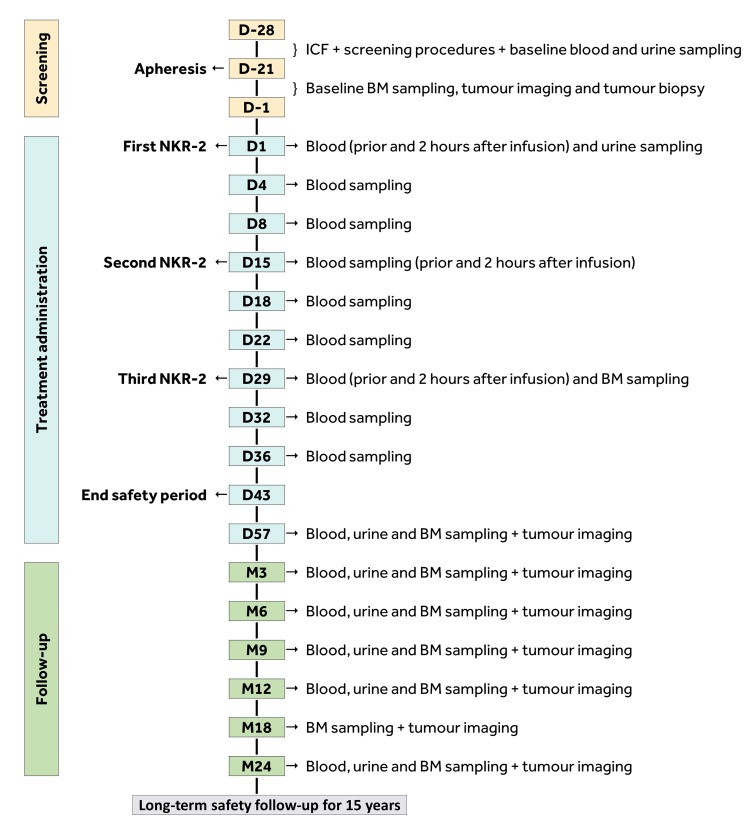
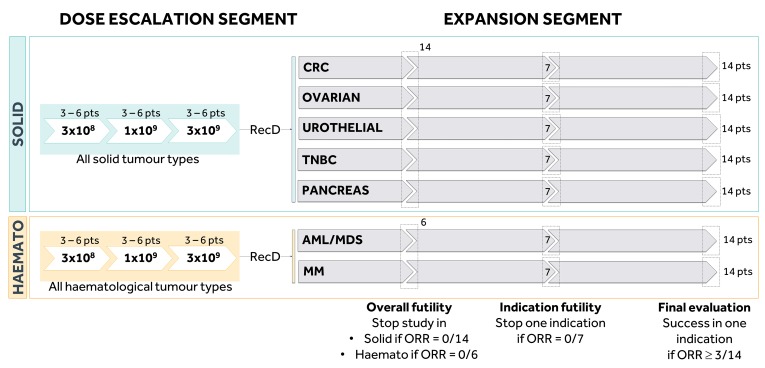
This open-label phase I study will assess the safety and clinical activity of NKR-2 treatment administered three times, with a 2-week interval between each administration in different tumour types. The study will contain two consecutive segments: a dose escalation phase followed by an expansion phase. The dose escalation study involves two arms, one in solid tumours (five specific indications) and one in haematological tumours (two specific indications) and will include three dose levels in each arm: 3×10, 1×10 and 3×10 NKR-2 per injection. On the identification of the recommended dose in the first segment, based on dose-limiting toxicity occurrences, the study will expand to seven different cohorts examining the seven different tumour types separately. Clinical responses will be determined according to standard Response Evaluation Criteria In Solid Tumors (RECIST) criteria for solid tumours or international working group response criteria in haematological tumours.
Ethical approval has been obtained at all sites. Written informed consent will be taken from all participants. The results of this study will be disseminated through presentation at international scientific conferences and reported in peer-reviewed scientific journals.
NCT03018405, EudraCT 2016-003312-12; Pre-result.
NKR-2 是一种自体 T 细胞,经过基因修饰后表达嵌合抗原受体(CAR),该受体由自然杀伤组 2D(NKG2D)受体与 CD3ζ 信号结构域融合而成,与 10kDa 的 DNAX 激活蛋白(DAP10)衔接分子结合,在配体结合时提供共刺激信号。NKG2D 与许多肿瘤细胞表面表达的 8 种不同配体结合,而这些配体在非肿瘤细胞中通常不存在。在临床前研究中,NKR-2 对多种肿瘤适应证表现出长期的抗肿瘤活性,在多次 NKR-2 给药后观察到最大疗效。重要的是,NKR-2 靶向肿瘤细胞和肿瘤新生血管以及局部肿瘤免疫抑制微环境,这种 NKR-2 的作用机制在没有预处理的情况下得到了确立。
本开放标签的 I 期研究将评估 NKR-2 治疗在不同肿瘤类型中的安全性和临床活性,三次给药,每次给药间隔 2 周。该研究将包含两个连续的部分:剂量递增阶段和扩展阶段。剂量递增研究包括两个部分,一个是实体瘤(五种特定适应证),一个是血液肿瘤(两种特定适应证),每个部分将包括三个剂量水平:每次注射 3×10、1×10 和 3×10 NKR-2。在确定第一部分中推荐剂量的基础上,根据剂量限制毒性的发生,研究将扩展到七个不同的队列,分别检查七种不同的肿瘤类型。根据实体瘤的实体瘤反应评估标准(RECIST)标准或血液肿瘤的国际工作组反应标准确定临床反应。
所有站点均已获得伦理批准。将从所有参与者处获得书面知情同意。该研究的结果将通过在国际科学会议上的报告和在同行评议的科学期刊上的发表进行传播。
NCT03018405,EudraCT 2016-003312-12;预结果。