Department of Bioengineering, University of Missouri, Columbia, MO, 65211, USA.
Dalton Cardiovascular Research Center, University of Missouri, Columbia, MO, 65211, USA.
Nat Commun. 2017 Nov 13;8(1):1458. doi: 10.1038/s41467-017-01588-z.
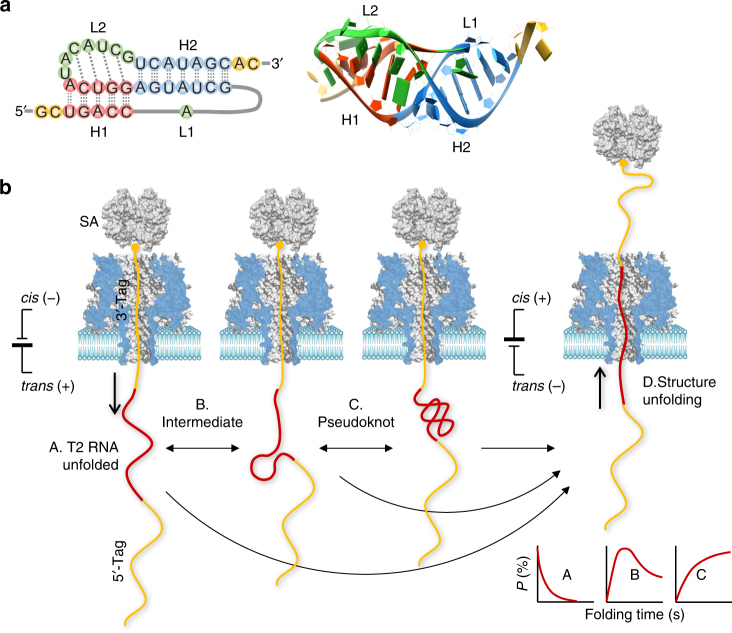
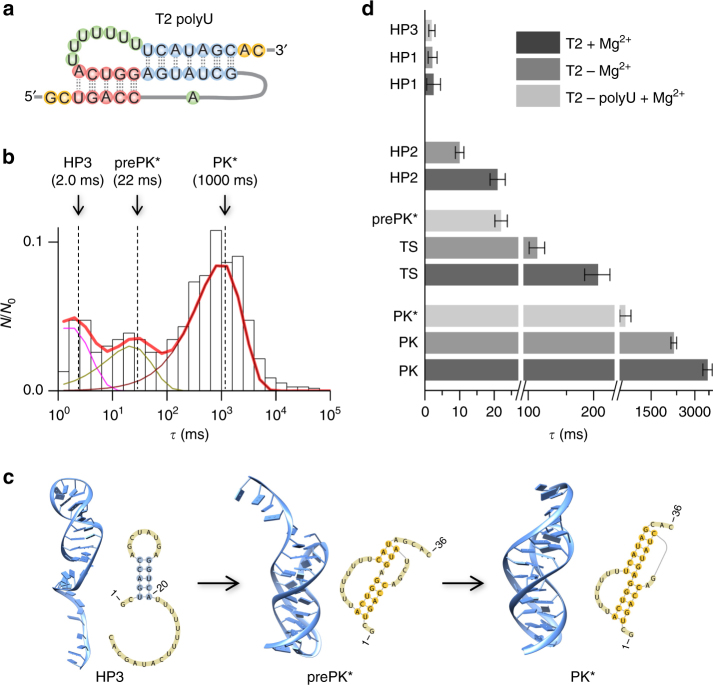
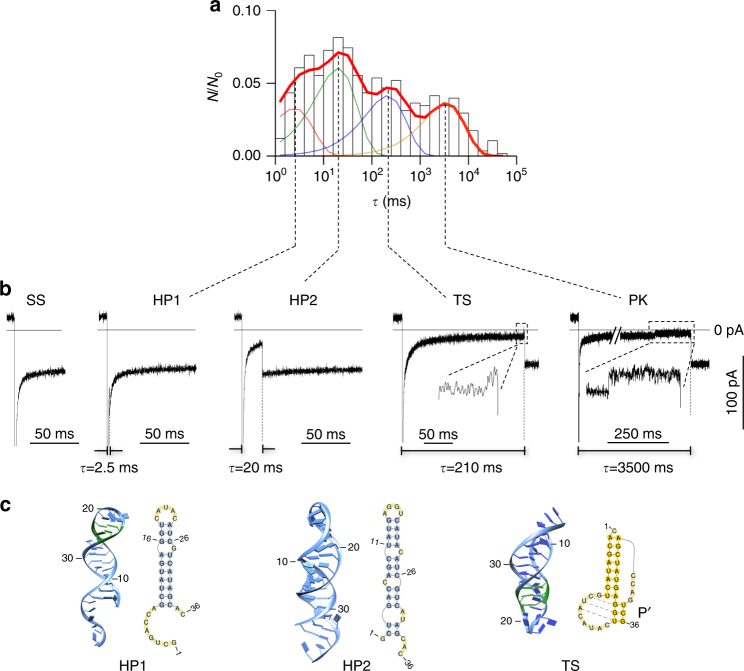
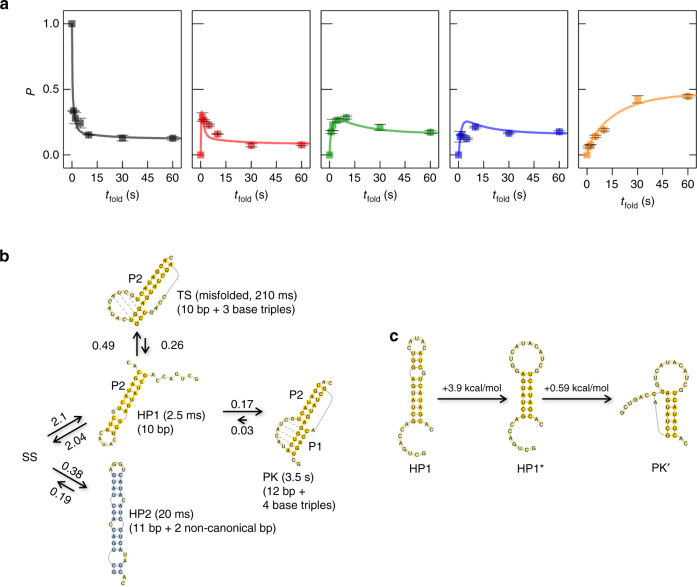
The chemical properties and biological mechanisms of RNAs are determined by their tertiary structures. Exploring the tertiary structure folding processes of RNA enables us to understand and control its biological functions. Here, we report a nanopore snapshot approach combined with coarse-grained molecular dynamics simulation and master equation analysis to elucidate the folding of an RNA pseudoknot structure. In this approach, single RNA molecules captured by the nanopore can freely fold from the unstructured state without constraint and can be programmed to terminate their folding process at different intermediates. By identifying the nanopore signatures and measuring their time-dependent populations, we can "visualize" a series of kinetically important intermediates, track the kinetics of their inter-conversions, and derive the RNA pseudoknot folding pathway. This approach can potentially be developed into a single-molecule toolbox to investigate the biophysical mechanisms of RNA folding and unfolding, its interactions with ligands, and its functions.
RNA 的化学性质和生物学机制由其三级结构决定。探索 RNA 的三级结构折叠过程使我们能够理解和控制其生物学功能。在这里,我们报告了一种纳米孔快照方法,结合粗粒度分子动力学模拟和主方程分析,阐明了 RNA 假结结构的折叠过程。在这种方法中,被纳米孔捕获的单个 RNA 分子可以不受约束地从无规卷曲状态自由折叠,并可以被编程在不同的中间状态终止其折叠过程。通过识别纳米孔特征并测量其随时间变化的丰度,我们可以“可视化”一系列动力学上重要的中间状态,跟踪它们相互转化的动力学,并得出 RNA 假结折叠途径。这种方法有可能发展成为一个单分子工具包,用于研究 RNA 折叠和展开的生物物理机制、与配体的相互作用及其功能。