Centre for Psychiatry Research, Department of Clinical Neuroscience, Karolinska Institutet, Stockholm, Sweden.
Stockholm Health Care Services, Stockholm County Council, Stockholm, Sweden.
Mol Psychiatry. 2018 Jul;23(7):1652-1658. doi: 10.1038/mp.2017.215. Epub 2017 Nov 14.
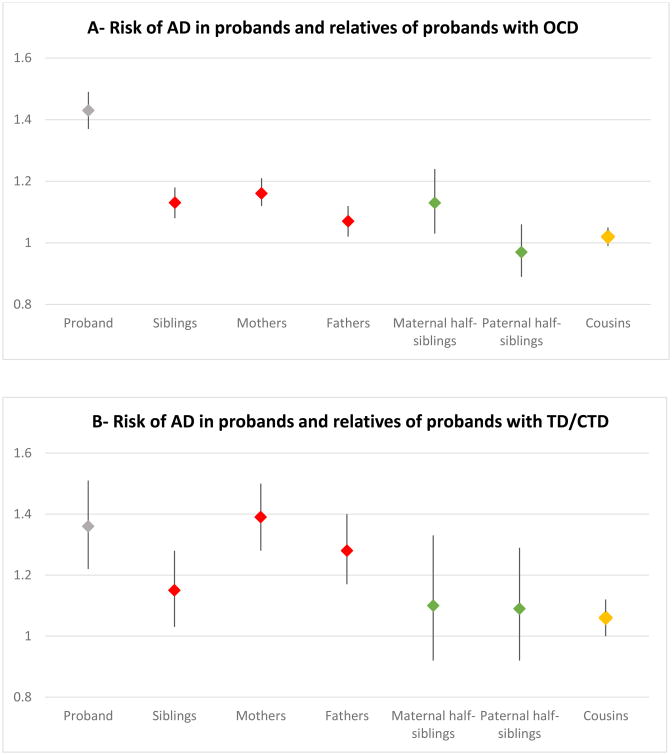
The association between obsessive-compulsive disorder (OCD) and Tourette's/chronic tic disorders (TD/CTD) with autoimmune diseases (ADs) is uncertain. In this nationwide study, we sought to clarify the patterns of comorbidity and familial clustering of a broad range of ADs in individuals with OCD, individuals with TD/CTD and their biological relatives. From a birth cohort of 7 465 455 individuals born in Sweden between 1940 and 2007, we identified 30 082 OCD and 7279 TD/CTD cases in the National Patient Register and followed them up to 31 December 2013. The risk of 40 ADs was evaluated in individuals with OCD, individuals with TD/CTD and their first- (siblings, mothers, fathers), second- (half siblings) and third-degree (cousins) relatives, compared with population controls. Individuals with OCD and TD/CTD had increased comorbidity with any AD (43% and 36%, respectively) and many individual ADs. The risk of any AD and several individual ADs was consistently higher among first-degree relatives than among second- and third-degree relatives of OCD and TD/CTD probands. The risk of ADs was very similar in mothers, fathers and siblings of OCD probands, whereas it tended to be higher in mothers and fathers of TD/CTD probands (compared with siblings). The results suggest a familial link between ADs in general (that is, not limited to Streptococcus-related conditions) and both OCD and TD/CTD. Additional mother-specific factors, such as the placental transmission of antibodies, cannot be fully ruled out, particularly in TD/CTD.
强迫症(OCD)和妥瑞氏症/慢性抽动障碍(TD/CTD)与自身免疫性疾病(ADs)之间的关联尚不确定。在这项全国性研究中,我们试图阐明 OCD、TD/CTD 患者及其生物学亲属中广泛 AD 共病和家族聚集的模式。从瑞典 1940 年至 2007 年间出生的 7465455 名出生队列中,我们在国家患者登记处确定了 30082 例 OCD 和 7279 例 TD/CTD 病例,并随访至 2013 年 12 月 31 日。在 OCD、TD/CTD 患者及其一级(兄弟姐妹、母亲、父亲)、二级(同父异母或同母异父兄弟姐妹)和三级(表兄弟姐妹)亲属中,评估了 40 种 AD 的风险,与人群对照相比。OCD 和 TD/CTD 患者的共病率较高,患有任何 AD(分别为 43%和 36%)和多种特定 AD。与 OCD 和 TD/CTD 患者的二级和三级亲属相比,一级亲属的任何 AD 和多种特定 AD 的风险均较高。OCD 患者的一级亲属(母亲、父亲和兄弟姐妹)中 AD 的风险非常相似,而 TD/CTD 患者的一级亲属(母亲和父亲)中 AD 的风险往往较高(与兄弟姐妹相比)。结果表明,AD 与 OCD 和 TD/CTD 之间存在家族联系(即不限于与链球菌相关的情况)。不能完全排除母亲特异性因素(例如胎盘抗体的传递),特别是在 TD/CTD 中。