Gaffney Christopher J, Fomina Elena, Babich Dennis, Kitov Vladimir, Uskov Konstantin, Green David A
Institute of Biomedical Problems (IBMP), Moscow, Russia.
Centre of Human & Aerospace Physiological Sciences (CHAPS), King's College London, Faculty of Life Sciences & Medicine, Guy's Campus, London, SE1 1UL, UK.
Sports Med Open. 2017 Nov 13;3(1):40. doi: 10.1186/s40798-017-0107-y.
Isolation and long duration spaceflight are associated with musculoskeletal deconditioning. Mars500 was a unique, high-fidelity analogue of the psychological challenges of a 520-day manned mission to Mars. We aimed to explore the effect of musculoskeletal deconditioning on three outcome measures: (1) if lower limb muscle strength was reduced during the 520-day isolation; (2) if type I or II muscle fibres were differentially affected; and (3) whether any 70-day exercise interventions prevented any isolation-induced loss of strength.
Six healthy male subjects (mean ± SEM) (34 ± 3 years; 1.76 ± 0.02 metres; 83.7 ± 4.8 kg) provided written, informed consent to participate. The subjects' maximal voluntary contraction (MVC) was assessed isometrically in the calf (predominantly type I fibres), and maximal voluntary isokinetic force (MVIF) was assessed in the quadriceps/hamstrings (predominantly type II fibres) at 0.2 and 0.4 ms using the Multifunctional Dynamometer for Space (MDS) at 35-day intervals throughout Mars500. Exercise interventions were completed 3-7 days/week throughout the 520-day isolation in a counterbalanced design excluding 142-177 days (rest period) and 251-284 days (simulated Mars landing). Exercise interventions included motorized treadmill running, non-motorized treadmill running, cycle ergometry, elastomer-based resistance exercise, whole-body vibration (WBV), and resistance exercise using MDS.
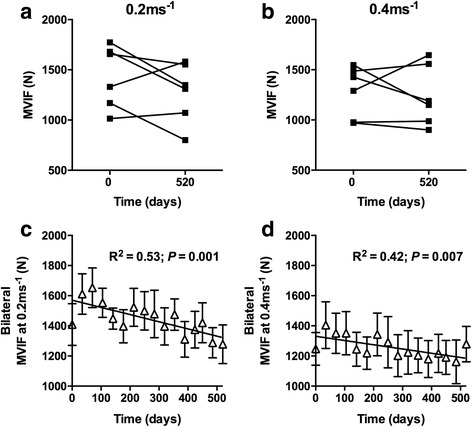
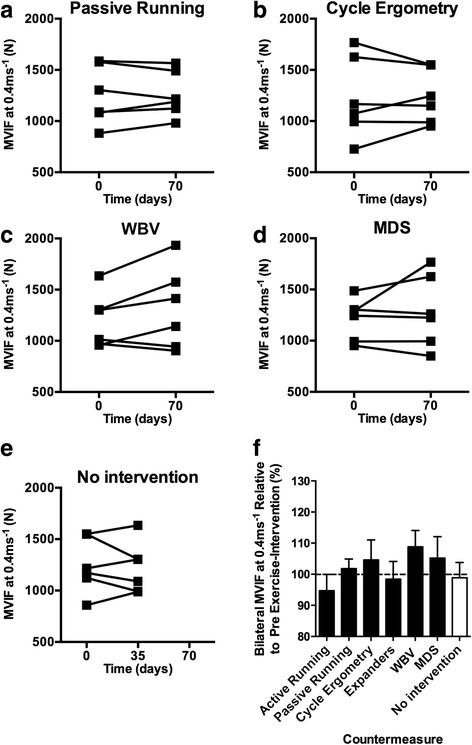
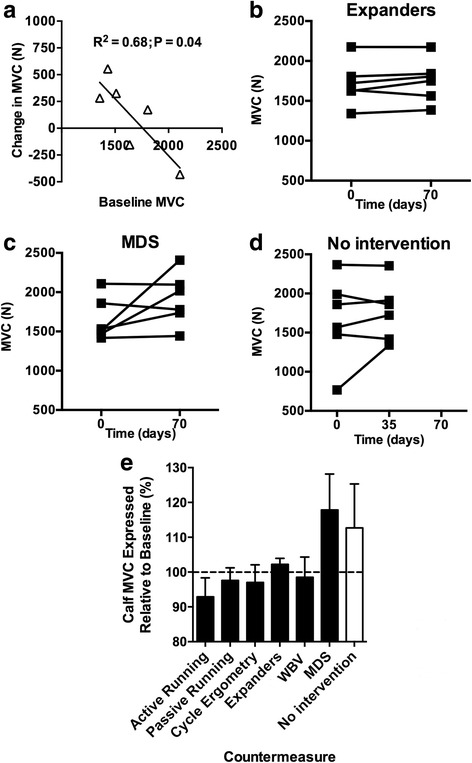
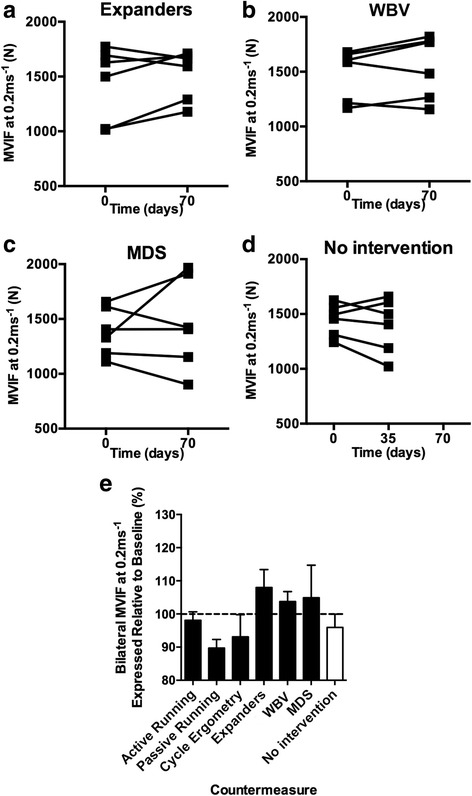
Calf MVC did not reduce across the 520-day isolation and MDS increased strength by 18% compared to before that of 70-day exercise intervention. In contrast, there was a significant bilateral loss of MVIF across the 520 days at both 0.2 ms (R = 0.53; P = 0.001) and 0.4 ms (0.4 ms; R = 0.42; P = 0.007). WBV (+ 3.7 and 8.8%) and MDS (+ 4.9 and 5.2%) afforded the best protection against isolation-induced loss of MVIF, although MDS was the only intervention to prevent bilateral loss of calf MVC and leg MVIF at 0.2 and 0.4 ms.
Mars500 induced significant loss of quadriceps/hamstrings MVIF but not calf MVC. Collectively, these data suggest that muscles with predominantly type I fibres were affected less by isolation compared to type II dominant muscles. MDS and WBV afforded the best protection against isolation-induced loss of strength and thus may have virtue in exploration class missions.
隔离和长时间太空飞行与肌肉骨骼功能失调有关。“火星500”是一项独特的、高度逼真模拟520天载人火星任务心理挑战的项目。我们旨在探讨肌肉骨骼功能失调对三项结果指标的影响:(1)在520天的隔离期间下肢肌肉力量是否下降;(2)I型或II型肌纤维是否受到不同影响;(3)任何70天的运动干预措施能否预防隔离引起的力量损失。
六名健康男性受试者(均值±标准误)(34±3岁;身高1.76±0.02米;体重83.7±4.8千克)提供了书面知情同意书参与研究。在整个“火星500”项目期间,每隔35天使用太空多功能测力计(MDS)等长评估受试者小腿(主要为I型纤维)的最大自主收缩(MVC),并在0.2和0.4毫秒时等速评估股四头肌/腘绳肌(主要为II型纤维)的最大自主等动力力量(MVIF)。在520天的隔离期间,运动干预以平衡设计每周进行3 - 7天,排除142 - 177天(休息期)和251 - 284天(模拟火星着陆)。运动干预包括电动跑步机跑步、非电动跑步机跑步、自行车测力计运动、基于弹性体的抗阻运动、全身振动(WBV)以及使用MDS的抗阻运动。
在520天的隔离期间,小腿MVC没有下降,与70天运动干预前相比,MDS使力量增加了18%。相比之下,在520天内,0.2毫秒(R = 0.53;P = 0.001)和0.4毫秒(R = 0.42;P = 0.007)时双侧MVIF均出现显著下降。WBV(分别增加3.7%和8.8%)和MDS(分别增加4.9%和5.2%)对隔离引起的MVIF损失提供了最佳保护,尽管MDS是唯一能预防0.2和0.4毫秒时小腿MVC和腿部MVIF双侧损失的干预措施。
“火星500”项目导致股四头肌/腘绳肌MVIF显著下降,但小腿MVC未下降。总体而言,这些数据表明,与以II型肌纤维为主的肌肉相比,以I型肌纤维为主的肌肉受隔离影响较小。MDS和WBV对隔离引起的力量损失提供了最佳保护,因此可能在探索类任务中具有优势。