Department of Communication Sciences and Disorders, University of South Florida, Tampa, Florida, USA.
Department of Chemical and Biomedical Engineering, University of South Florida, Tampa, Florida, USA.
Ear Hear. 2018 May/Jun;39(3):594-604. doi: 10.1097/AUD.0000000000000518.
This study was designed to evaluate binaural temporal processing in young and older adults using a binaural masking level difference (BMLD) paradigm. Using behavioral and electrophysiological measures within the same listeners, a series of stimulus manipulations was used to evaluate the relative contribution of binaural temporal fine-structure and temporal envelope cues. We evaluated the hypotheses that age-related declines in the BMLD task would be more strongly associated with temporal fine-structure than envelope cues and that age-related declines in behavioral measures would be correlated with cortical auditory evoked potential (CAEP) measures.
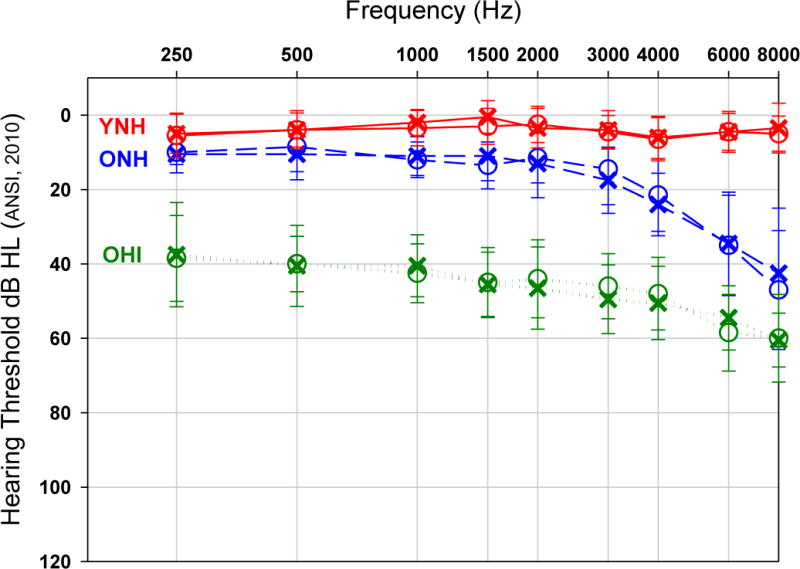
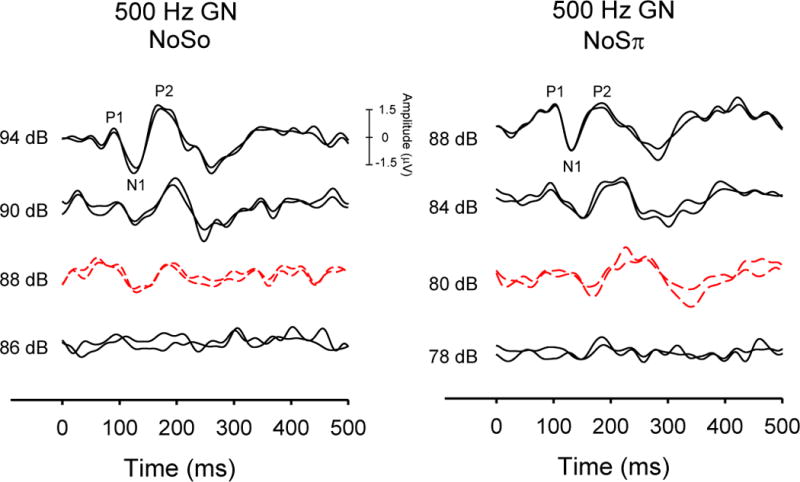
Thirty adults participated in the study, including 10 young normal-hearing, 10 older normal-hearing, and 10 older hearing-impaired adults with bilaterally symmetric, mild-to-moderate sensorineural hearing loss. Behavioral and CAEP thresholds were measured for diotic (So) and dichotic (Sπ) tonal signals presented in continuous diotic (No) narrowband noise (50-Hz wide) maskers. Temporal envelope cues were manipulated by using two different narrowband maskers; Gaussian noise (GN) with robust envelope fluctuations and low-noise noise (LNN) with minimal envelope fluctuations. The potential to use temporal fine-structure cues was controlled by varying the signal frequency (500 or 4000 Hz), thereby relying on the natural decline in phase-locking with increasing frequency.
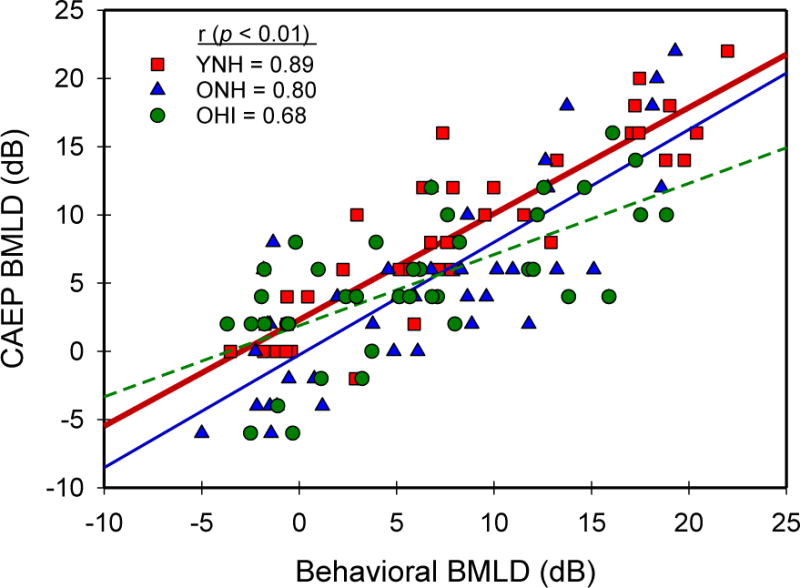
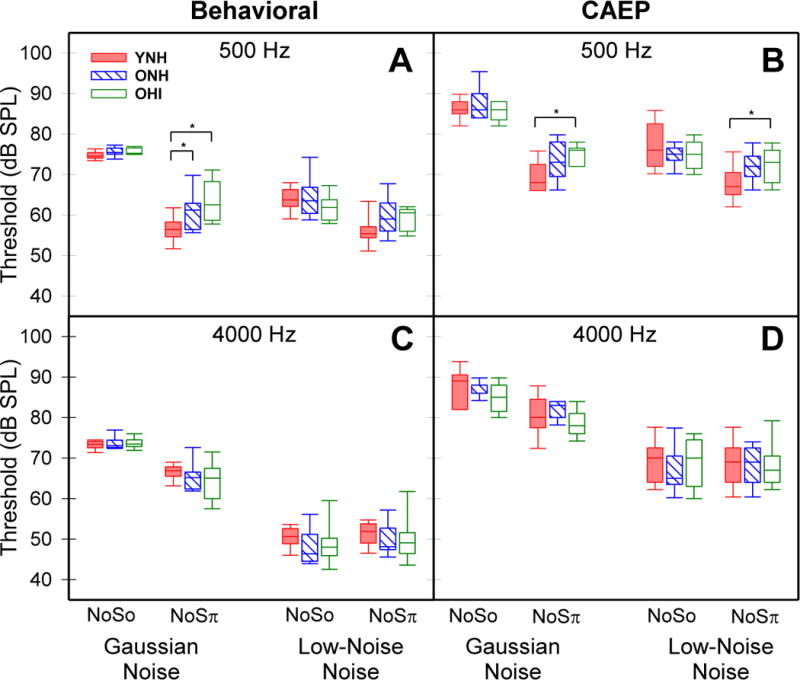
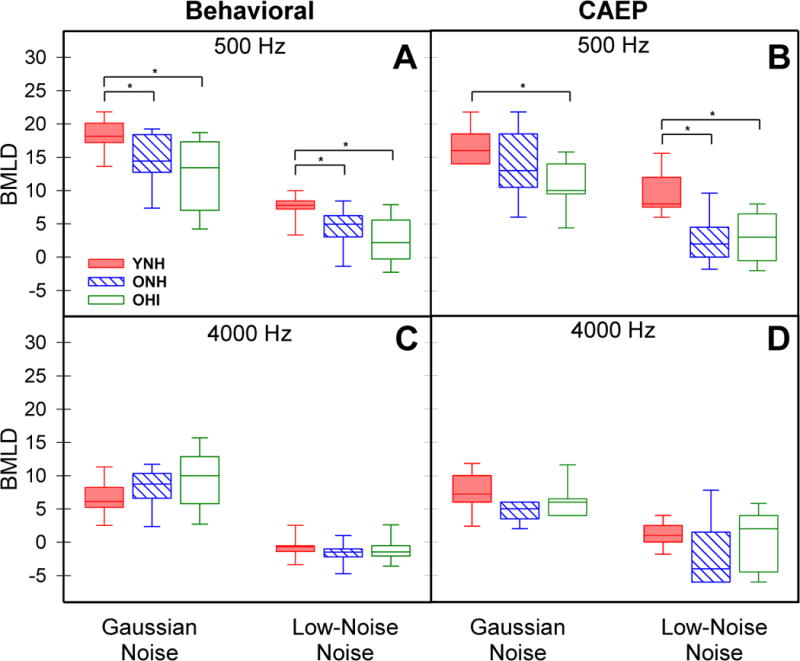
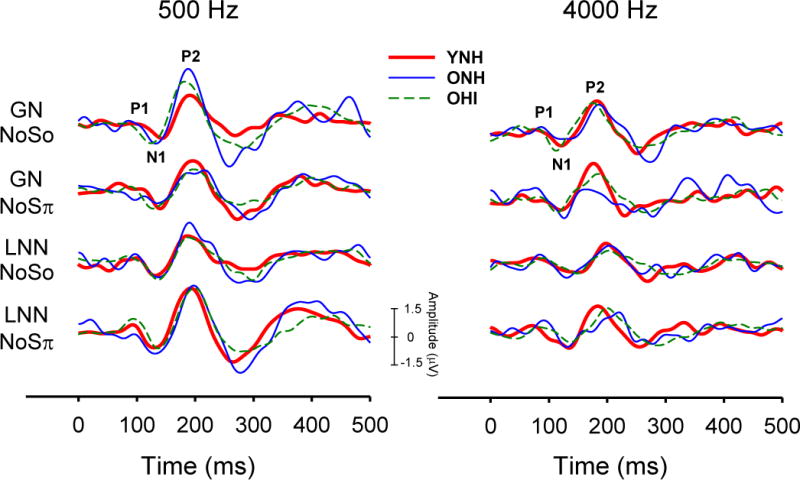
Behavioral and CAEP thresholds were similar across groups for diotic conditions, while the masking release in dichotic conditions was larger for younger than for older participants. Across all participants, BMLDs were larger for GN than LNN and for 500-Hz than for 4000-Hz conditions, where envelope and fine-structure cues were most salient, respectively. Specific age-related differences were demonstrated for 500-Hz dichotic conditions in GN and LNN, reflecting reduced binaural temporal fine-structure coding. No significant age effects were observed for 4000-Hz dichotic conditions, consistent with similar use of binaural temporal envelope cues across age in these conditions. For all groups, thresholds and derived BMLD values obtained using the behavioral and CAEP methods were strongly correlated, supporting the notion that CAEP measures may be useful as an objective index of age-related changes in binaural temporal processing.
These results demonstrate an age-related decline in the processing of binaural temporal fine-structure cues with preserved temporal envelope coding that was similar with and without mild-to-moderate peripheral hearing loss. Such age-related changes can be reliably indexed by both behavioral and CAEP measures in young and older adults.
本研究旨在使用双耳掩蔽级差(BMLD)范式评估年轻和老年成年人的双耳时间处理能力。通过同一听众内的行为和电生理测量,使用一系列刺激操作来评估双耳时间精细结构和时间包络线索的相对贡献。我们评估了以下假设:与包络线索相比,与 BMLD 任务相关的年龄相关下降将与时间精细结构更为密切相关,并且与行为测量相关的年龄相关下降将与皮质听觉诱发电位(CAEP)测量相关。
30 名成年人参与了这项研究,包括 10 名年轻的正常听力者、10 名老年正常听力者和 10 名年龄较大的听力受损者,他们具有双侧对称、轻度至中度感音神经性听力损失。使用两种不同的窄带掩蔽器(具有稳健包络波动的高斯噪声(GN)和具有最小包络波动的低噪声噪声(LNN))对双耳时间包络线索进行了操纵。通过改变信号频率(500 或 4000 Hz)来控制使用时间精细结构线索的能力,从而依赖于随着频率增加相位锁定的自然下降。
对于二音条件,行为和 CAEP 阈值在各组之间相似,而对于年轻参与者,二音条件下的掩蔽释放大于老年参与者。在所有参与者中,GN 比 LNN 和 500 Hz 比 4000 Hz 条件下的 BMLD 更大,分别是包络和精细结构线索最明显的条件。在 GN 和 LNN 的 500 Hz 二音条件下,对于年龄相关的差异进行了特定的测试,反映了双耳时间精细结构编码的减少。在 4000 Hz 二音条件下,未观察到显著的年龄效应,这与这些条件下年龄相似的双耳时间包络线索的使用一致。对于所有组,使用行为和 CAEP 方法获得的阈值和衍生的 BMLD 值具有很强的相关性,这支持了 CAEP 测量可能是评估双耳时间处理中与年龄相关变化的有用指标的观点。
这些结果表明,与双耳时间精细结构线索相关的处理能力随着时间的推移而下降,而时间包络编码则保持不变,无论是否存在轻度至中度的外围听力损失,这种年龄相关的变化都可以通过年轻和老年成年人的行为和 CAEP 测量来可靠地标记。