Goupell Matthew J
Department of Hearing and Speech Sciences, University of Maryland, College Park, MD, United States.
Neuroscience and Cognitive Science Program, University of Maryland, College Park, MD, United States.
Front Aging Neurosci. 2022 Jul 27;14:887401. doi: 10.3389/fnagi.2022.887401. eCollection 2022.
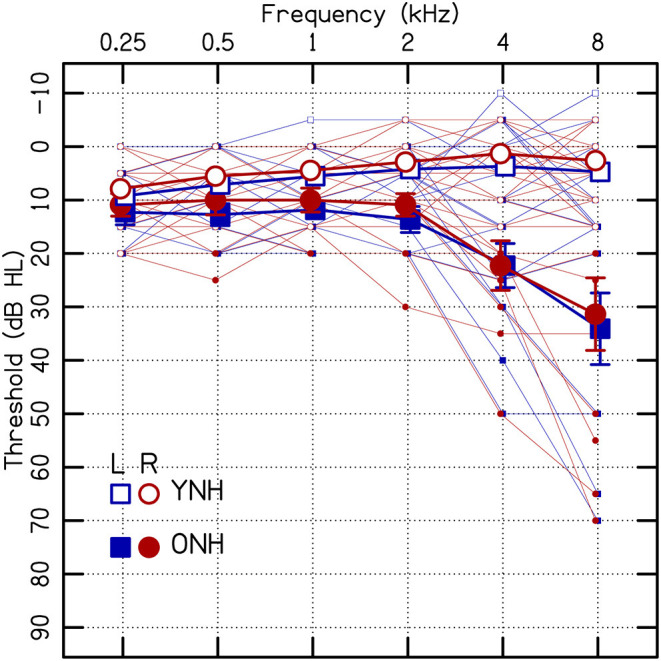
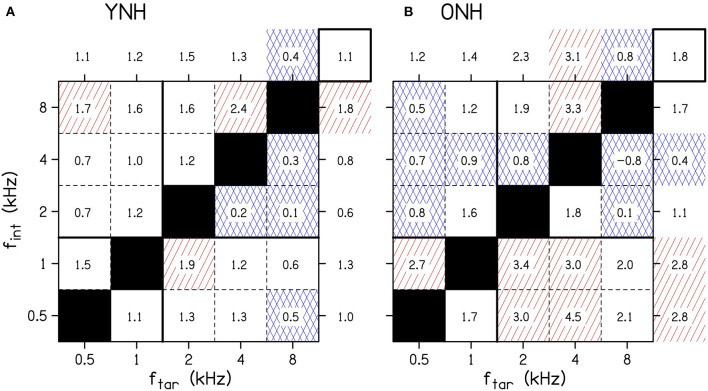
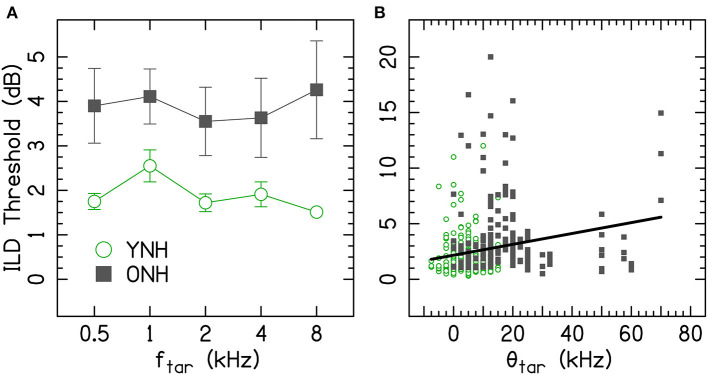
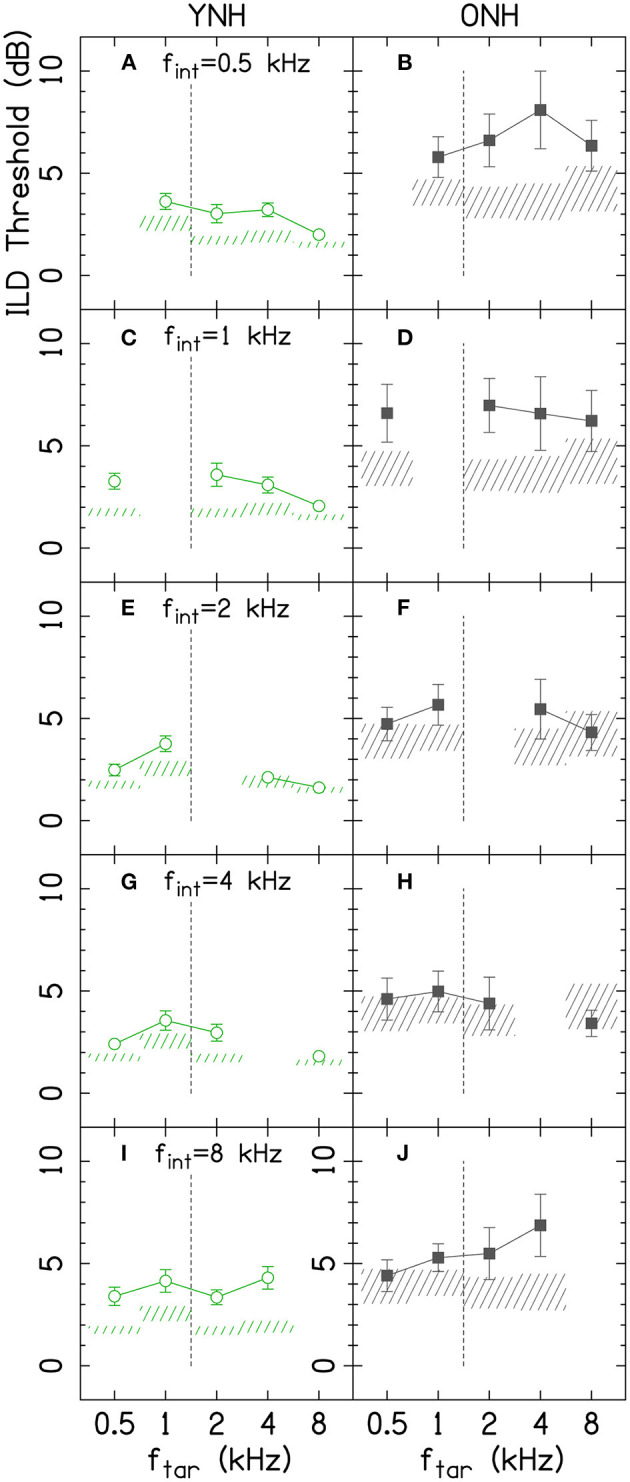
Low-frequency interaural time differences and high-frequency interaural level differences (ILDs) are used to localize sounds in the horizontal plane. Older listeners appear to be worse at horizontal-plane sound localization to compared younger listeners, but little is understood about age-related changes to across-frequency binaural processing. This study investigated if the frequency dependence of across-frequency ILD processing is altered for older compared to younger listeners, which was done by using an across-frequency binaural interference task (when the interaural difference sensitivity for a target sound is decreased by a spectrally remote interfering sound with zero interaural differences). It was hypothesized that as listeners experience advancing age and age-related high-frequency hearing loss (i.e., presbycusis), they will demonstrate worse binaural performance and experience more across-channel binaural interference (because of age-related temporal processing deficits), and will increasingly be affected by interferers at lower frequencies (because of age-related hearing loss) when compared to younger listeners. There were 11 older (>65 yrs) and 20 younger (<30 yrs) listeners with normal to near-normal audiometric thresholds up to 2 kHz. They were tested using a left-right ILD lateralization discrimination task. Single-tone ILD discrimination thresholds and across-frequency binaural interference were measured at 0.5, 1, 2, 4, and 8 kHz. ILD thresholds and interference were about twice as large for older compared to younger listeners. Interferers ≤1 kHz produced 2-3 times as much across-frequency binaural interference for older compared to younger listeners. Hearing thresholds were significant predictors of single-tone ILD thresholds; in addition, both target and interferer hearing thresholds were significant predictors of binaural interference. The results suggest a reweighting of binaural information that occurs with advancing age and age-related high-frequency hearing loss. This evidence of plasticity may help explain some of the age-related changes in spatial-hearing abilities.
低频双耳时间差和高频双耳声级差(ILDs)用于在水平面中定位声音。与年轻听众相比,年长听众在水平面声音定位方面似乎表现更差,但对于跨频率双耳处理中与年龄相关的变化却知之甚少。本研究调查了与年轻听众相比,年长听众跨频率ILD处理的频率依赖性是否发生改变,这是通过使用跨频率双耳干扰任务来完成的(当目标声音的双耳差异敏感度被具有零双耳差异的频谱上较远的干扰声音降低时)。研究假设,随着听众年龄增长以及出现与年龄相关的高频听力损失(即老年性耳聋),与年轻听众相比,他们将表现出更差的双耳性能并经历更多的跨通道双耳干扰(由于与年龄相关的时间处理缺陷),并且会越来越受到低频干扰源的影响(由于与年龄相关的听力损失)。共有11名年长(>65岁)和20名年轻(<30岁)听众,其听力阈值在2kHz以下正常或接近正常。他们使用左右ILD侧向化辨别任务进行测试。在0.5、1、2、4和8kHz测量单音ILD辨别阈值和跨频率双耳干扰。与年轻听众相比,年长听众的ILD阈值和干扰大约是其两倍。与年轻听众相比,频率≤1kHz的干扰源对年长听众产生的跨频率双耳干扰要多2至3倍。听力阈值是单音ILD阈值的重要预测指标;此外,目标和干扰源的听力阈值都是双耳干扰的重要预测指标。结果表明,随着年龄增长和与年龄相关的高频听力损失,双耳信息会重新加权。这种可塑性证据可能有助于解释空间听力能力中一些与年龄相关的变化。