Liu Xu, Qu Jing-Kun, Zhang Jia, Yan Yan, Zhao Xi-Xi, Wang Ji-Zhao, Qu Hang-Ying, Liu Lin, Wang Jian-Sheng, Duan Xiao-Yi
The Second Department of Thoracic Surgery, the First Affiliated Hospital of Xi'an Jiaotong University Department of Oncology, the Second Affiliated Hospital of Xi'an Jiaotong University The Department of Oncological Surgery, Shaanxi University of Chinese Medicine The Department of Radiology, the First Affiliated Hospital of Xi'an Jiaotong University, Xi'an, Shaanxi, P.R. China.
Medicine (Baltimore). 2017 Nov;96(45):e8101. doi: 10.1097/MD.0000000000008101.
Inflammation and cancer are closely related to each other. As a parameter that can reflect inflammation and host immune reaction, elevated blood neutrophil to lymphocyte ratio (NLR) has been confirmed to be correlated with poor prognosis in a variety of cancers. However, this remains controversial in breast cancer. Thus, we performed this updated meta-analysis to further clarify whether high NLR could be a predictor of survival in breast cancer patients.
We searched on PubMed Database and Cochrane Library. Overall survival (OS), disease-free survival (DFS), and cancer-specific survival were used as outcome events, and hazard ratio (HR) was chosen as the parameter to evaluate the correlation.
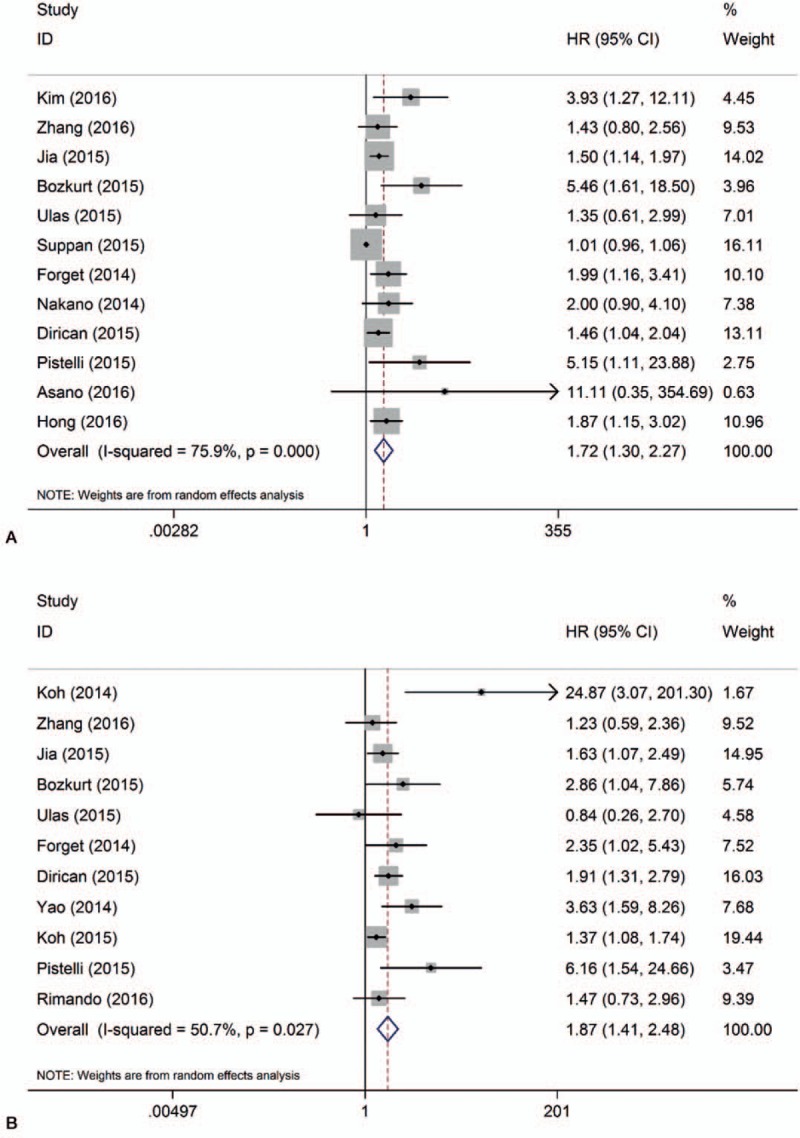
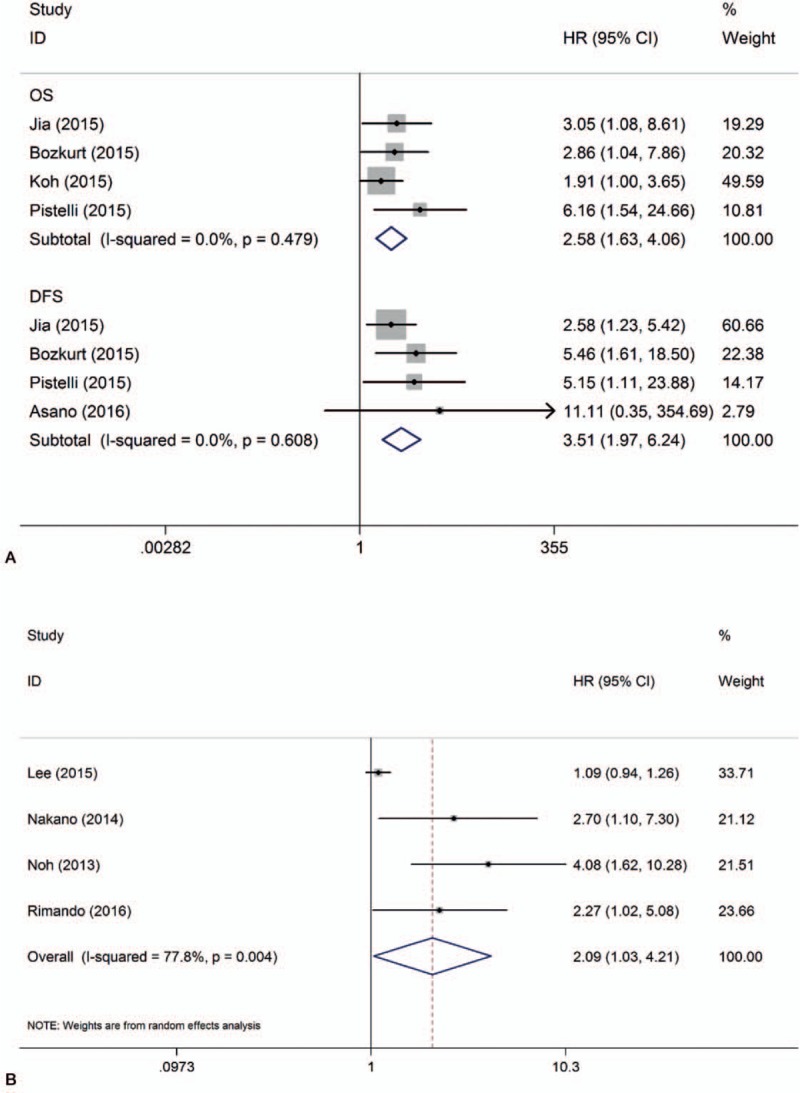
Eighteen eligible studies were involved in this meta-analysis. The synthesized analysis demonstrated that elevated NLR was associated with poor DFS [HR = 1.72, 95% confidence interval (95% CI) = 1.30-2.27], OS (HR = 1.87, 95% CI = 1.41-2.48), and cancer-specific survival (HR = 2.09, 95% CI = 1.04-4.21). The correlation was stronger in triple-negative breast cancer (TNBC) (OS: HR = 2.58, 95% CI = 1.63-4.06; DFS: HR = 3.51, 95% CI = 1.97-6.24).
Higher NLR was correlated to poor prognosis of breast cancer patients. As a clinical parameter that we can easily obtain, NLR might be a potential predictor in patients' survival to assist with physicians' treatment decisions.
炎症与癌症密切相关。作为能够反映炎症和宿主免疫反应的一个参数,血液中中性粒细胞与淋巴细胞比值(NLR)升高已被证实与多种癌症的不良预后相关。然而,在乳腺癌中这一观点仍存在争议。因此,我们进行了这项更新的荟萃分析,以进一步阐明高NLR是否可作为乳腺癌患者生存的预测指标。
我们检索了PubMed数据库和Cochrane图书馆。总生存期(OS)、无病生存期(DFS)和癌症特异性生存期被用作结局事件,并选择风险比(HR)作为评估相关性的参数。
18项符合条件的研究纳入了该荟萃分析。综合分析表明,NLR升高与DFS不良相关[HR = 1.72,95%置信区间(95%CI)= 1.30 - 2.27]、OS不良相关(HR = 1.87,95%CI = 1.41 - 2.48)以及癌症特异性生存期不良相关(HR = 2.09,95%CI = 1.04 - 4.21)。在三阴性乳腺癌(TNBC)中这种相关性更强(OS:HR = 2.58,95%CI = 1.63 - 4.06;DFS:HR = 3.51,95%CI = 1.97 - 6.24)。
较高的NLR与乳腺癌患者的不良预后相关。作为一个易于获取的临床参数,NLR可能是预测患者生存情况的一个潜在指标,有助于医生做出治疗决策。