Chen Yujuan, Liu Ya, Wang Yu, Li Wen, Wang Xiaolu, Liu Xuejuan, Chen Yao, Ouyang Chibin, Wang Jing
Department of Breast Surgery, Western China Hospital of Sichuan University Laboratory of Molecular Diagnosis of Cancer, State Key Laboratory of Biotherapy, National Collaborative Innovation Center for Biotherapy, West China Hospital, Sichuan University, Chengdu, China.
Medicine (Baltimore). 2017 Nov;96(45):e8488. doi: 10.1097/MD.0000000000008488.
Axillary lymph node metastasis is associated with increased risk of regional recurrence, distant metastasis, and poor survival in breast malignant neoplasm. Expression of signal transducer and activator of transcription 3 (STAT3) is significantly associated with tumor formation, migration, and invasion in various cancers. In addition, vascular endothelial growth factor (VEGF) expression could promote angiogenesis and increase the risk of tumorigenesis. To determine correlations among STAT3 expression, VEGF, and clinicopathological data on lymph node involvement in breast cancer patients after surgery.
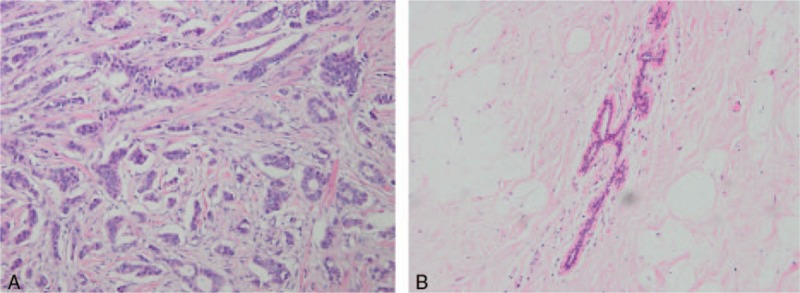
The mRNA expression levels of STAT3 and VEGFs were measured in 45 breast invasive ductal carcinoma tissues, 45 peritumoral tissues, and 45 adjacent nontumor tissues by real-time quantitative reverse transcription-polymerase chain reaction (RT-qPCR). Postoperative pathological examination revealed explicit axillary lymph node involvement in all patients.
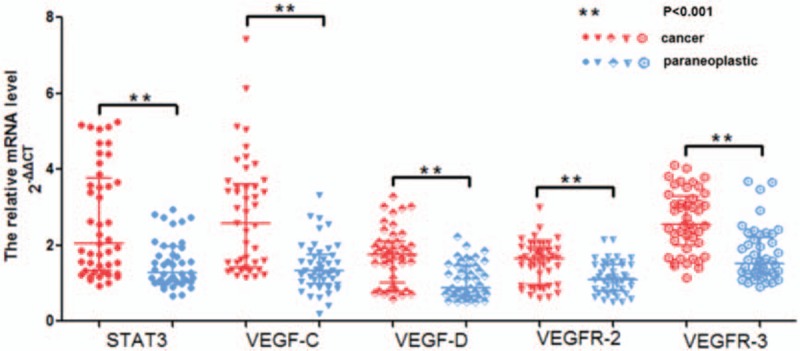
Average mRNA levels of STAT3 and VEGFs were the highest in breast invasive ductal carcinoma tissues, followed by peritumoral tissues. High expression of STAT3 showed significant positive correlation with high axillary lymph node involvement and progesterone receptor (PR), VEGF-C, VEGF-D, and vascular endothelial growth factor receptor (VEGFR)-3 expression. The expression levels of STAT3, VEGF-C, and VEGFR-3 were significantly higher in the tumor tissues of patients with axillary lymph node metastasis than in those of patients without the metastasis. Expression levels of VEGF-C and VEGFR-3 were also significantly higher in peritumoral tissues of patients with axillary lymph node metastasis. Positive correlations were found between STAT3 and VEGF-C/-D mRNA levels.
These data suggest that STAT3/VEGF-C/VEGFR-3 signaling pathway plays an important role in carcinogenesis and lymph-angiogenesis. Our findings suggest that STAT3 may be a potential molecular biomarker for predicting the involvement of axillary lymph nodes in breast cancer, and therapies targeting STAT3 may be important for preventing breast cancer metastasis.
腋窝淋巴结转移与乳腺恶性肿瘤区域复发、远处转移风险增加及生存率降低相关。信号转导和转录激活因子3(STAT3)的表达与多种癌症的肿瘤形成、迁移及侵袭显著相关。此外,血管内皮生长因子(VEGF)表达可促进血管生成并增加肿瘤发生风险。旨在确定STAT3表达、VEGF与乳腺癌患者术后腋窝淋巴结受累的临床病理数据之间的相关性。
采用实时定量逆转录-聚合酶链反应(RT-qPCR)检测45例乳腺浸润性导管癌组织、45例瘤周组织及45例相邻非肿瘤组织中STAT3和VEGFs的mRNA表达水平。术后病理检查显示所有患者均有明确的腋窝淋巴结受累。
乳腺浸润性导管癌组织中STAT3和VEGFs的平均mRNA水平最高,其次是瘤周组织。STAT3高表达与腋窝淋巴结高受累及孕激素受体(PR)、VEGF-C、VEGF-D和血管内皮生长因子受体(VEGFR)-3表达呈显著正相关。腋窝淋巴结转移患者肿瘤组织中STAT3、VEGF-C和VEGFR-3的表达水平显著高于无转移患者。腋窝淋巴结转移患者瘤周组织中VEGF-C和VEGFR-3的表达水平也显著更高。STAT3与VEGF-C/-D mRNA水平之间呈正相关。
这些数据表明STAT3/VEGF-C/VEGFR-3信号通路在致癌作用和淋巴管生成中起重要作用。我们的研究结果表明,STAT3可能是预测乳腺癌腋窝淋巴结受累的潜在分子生物标志物,针对STAT3的治疗可能对预防乳腺癌转移很重要。