Yang Xin-Hua, Song Su-Qi, Xu Yun
Department of Pharmacy, Hefei Eighth People's Hospital, Hefei.
Department of Psychiatry, Chaohu Hospital of Anhui Medical University, Hefei.
Neuropsychiatr Dis Treat. 2017 Oct 27;13:2727-2736. doi: 10.2147/NDT.S150028. eCollection 2017.
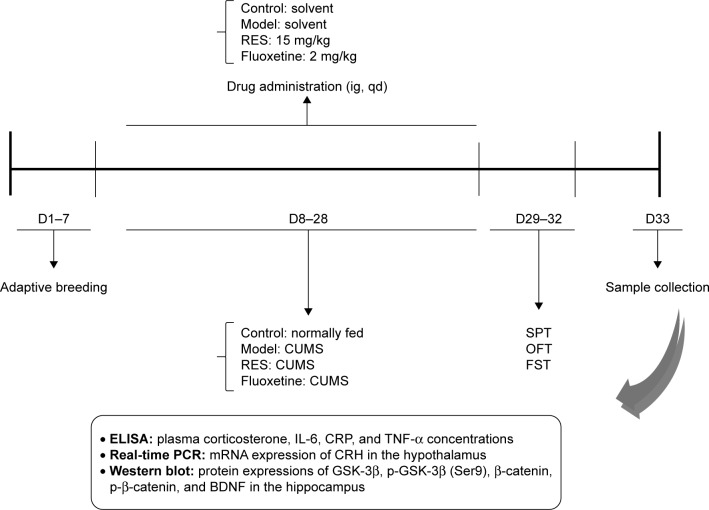
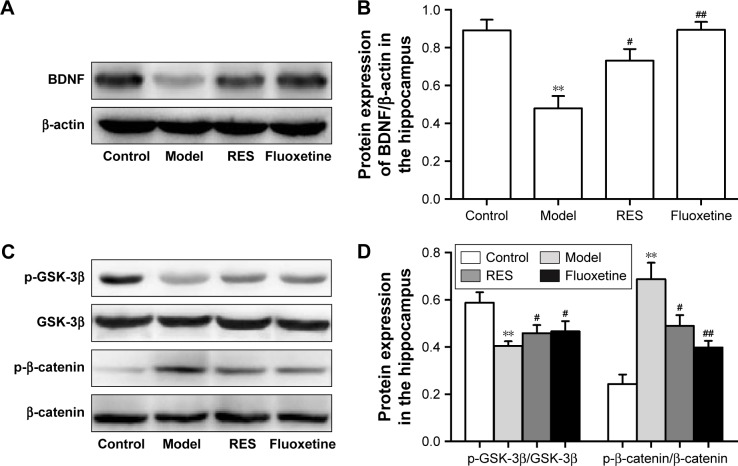
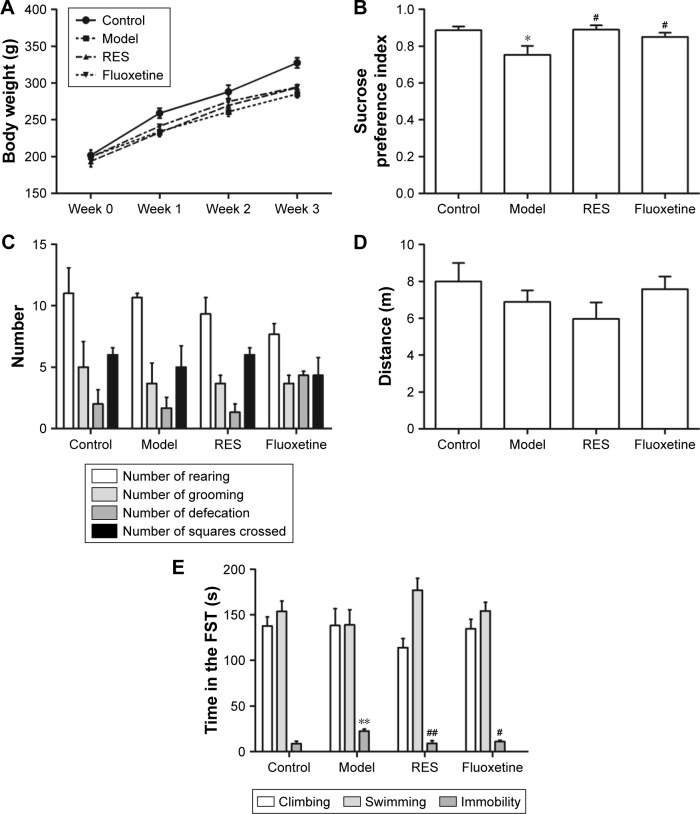
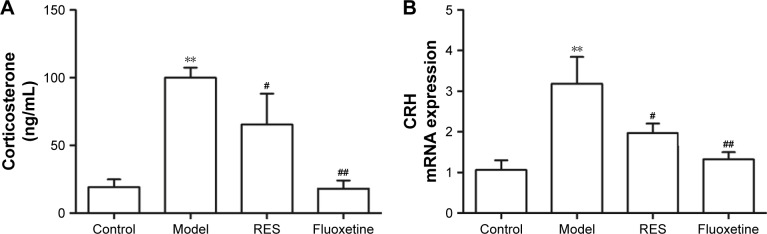
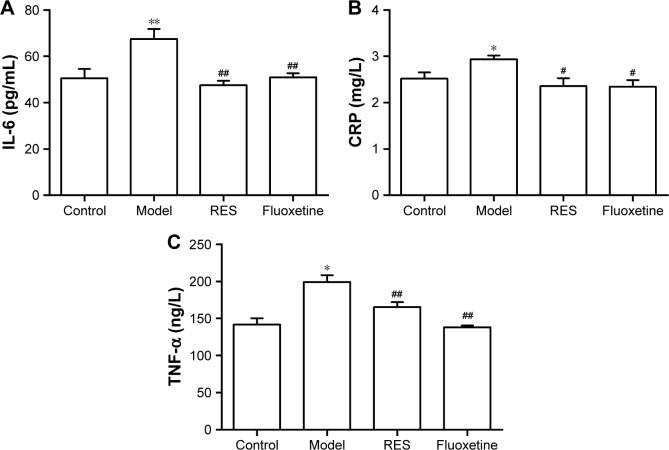
Classic antidepressant drugs are modestly effective across the population and most are associated with intolerable side effects. Recently, numerous lines of evidence suggest that resveratrol (RES), a natural polyphenol, possesses beneficial therapeutic activity for depression. The aim of the present study was to explore whether RES exhibits an antidepressant-like effect in a depression model and to explore the possible mechanism. A depression model was established via chronic unpredictable mild stress (CUMS), after which the model rats in the RES and fluoxetine groups received a daily injection of RES or fluoxetine, respectively. The sucrose preference test, open field test, and forced swimming test were used to explore the antidepressant-like effects of RES. The activity of the hypothalamic-pituitary-adrenal (HPA) axis was evaluated by detecting the plasma corticosterone concentration and hypothalamic mRNA expression of corticotrophin-releasing hormone. The plasma interleukin-6 (IL-6), C-reactive protein (CRP), and tumor necrosis factor-α (TNF-α) concentrations were measured by enzyme-linked immunosorbent assay. Hippocampal protein expression of brain-derived neurotrophic factor (BDNF) and the Wnt/β-catenin pathway were analyzed by western blot. The results showed that RES relieved depression-like behavior of CUMS rats, as indicated by the increased sucrose preference and the decreased immobile time. Rats that received RES treatment exhibited reduced plasma corticosterone levels and corticotrophin-releasing hormone mRNA expression in the hypothalamus, suggesting that the hyperactivity of the HPA axis in CUMS rats was reversed by RES. Moreover, after RES treatment, the rats exhibited increased plasma IL-6, CRP, and TNF-α concentrations. Furthermore, RES treatment upregulated the hippocampal protein levels of BDNF and the relative ratio of p-β-catenin/β-catenin while downregulating the relative ratio of p-GSK-3β/GSK-3β. Our findings suggest that RES improved depressive behavior in CUMS rats by downregulating HPA axis hyperactivity, increasing BDNF expression and plasma IL-6, CRP, and TNF-α concentrations, and regulating the hippocampal Wnt/β-catenin pathway.
经典抗抑郁药物在整个人口中的疗效一般,且大多数都伴有难以忍受的副作用。最近,大量证据表明,天然多酚白藜芦醇(RES)对抑郁症具有有益的治疗活性。本研究的目的是探讨RES在抑郁症模型中是否表现出抗抑郁样作用,并探究其可能的机制。通过慢性不可预测温和应激(CUMS)建立抑郁症模型,之后RES组和氟西汀组的模型大鼠分别每日注射RES或氟西汀。采用蔗糖偏好试验、旷场试验和强迫游泳试验来探究RES的抗抑郁样作用。通过检测血浆皮质酮浓度和促肾上腺皮质激素释放激素的下丘脑mRNA表达来评估下丘脑-垂体-肾上腺(HPA)轴的活性。采用酶联免疫吸附测定法测量血浆白细胞介素-6(IL-6)、C反应蛋白(CRP)和肿瘤坏死因子-α(TNF-α)的浓度。通过蛋白质免疫印迹法分析脑源性神经营养因子(BDNF)的海马蛋白表达以及Wnt/β-连环蛋白信号通路。结果显示,RES减轻了CUMS大鼠的抑郁样行为,表现为蔗糖偏好增加和不动时间减少。接受RES治疗的大鼠血浆皮质酮水平降低,下丘脑促肾上腺皮质激素释放激素mRNA表达减少,这表明RES逆转了CUMS大鼠HPA轴的功能亢进。此外,RES治疗后,大鼠血浆IL-6、CRP和TNF-α浓度升高。此外,RES治疗上调了海马中BDNF的蛋白水平以及p-β-连环蛋白/β-连环蛋白的相对比例,同时下调了p-GSK-3β/GSK-3β的相对比例。我们的研究结果表明,RES通过下调HPA轴功能亢进、增加BDNF表达以及血浆IL-6、CRP和TNF-α浓度,并调节海马Wnt/β-连环蛋白信号通路,改善了CUMS大鼠的抑郁行为。