Department of Cardiology, Shaanxi Provincial People's Hospital, Xi'an, Shaanxi 710068, P.R. China.
Department of Ultrasonography, Xianyang Central Hospital, Xianyang, Shaanxi 712000, P.R. China.
Mol Med Rep. 2018 Jan;17(1):1775-1781. doi: 10.3892/mmr.2017.8054. Epub 2017 Nov 14.
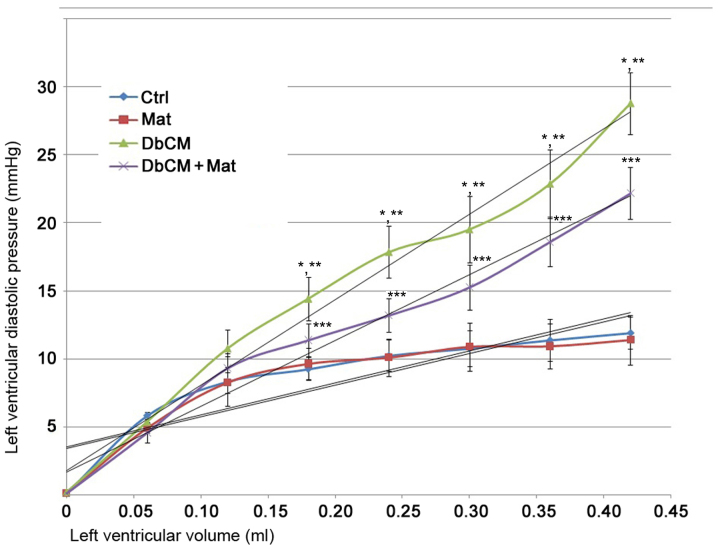
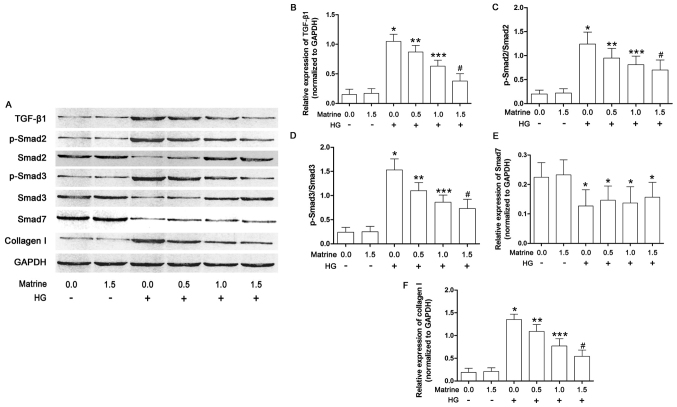
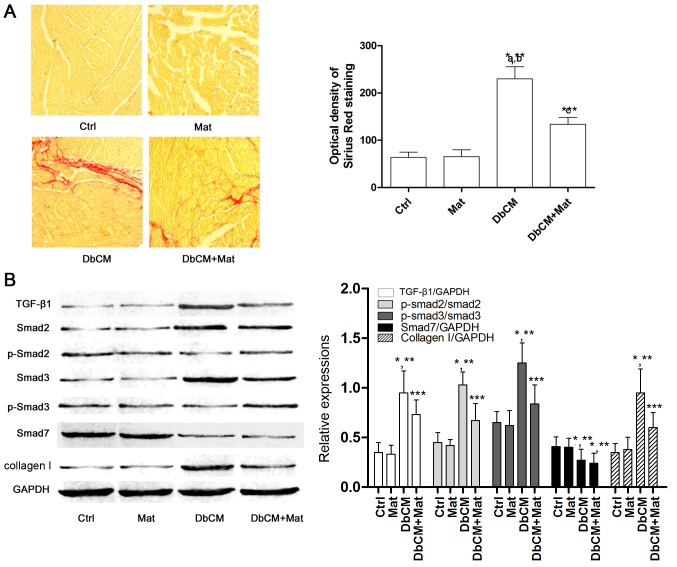
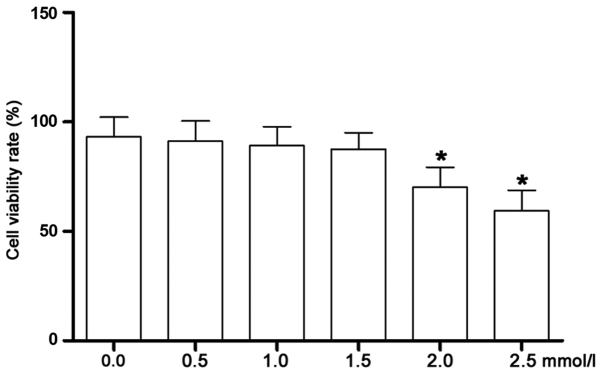
Cardiac fibrosis is one of the pathological characteristics of diabetic cardiomyopathy (DbCM). Matrine treatment has proven to be effective in cases of organ fibrosis and cardiovascular diseases. In the present study, the anti-fibrosis-associated cardioprotective effects of matrine on DbCM were investigated. Rats with experimental DbCM were administered matrine orally. Cardiac functions were evaluated using invasive hemodynamic examinations. Cardiac compliance was assessed in isolated hearts. Using Sirius Red and fluorescence staining, the collagen in diabetic hearts was visualized. MTT assay was used to select non‑cytotoxic concentrations of matrine, which were subsequently used to treat isolated cardiac fibroblasts incubated under various conditions. Western blotting was performed to assess activation of the transforming growth factor‑β1 (TGF‑β1)/Smad signaling pathway. Rats with DbCM exhibited impaired heart compliance and left ventricular (LV) functions. Excessive collagen deposition in cardiac tissue was also observed. Furthermore, TGF‑β1/R‑Smad (Smad2/3) signaling was revealed to be markedly activated; however, the expression of inhibitory Smad (I‑Smad, also termed Smad7) was reduced in DbCM. Matrine administration led to a marked recovery in LV function and heart compliance by exerting inhibitory effects on TGF‑β1/R‑Smad signaling pathway‑induced fibrosis without affecting I‑Smad. Incubation with a high concentration of glucose triggered the TGF‑β1/R‑Smad (Smad2/3) signaling pathway and suppressed I‑Smad signaling transduction in cultured cardiac fibroblasts, which led to an increase in the synthesis of collagen. After cardiac fibroblasts had been treated with matrine at non‑cytotoxic concentrations without affecting I‑Smad, matrine blocked TGF‑β1/R‑Smad signaling transduction to repress collagen production and deposition. In conclusion, the results of the present study demonstrated that TGF‑β1/Smad signaling‑associated cardiac fibrosis is involved in the impairment of heart compliance and LV dysfunction in DbCM. By exerting therapeutic effects against cardiac fibrosis via its influence on TGF‑β1/Smad signaling, matrine exhibited cardioprotective effects in DbCM.
心肌纤维化是糖尿病心肌病(DbCM)的病理特征之一。苦参碱在器官纤维化和心血管疾病方面的治疗已被证明是有效的。本研究旨在探讨苦参碱对 DbCM 的抗纤维化相关心脏保护作用。通过灌胃给予实验性 DbCM 大鼠苦参碱。通过侵入性血液动力学检查评估心脏功能。在分离的心脏中评估心脏顺应性。使用天狼星红和荧光染色显示糖尿病心脏中的胶原。MTT 测定法用于选择苦参碱的非细胞毒性浓度,随后用于在各种条件下孵育的分离的心脏成纤维细胞。通过 Western blot 检测转化生长因子-β1(TGF-β1)/Smad 信号通路的激活情况。DbCM 大鼠表现出心脏顺应性和左心室(LV)功能受损。还观察到心脏组织中胶原过度沉积。此外,TGF-β1/R-Smad(Smad2/3)信号明显激活;然而,DbCM 中抑制性 Smad(I-Smad,也称为 Smad7)的表达减少。苦参碱给药通过抑制 TGF-β1/R-Smad 信号通路诱导的纤维化,对 LV 功能和心脏顺应性有明显恢复作用,而不影响 I-Smad。高浓度葡萄糖孵育触发 TGF-β1/R-Smad(Smad2/3)信号,并抑制培养的心脏成纤维细胞中的 I-Smad 信号转导,导致胶原合成增加。苦参碱在不影响 I-Smad 的情况下以非细胞毒性浓度处理心脏成纤维细胞后,阻断 TGF-β1/R-Smad 信号转导,抑制胶原产生和沉积。总之,本研究结果表明,TGF-β1/Smad 信号相关的心肌纤维化参与了 DbCM 中心脏顺应性和 LV 功能障碍的发生。苦参碱通过对 TGF-β1/Smad 信号的影响发挥对心脏纤维化的治疗作用,对 DbCM 具有心脏保护作用。