UMR1313, Génétique Animale et Biologie Intégrative, INRA, AgroParisTech, Université Paris-Saclay, 78350, Jouy-en-Josas, France.
Département R&D, ALLICE, 149 rue de Bercy, 75595, Paris Cedex 12, France.
Genet Sel Evol. 2017 Nov 15;49(1):85. doi: 10.1186/s12711-017-0359-5.
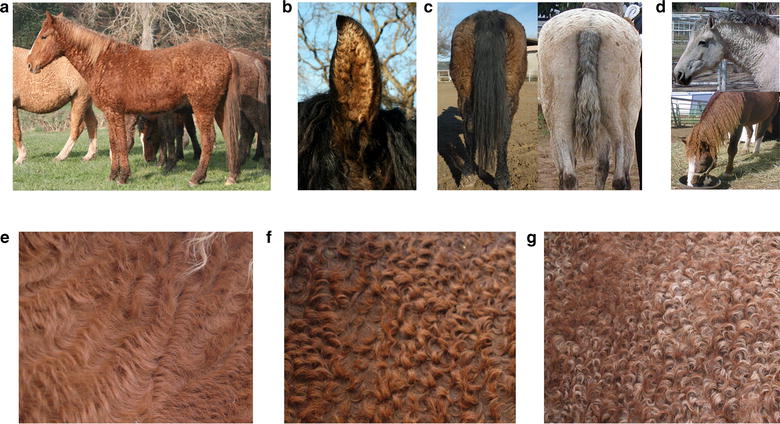
Curly horses present a variety of curl phenotypes that are associated with various degrees of curliness of coat, mane, tail and ear hairs. Their origin is still a matter of debate and several genetic hypotheses have been formulated to explain the diversity in phenotype, including the combination of autosomal dominant and recessive alleles. Our purpose was to map the autosomal dominant curly hair locus and identify the causal variant using genome-wide association study (GWAS) and whole-genome sequencing approaches.
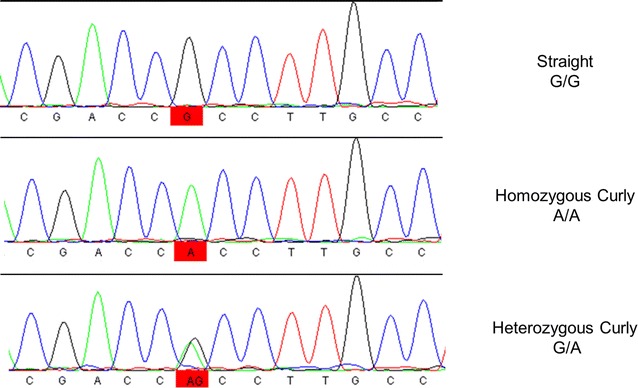
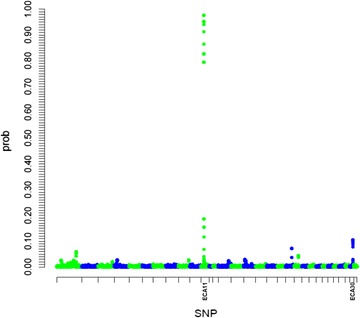
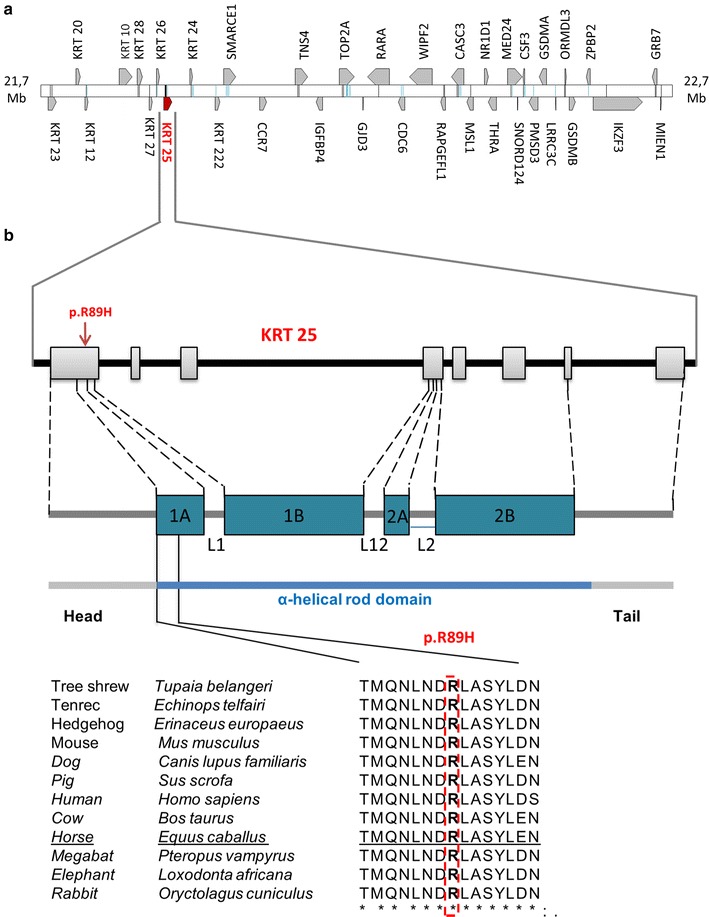
A GWAS was performed using a Bayesian sparse linear mixed model, based on 51 curly and 19 straight-haired French and North American horses from 13 paternal families genotyped on the Illumina EquineSNP50 BeadChip. A single strong signal was observed on equine chromosome 11, in a region that encompasses the type I keratin gene cluster. This region was refined by haplotype analysis to a segment including 36 genes, among which are 10 keratin genes (KRT-10, -12, -20, -23, -24, -25, -26, -27, -28, -222). To comprehensively identify candidate causal variants within all these genes, whole-genome sequences were obtained for one heterozygous curly stallion and its straight-haired son. Among the four non-synonymous candidate variants identified and validated in the curly region, only variant g.21891160G>A in the KRT25 gene (KRT25:p.R89H) was in perfect agreement with haplotype status in the whole pedigree. Genetic association was then confirmed by genotyping a larger population consisting of 353 horses. However, five discordant curly horses were observed, which carried neither the variant nor the main haplotype associated with curliness. Sequencing of KRT25 for two discordant horses did not identify any other deleterious variant, which suggests locus rather than allelic heterogeneity for the curly phenotype.
We identified the KRT25:p.R89H variant as responsible for the dominant curly trait, but a second dominant locus may also be involved in the shape of hairs within North American Curly horses.
卷毛马呈现出多种卷曲表型,这些表型与被毛、鬃毛、尾巴和耳毛卷曲程度的不同有关。其起源仍然存在争议,已经提出了几种遗传假设来解释表型的多样性,包括常染色体显性和隐性等位基因的组合。我们的目的是通过全基因组关联研究(GWAS)和全基因组测序方法,定位常染色体显性卷曲毛基因座,并确定致病变异。
对来自 13 个父系家族的 51 头卷曲和 19 头直毛法国和北美马进行了基于 Illumina EquineSNP50 BeadChip 基因型的贝叶斯稀疏线性混合模型的 GWAS。在马 11 号染色体上观察到一个单一的强信号,该信号位于包含 I 型角蛋白基因簇的区域内。通过单倍型分析,该区域被细化为包括 36 个基因的片段,其中包括 10 个角蛋白基因(KRT-10、-12、-20、-23、-24、-25、-26、-27、-28、-222)。为了全面鉴定所有这些基因内的候选致病变异,对一个杂合卷曲种马及其直毛儿子进行了全基因组测序。在鉴定和验证的卷曲区域中的四个非同义候选变异中,只有 KRT25 基因中的 g.21891160G>A 变异(KRT25:p.R89H)与整个家系的单倍型状态完全一致。通过对包括 353 匹马的更大群体进行基因分型,进一步证实了遗传关联。然而,观察到了 5 头不一致的卷曲马,它们既不携带与卷曲相关的变异,也不携带主要单倍型。对两个不一致的马进行 KRT25 测序并未发现任何其他有害变异,这表明卷曲表型的原因是基因座而不是等位基因的异质性。
我们确定了 KRT25:p.R89H 变异是导致显性卷曲性状的原因,但也可能存在第二个显性基因座参与北美卷曲马的毛发形状。