Institute of Genome Biology, Leibniz-Institute for Farm Animal Biology, Dummerstorf, Germany.
Institute for Animal Breeding and Husbandry, Christian-Albrechts-University Kiel, Kiel, Germany.
PLoS One. 2019 Apr 25;14(4):e0215913. doi: 10.1371/journal.pone.0215913. eCollection 2019.
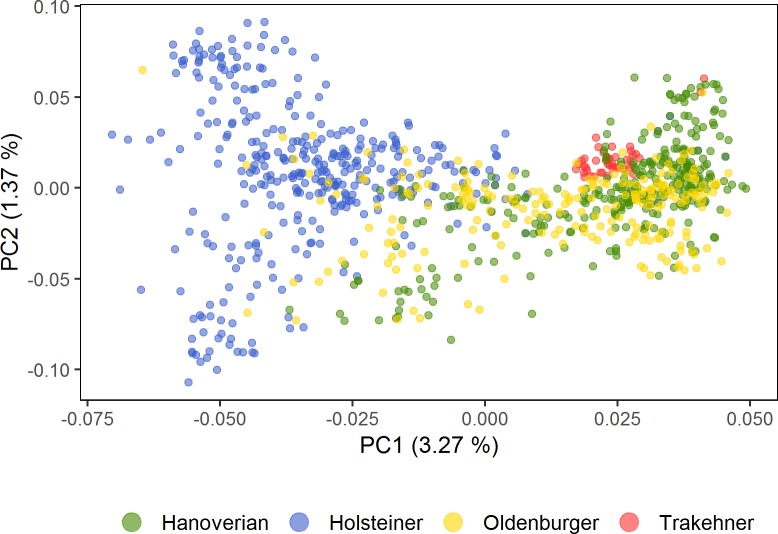
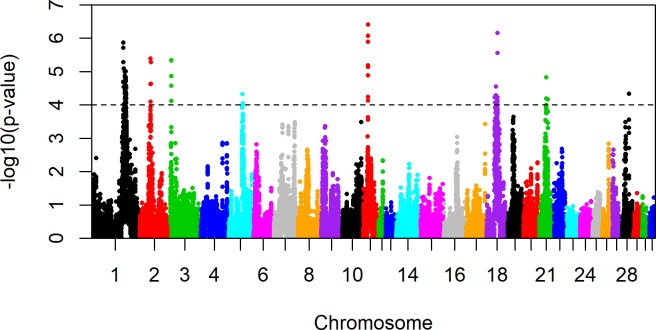
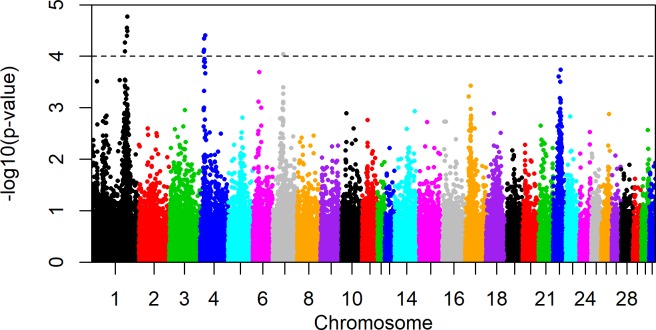
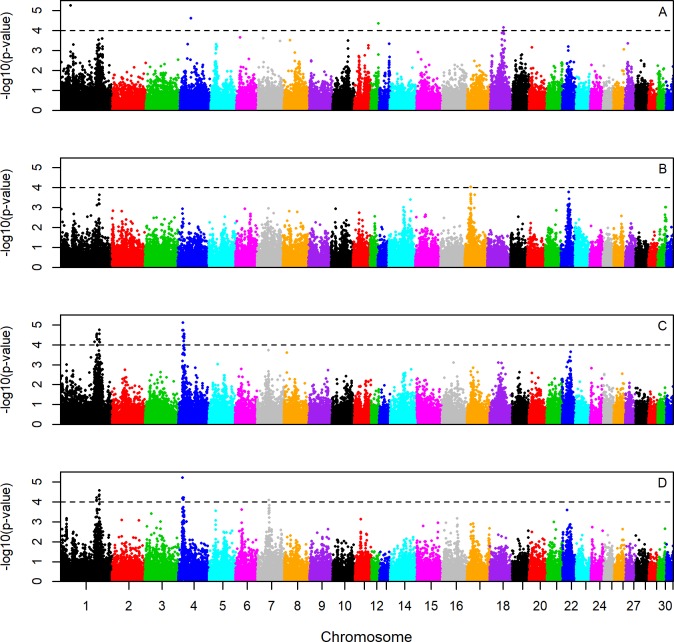
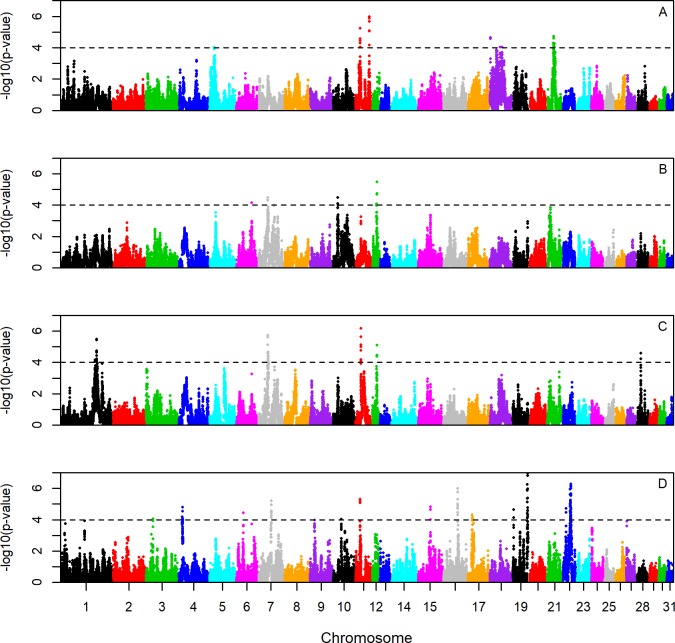
The study of selection signatures helps to find genomic regions that have been under selective pressure and might host genes or variants that modulate important phenotypes. Such knowledge improves our understanding of how breeding programmes have shaped the genomes of livestock. In this study, 942 stallions were included from four, exemplarily chosen, German warmblood breeds with divergent historical and recent selection focus and different crossbreeding policies: Trakehner (N = 44), Holsteiner (N = 358), Hanoverian (N = 319) and Oldenburger (N = 221). Those breeds are nowadays bred for athletic performance and aptitude for show-jumping, dressage or eventing, with a particular focus of Holsteiner on the first discipline. Blood samples were collected during the health exams of the stallion preselections before licensing and were genotyped with the Illumina EquineSNP50 BeadChip. Autosomal markers were used for a multi-method search for signals of positive selection. Analyses within and across breeds were conducted by using the integrated Haplotype Score (iHS), cross-population Extended Haplotype Homozygosity (xpEHH) and Runs of Homozygosity (ROH). Oldenburger and Hanoverian showed very similar iHS signatures, but breed specificities were detected on multiple chromosomes with the xpEHH. The Trakehner clustered as a distinct group in a principal component analysis and also showed the highest number of ROHs, which reflects their historical bottleneck. Beside breed specific differences, we found shared selection signals in an across breed iHS analysis on chromosomes 1, 4 and 7. After investigation of these iHS signals and shared ROH for potential functional candidate genes and affected pathways including enrichment analyses, we suggest that genes affecting muscle functionality (TPM1, TMOD2-3, MYO5A, MYO5C), energy metabolism and growth (AEBP1, RALGAPA2, IGFBP1, IGFBP3-4), embryonic development (HOXB-complex) and fertility (THEGL, ZPBP1-2, TEX14, ZP1, SUN3 and CFAP61) have been targeted by selection in all breeds. Our findings also indicate selection pressure on KITLG, which is well-documented for influencing pigmentation.
选择信号的研究有助于发现受到选择压力的基因组区域,这些区域可能包含调节重要表型的基因或变异。这种知识提高了我们对育种种群如何塑造家畜基因组的理解。在这项研究中,包括了来自四个具有不同历史和近期选择重点以及不同杂交政策的典型德国温血品种的 942 匹种马:特雷克纳(N = 44)、荷斯坦(N = 358)、汉诺威(N = 319)和奥尔登堡(N = 221)。这些品种现在主要用于竞技表现和跳跃、盛装舞步或三项赛,荷斯坦特别注重第一项运动。在获得许可证之前,在种马预选的健康检查期间采集了血液样本,并使用 Illumina EquineSNP50 BeadChip 对其进行了基因分型。常染色体标记用于通过综合单倍型评分(iHS)、跨群体扩展单倍型纯合度(xpEHH)和单倍型纯合区(ROH)进行多方法寻找正选择信号。在品种内和品种间进行了分析,使用了整合的单倍型评分(iHS)、跨群体扩展单倍型纯合度(xpEHH)和单倍型纯合区(ROH)。奥尔登堡和汉诺威的 iHS 特征非常相似,但在多个染色体上检测到了种特异性,xpEHH 也是如此。特雷克纳在主成分分析中聚类为一个独特的群体,并且还显示出最高数量的 ROH,这反映了它们的历史瓶颈。除了品种特异性差异之外,我们还在跨品种 iHS 分析中发现了 1、4 和 7 号染色体上的共同选择信号。在对这些 iHS 信号和潜在功能候选基因的共享 ROH 进行调查以及对受影响的途径进行富集分析之后,我们建议影响肌肉功能(TPM1、TMOD2-3、MYO5A、MYO5C)、能量代谢和生长(AEBP1、RALGAPA2、IGFBP1、IGFBP3-4)、胚胎发育(HOXB 复合物)和生育力(THEGL、ZPBP1-2、TEX14、ZP1、SUN3 和 CFAP61)的基因已成为所有品种选择的目标。我们的研究结果还表明,KITLG 受到了选择压力的影响,这一基因对色素沉着有很好的记录。