Cell Ageing, Institute of Medical Biology, 8A Biomedical Grove, #06-06, Immunos, 138648, Singapore.
Developmental and Regenerative Biology, 8A Biomedical Grove, #06-06, Immunos, 138648, Singapore.
Sci Rep. 2017 Nov 15;7(1):15678. doi: 10.1038/s41598-017-15901-9.
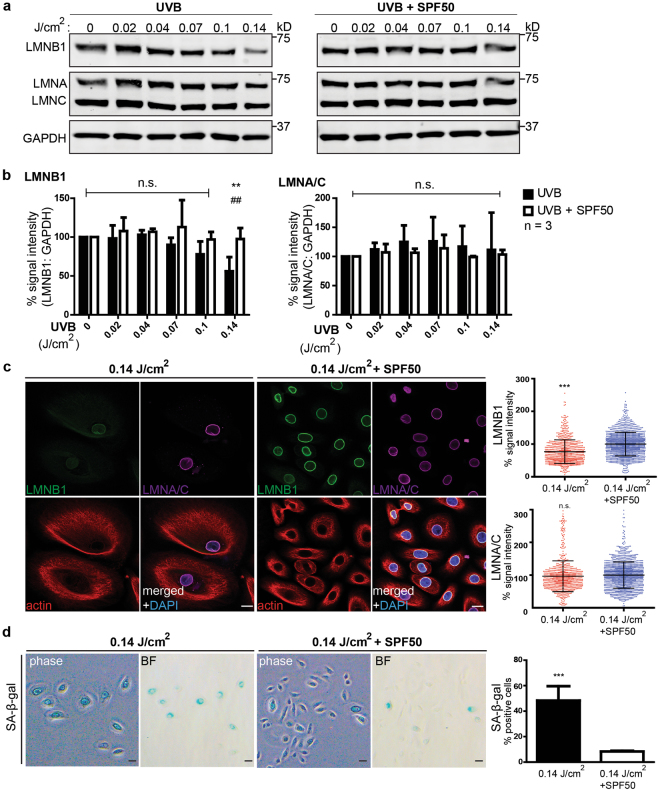
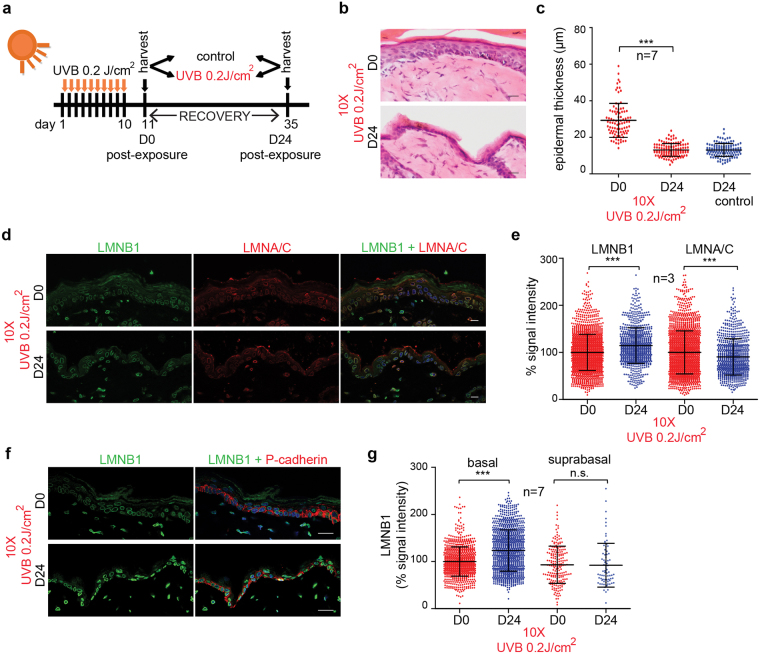
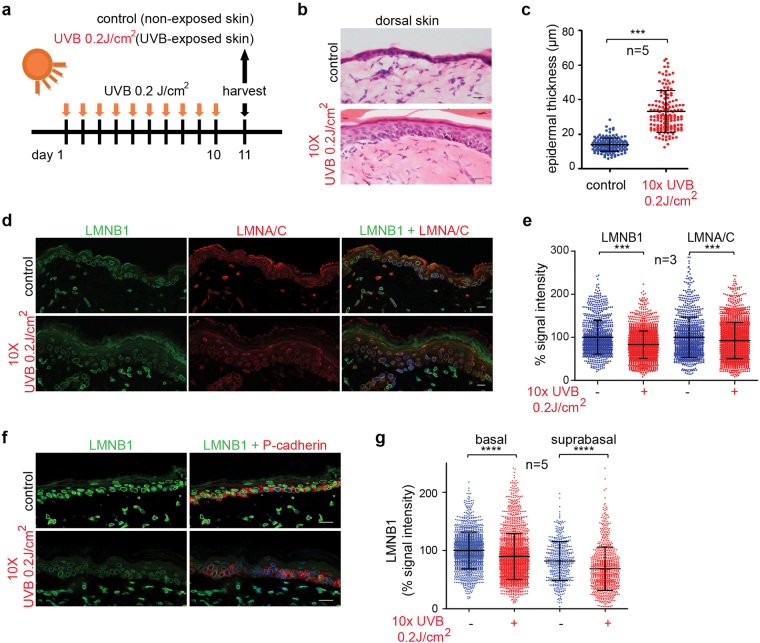
Skin ageing is an inevitable consequence of life and accelerated by exposure to ultraviolet (UV) rays. Senescence is an irreversible growth arrest and senescent cells accumulate in ageing tissues, at sites of age-related pathologies and in pre-neoplastic lesions. Conventionally, senescent cells have been detected by senescence associated-β-galactosidase (SA-β-gal) staining, a procedure that requires enzymatic activity, which is lost in fixed tissue samples. We previously demonstrated that loss of lamin B1 is a novel marker to identify senescent cells. Here, we demonstrate that loss of lamin B1 facilitates the detection and quantification of senescent cells upon UV-exposure in vitro and upon chronic UV-exposure and skin regeneration in vivo. Taken together, this marker enables the study of environmental conditions on tissue ageing and regeneration in vivo, serves as a diagnostic tool to distinguish senescent from proliferating cells in pre-neoplastic lesions, and facilitates investigating the role of senescent cells in various age-related pathologies.
皮肤衰老(Skin ageing)是生命的必然结果,并因暴露于紫外线(ultraviolet,UV)而加速。衰老(senescence)是一种不可逆的生长停滞(growth arrest),衰老细胞在衰老组织中积累,在与年龄相关的病理部位和癌前病变中积累。传统上,衰老细胞通过衰老相关-β-半乳糖苷酶(senescence associated-β-galactosidase,SA-β-gal)染色来检测,这一过程需要酶活性,而固定组织样本中则会失去这种酶活性。我们之前证明,层粘连蛋白 B1(lamin B1)的丢失是识别衰老细胞的一种新标记。在这里,我们证明在体外暴露于 UV 下以及体内慢性暴露于 UV 和皮肤再生时,层粘连蛋白 B1 的丢失有助于检测和量化衰老细胞。总之,这种标记物使人们能够研究环境条件对组织衰老和体内再生的影响,作为一种诊断工具,用于区分癌前病变中增殖细胞和衰老细胞,并有助于研究衰老细胞在各种与年龄相关的病理中的作用。