Okabayashi Yusuke, Tsuboi Nobuo, Sasaki Takaya, Haruhara Kotaro, Kanzaki Go, Koike Kentaro, Miyazaki Yoichi, Kawamura Tetsuya, Ogura Makoto, Yokoo Takashi
Division of Nephrology and Hypertension, Department of Internal Medicine, The Jikei University School of Medicine, Tokyo, Japan.
Kidney Int Rep. 2016 Aug 12;1(4):250-255. doi: 10.1016/j.ekir.2016.08.006. eCollection 2016 Nov.
Obesity-related glomerulopathy is an established secondary glomerular disease that may occur in obese individuals with a body mass index (BMI) of ≥30 kg/m. However, patients with moderate obesity (BMI ≤ 30 kg/m) may also develop this disease.
A total of 20 patients with grade 1 obesity (25 ≤ BMI < 30 kg/m) with persistent proteinuria, without evidence of other renal diseases, were analyzed retrospectively. These patients were compared with 20 patients with grade 2 or higher obesity (BMI ≥ 30 kg/m) with persistent proteinuria. Biopsies of 31 kidney transplant donors as healthy controls were used to compare histologic parameters.
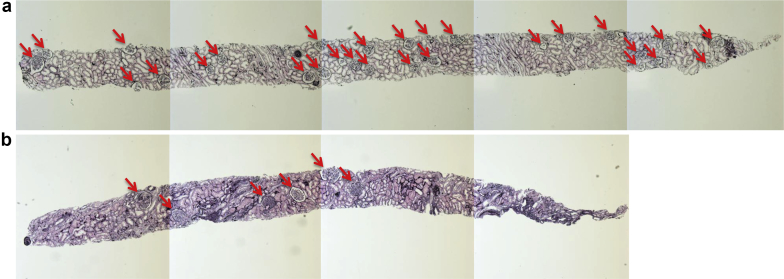
Similar to the grade 2 or higher obesity group, the grade 1 obesity group had a male predominance (85%) and showed a high incidence of hypertension (80%). Urinary protein excretion and renal outcome parameters were comparable between the groups. Patients with grade 1 obesity showed typical histologic features of obesity-related glomerulopathy: low glomerular density with glomerulomegaly. The glomerular density and mean glomerular volume in the grade 1 group, the grade 2 or higher group, and the kidney transplant donors with grade 1 obesity were 1.6 ± 0.8 versus 1.4 ± 0.6 versus 3.0 ± 1.1 (per mm) and 6.1 ± 2.1 versus 6.4 ± 1.6 versus 2.9 ± 0.8 (×10 μm), respectively.
A glomerulopathy similar to obesity-related glomerulopathy can occur in moderately obese individuals. Renal factor(s), such as low glomerular density, may thus underlie susceptibility to this disease entity as well as BMI.
肥胖相关性肾小球病是一种已被确认的继发性肾小球疾病,可发生于体重指数(BMI)≥30 kg/m²的肥胖个体。然而,中度肥胖(BMI≤30 kg/m²)的患者也可能罹患此病。
对20例1级肥胖(25≤BMI<30 kg/m²)且持续蛋白尿、无其他肾脏疾病证据的患者进行回顾性分析。将这些患者与20例2级或更高程度肥胖(BMI≥30 kg/m²)且持续蛋白尿的患者进行比较。选取31例肾移植供体的活检组织作为健康对照,以比较组织学参数。
与2级或更高程度肥胖组相似,1级肥胖组男性居多(85%),且高血压发病率较高(80%)。两组间尿蛋白排泄及肾脏预后参数相当。1级肥胖患者表现出肥胖相关性肾小球病的典型组织学特征:肾小球密度低伴肾小球肿大。1级肥胖组、2级或更高程度肥胖组以及1级肥胖肾移植供体的肾小球密度及平均肾小球体积分别为1.6±0.8对1.4±0.6对3.0±1.1(每毫米)和6.1±2.1对6.4±1.6对2.9±0.8(×10³μm³)。
中度肥胖个体可能发生与肥胖相关性肾小球病相似的肾小球病。因此,诸如肾小球密度低等肾脏因素可能是该疾病实体易感性以及BMI的潜在原因。