MMU Sports Genomics Laboratory, Manchester Metropolitan University, Crewe, Manchester, UK.
School of Public Health, Physiotherapy and Sports Science, University College Dublin, Dublin 4, Ireland.
BMC Genomics. 2017 Nov 14;18(Suppl 8):820. doi: 10.1186/s12864-017-4187-3.
Two common single nucleotide polymorphisms within the COL5A1 gene (SNPs; rs12722 C/T and rs3196378 C/A) have previously been associated with tendon and ligament pathologies. Given the high incidence of tendon and ligament injuries in elite rugby athletes, we hypothesised that both SNPs would be associated with career success.
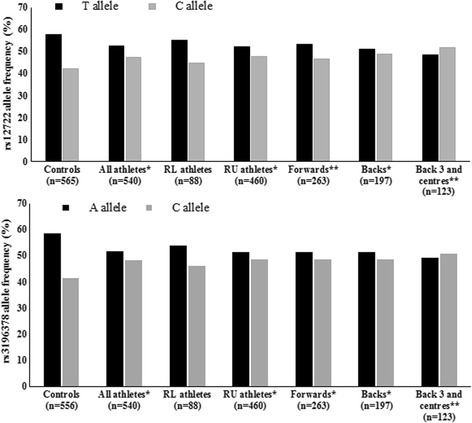
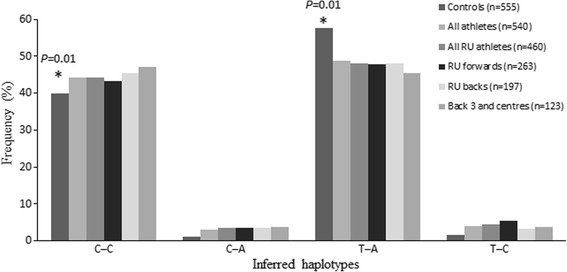
In 1105 participants (RugbyGene project), comprising 460 elite rugby union (RU), 88 elite rugby league athletes and 565 non-athlete controls, DNA was collected and genotyped for the COL5A1 rs12722 and rs3196378 variants using real-time PCR. For rs12722, the injury-protective CC genotype and C allele were more common in all athletes (21% and 47%, respectively) and RU athletes (22% and 48%) than in controls (16% and 41%, P ≤ 0.01). For rs3196378, the CC genotype and C allele were overrepresented in all athletes (23% and 48%) and RU athletes (24% and 49%) compared with controls (16% and 41%, P ≤ 0.02). The CC genotype in particular was overrepresented in the back and centres (24%) compared with controls, with more than twice the odds (OR = 2.25, P = 0.006) of possessing the injury-protective CC genotype. Furthermore, when considering both SNPs simultaneously, the CC-CC SNP-SNP combination and C-C inferred allele combination were higher in all the athlete groups (≥18% and ≥43%) compared with controls (13% and 40%; P = 0.01). However, no genotype differences were identified for either SNP when RU playing positions were compared directly with each other.
It appears that the C alleles, CC genotypes and resulting combinations of both rs12722 and rs3196378 are beneficial for rugby athletes to achieve elite status and carriage of these variants may impart an inherited resistance against soft tissue injury, despite exposure to the high-risk environment of elite rugby. These data have implications for the management of inter-individual differences in injury risk amongst elite athletes.
COL5A1 基因中的两个常见单核苷酸多态性(SNP;rs12722 C/T 和 rs3196378 C/A)先前与肌腱和韧带病变有关。鉴于精英橄榄球运动员中肌腱和韧带损伤的高发率,我们假设这两个 SNP 都与职业成功相关。
在 1105 名参与者(RugbyGene 项目)中,包括 460 名精英橄榄球联盟(RU)、88 名精英橄榄球联盟运动员和 565 名非运动员对照组,使用实时 PCR 收集和检测 COL5A1 rs12722 和 rs3196378 变体的 DNA。对于 rs12722,损伤保护的 CC 基因型和 C 等位基因在所有运动员(分别为 21%和 47%)和 RU 运动员(分别为 22%和 48%)中比对照组(分别为 16%和 41%,P≤0.01)更常见。对于 rs3196378,CC 基因型和 C 等位基因在所有运动员(分别为 23%和 48%)和 RU 运动员(分别为 24%和 49%)中比对照组(分别为 16%和 41%,P≤0.02)中更为常见。与对照组相比,CC 基因型在背部和中锋(24%)中更为常见,具有保护作用的 CC 基因型的几率是对照组的两倍多(OR=2.25,P=0.006)。此外,当同时考虑两个 SNP 时,所有运动员群体(≥18%和≥43%)中 CC-CC SNP-SNP 组合和 C-C 推断等位基因组合都高于对照组(13%和 40%;P=0.01)。然而,当直接比较 RU 比赛位置时,两个 SNP 均未发现基因型差异。
似乎 rs12722 和 rs3196378 的 C 等位基因、CC 基因型及其组合对橄榄球运动员达到精英状态是有益的,尽管它们暴露在精英橄榄球的高风险环境中,但这些变体可能赋予了对软组织损伤的遗传抗性。这些数据对管理精英运动员个体间损伤风险的差异具有重要意义。