• 文献检索
  • 文档翻译
  • 深度研究
  • 学术资讯
  • Suppr Zotero 插件Zotero 插件
  • 邀请有礼
  • 套餐&价格
  • 历史记录
应用&插件
Suppr Zotero 插件Zotero 插件浏览器插件Mac 客户端Windows 客户端微信小程序
定价
高级版会员购买积分包购买API积分包
服务
文献检索文档翻译深度研究API 文档MCP 服务
关于我们
关于 Suppr公司介绍联系我们用户协议隐私条款
关注我们

Suppr 超能文献

核心技术专利:CN118964589B侵权必究
粤ICP备2023148730 号-1Suppr @ 2026

文献检索

告别复杂PubMed语法,用中文像聊天一样搜索,搜遍4000万医学文献。AI智能推荐,让科研检索更轻松。

立即免费搜索

文件翻译

保留排版,准确专业,支持PDF/Word/PPT等文件格式,支持 12+语言互译。

免费翻译文档

深度研究

AI帮你快速写综述,25分钟生成高质量综述,智能提取关键信息,辅助科研写作。

立即免费体验

站立在斜坡上——当前微处理器控制的假肢如何帮助小腿和大腿截肢者完成日常任务。

Standing on slopes - how current microprocessor-controlled prosthetic feet support transtibial and transfemoral amputees in an everyday task.

机构信息

Research Biomechanics, CR&S, Otto Bock HealthCare GmbH, Göttingen, Germany.

出版信息

J Neuroeng Rehabil. 2017 Nov 16;14(1):117. doi: 10.1186/s12984-017-0322-2.

DOI:10.1186/s12984-017-0322-2
PMID:29145876
原文链接:https://pmc.ncbi.nlm.nih.gov/articles/PMC5691831/
Abstract

BACKGROUND

Conventional prosthetic feet like energy storage and return feet provide only a limited range of ankle motion compared to human ones. In order to overcome the poor rotational adaptability, prosthetic manufacturers developed different prosthetic feet with an additional rotational joint and implemented active control in different states. It was the aim of the study to investigate to what extent these commercially available microprocessor-controlled prosthetic feet support a natural posture while standing on inclines and which concept is most beneficial for lower limb amputees.

METHODS

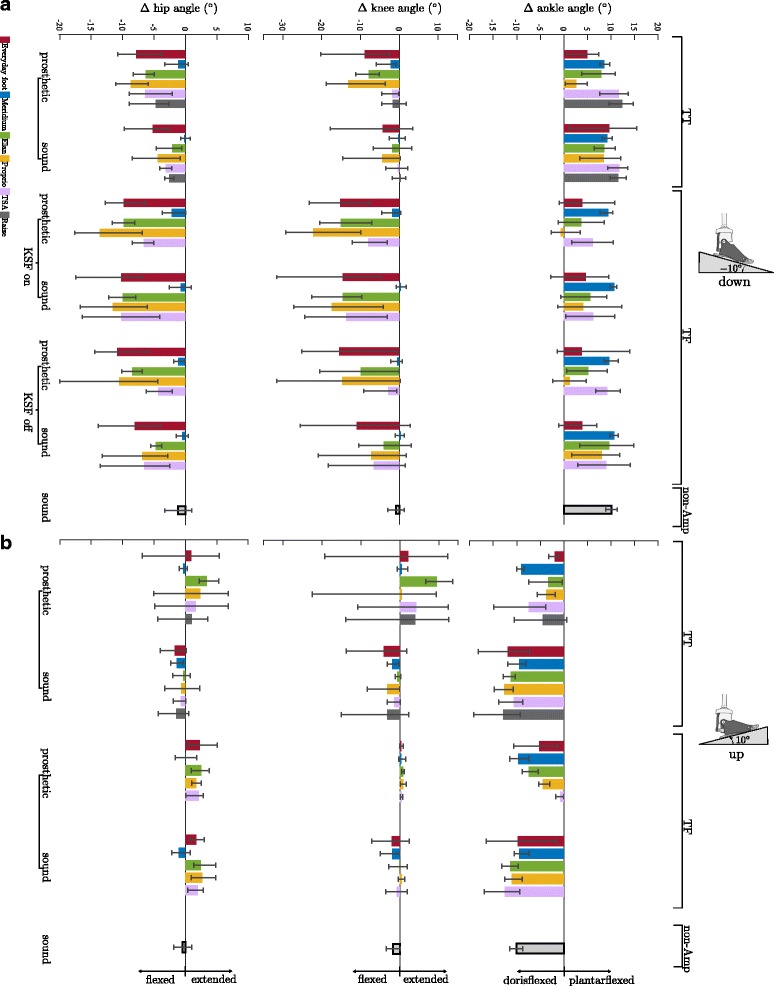
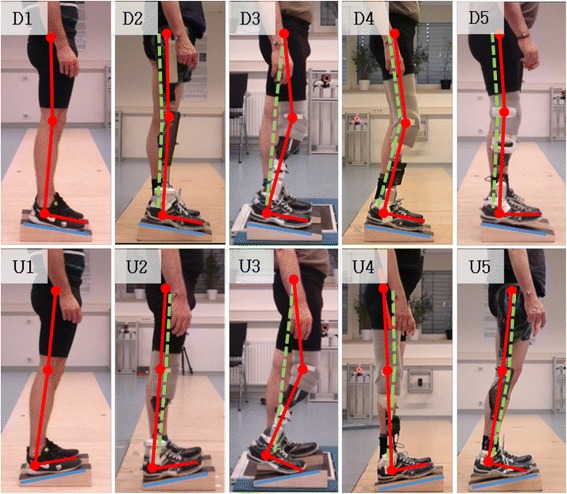
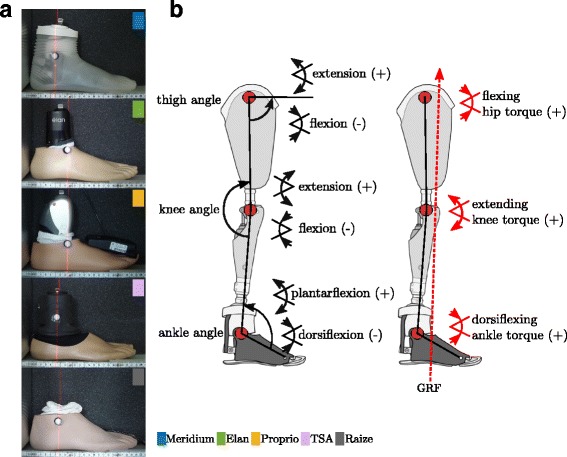
Four unilateral transtibial and four unilateral transfemoral amputees participated in the study. Each of the subjects wore five different microprocessor-controlled prosthetic feet in addition to their everyday feet. The subjects were asked to stand on slopes of different inclinations (level ground, upward slope of 10°, and downward slope of -10°). Vertical ground reaction forces, joint torques and joint angles in the sagittal plane were measured for both legs separately for the different situations and compared to a non-amputee reference group.

RESULTS

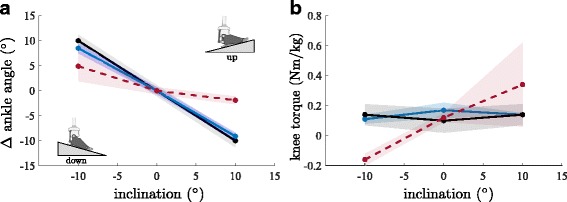
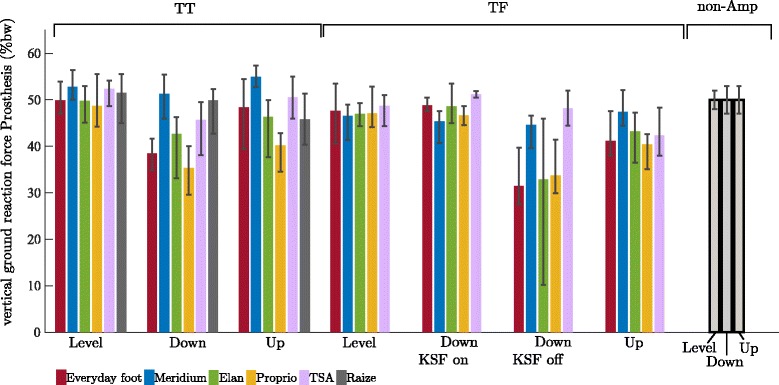
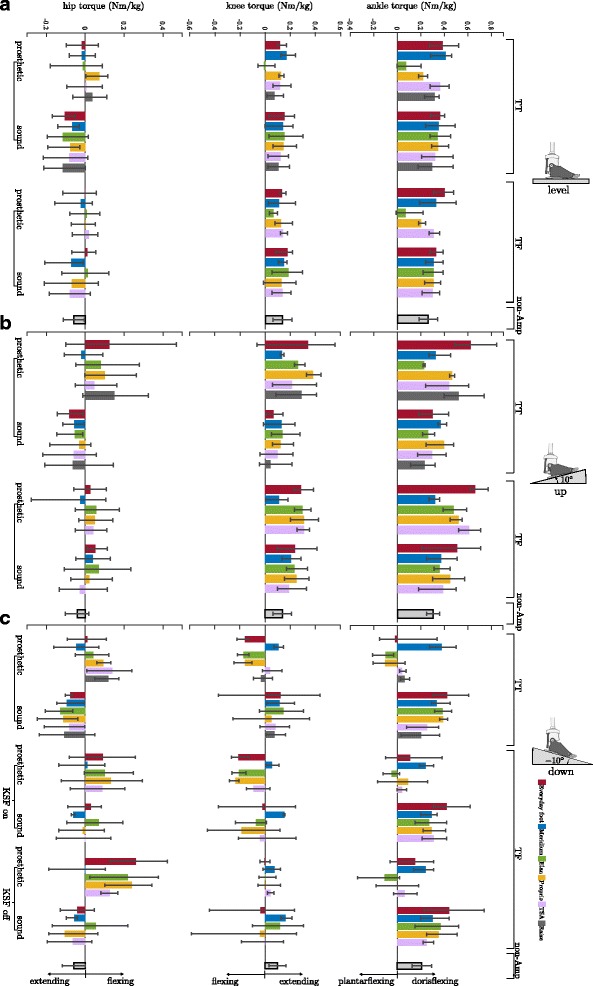
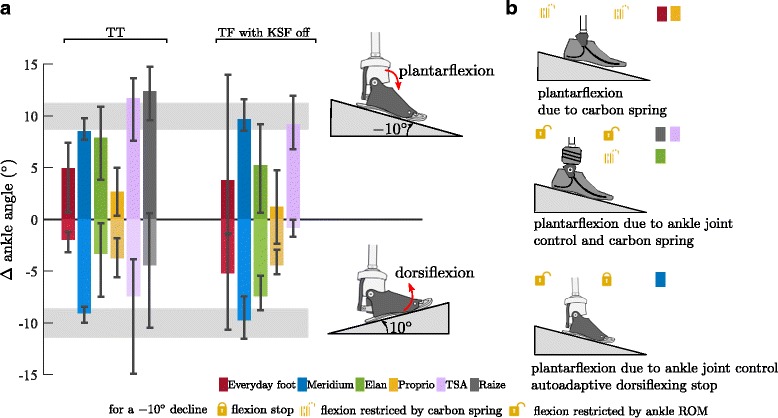
Differences in the biomechanical parameters were observed between the different prosthetic feet and compared to the reference group for the investigated situations. They were most prominent while standing on a downward slope. For example, on the prosthetic side, the vertical ground reaction force is reduced by about 20%, and the torque about the knee acts to flex the joint for feet that are not capable of a full adaptation to the downward slope. In contrast, fully adaptable feet with an auto-adaptive dorsiflexion stop show no changes in vertical ground reaction forces and knee extending torques.

CONCLUSIONS

A prosthetic foot that provides both, an auto-adaptive dorsiflexion stop and a sufficient range of motion for fully adapting to inclinations appears to be the key element in the prosthetic fitting for standing on inclinations in lower limb amputees. In such situations, this prosthetic concept appears superior to both, conventional feet with passive structures as well as feet that solely provide a sufficient range of motion. The results also indicate that both, transfemoral and transtibial amputees benefit from such a foot.

摘要

背景

与人类相比,传统的假肢脚(如储能和回弹脚)只能提供有限的踝关节运动范围。为了克服较差的旋转适应性,假肢制造商开发了具有附加旋转关节的不同假肢脚,并在不同状态下实施主动控制。本研究旨在探讨这些市售的微处理器控制假肢脚在站在斜坡上时在多大程度上支持自然姿势,以及哪种概念对下肢截肢者最有益。

方法

四名单侧胫骨截肢者和四名单侧股骨截肢者参加了这项研究。每位受试者除了日常使用的脚外,还穿着五种不同的微处理器控制假肢脚。要求受试者站在不同倾斜度的斜坡上(平地、向上 10°的斜坡和向下-10°的斜坡)。分别测量双腿在不同情况下的垂直地面反作用力、关节扭矩和矢状面关节角度,并与非截肢参考组进行比较。

结果

在不同的假肢脚之间观察到生物力学参数的差异,并与参考组进行了比较。在站立时,差异最为明显。例如,在假肢侧,垂直地面反作用力减少了约 20%,而膝关节的扭矩作用是使关节弯曲,对于不能完全适应下坡的脚。相比之下,具有自动自适应背屈停止功能的完全适应性脚在垂直地面反作用力和膝关节伸展扭矩方面没有变化。

结论

为适应斜坡而提供自动自适应背屈停止功能和足够运动范围的假肢脚似乎是下肢截肢者在斜坡上站立的假肢适配的关键要素。在这种情况下,这种假肢概念似乎优于具有被动结构的传统脚以及仅提供足够运动范围的脚。结果还表明,无论是股骨截肢者还是胫骨截肢者,都受益于这种脚。
https://cdn.ncbi.nlm.nih.gov/pmc/blobs/b04a/5691831/19cc46b7c8ff/12984_2017_322_Fig7_HTML.jpg
https://cdn.ncbi.nlm.nih.gov/pmc/blobs/b04a/5691831/0b08fea1b768/12984_2017_322_Fig1_HTML.jpg
https://cdn.ncbi.nlm.nih.gov/pmc/blobs/b04a/5691831/ede0989b352f/12984_2017_322_Fig2_HTML.jpg
https://cdn.ncbi.nlm.nih.gov/pmc/blobs/b04a/5691831/bf462e8d2ab0/12984_2017_322_Fig3_HTML.jpg
https://cdn.ncbi.nlm.nih.gov/pmc/blobs/b04a/5691831/d7866c5511fb/12984_2017_322_Fig4_HTML.jpg
https://cdn.ncbi.nlm.nih.gov/pmc/blobs/b04a/5691831/2f44fcf4d280/12984_2017_322_Fig5_HTML.jpg
https://cdn.ncbi.nlm.nih.gov/pmc/blobs/b04a/5691831/ac6c8bdc23ca/12984_2017_322_Fig6_HTML.jpg
https://cdn.ncbi.nlm.nih.gov/pmc/blobs/b04a/5691831/19cc46b7c8ff/12984_2017_322_Fig7_HTML.jpg
https://cdn.ncbi.nlm.nih.gov/pmc/blobs/b04a/5691831/0b08fea1b768/12984_2017_322_Fig1_HTML.jpg
https://cdn.ncbi.nlm.nih.gov/pmc/blobs/b04a/5691831/ede0989b352f/12984_2017_322_Fig2_HTML.jpg
https://cdn.ncbi.nlm.nih.gov/pmc/blobs/b04a/5691831/bf462e8d2ab0/12984_2017_322_Fig3_HTML.jpg
https://cdn.ncbi.nlm.nih.gov/pmc/blobs/b04a/5691831/d7866c5511fb/12984_2017_322_Fig4_HTML.jpg
https://cdn.ncbi.nlm.nih.gov/pmc/blobs/b04a/5691831/2f44fcf4d280/12984_2017_322_Fig5_HTML.jpg
https://cdn.ncbi.nlm.nih.gov/pmc/blobs/b04a/5691831/ac6c8bdc23ca/12984_2017_322_Fig6_HTML.jpg
https://cdn.ncbi.nlm.nih.gov/pmc/blobs/b04a/5691831/19cc46b7c8ff/12984_2017_322_Fig7_HTML.jpg

相似文献

1
Standing on slopes - how current microprocessor-controlled prosthetic feet support transtibial and transfemoral amputees in an everyday task.站立在斜坡上——当前微处理器控制的假肢如何帮助小腿和大腿截肢者完成日常任务。
J Neuroeng Rehabil. 2017 Nov 16;14(1):117. doi: 10.1186/s12984-017-0322-2.
2
Benefits of a microprocessor-controlled prosthetic foot for ascending and descending slopes.配备微处理器控制假肢脚上下坡的好处。
J Neuroeng Rehabil. 2022 Jan 28;19(1):9. doi: 10.1186/s12984-022-00983-y.
3
Lower limb amputee gait characteristics on a specifically designed test ramp: Preliminary results of a biomechanical comparison of two prosthetic foot concepts.在专门设计的测试坡道上下肢截肢者的步态特征:两种假足概念生物力学比较的初步结果
Gait Posture. 2019 Feb;68:161-167. doi: 10.1016/j.gaitpost.2018.11.017. Epub 2018 Nov 16.
4
Experimental characterization of the moment-angle curve during level and slope locomotion of transtibial amputee: Which parameters can be extracted to quantify the adaptations of microprocessor prosthetic ankle?实验分析小腿截肢患者在水平和斜坡运动中的力矩-角度曲线:哪些参数可以被提取出来以量化微处理器假肢踝关节的适应情况?
Proc Inst Mech Eng H. 2021 Jul;235(7):762-769. doi: 10.1177/09544119211006523. Epub 2021 Mar 30.
5
Microprocessor prosthetic ankles: comparative biomechanical evaluation of people with transtibial traumatic amputation during standing on level ground and slope.微电子处理器假肢踝关节:在平地和斜坡上站立时,对胫骨创伤性截肢者的比较生物力学评估。
Disabil Rehabil Assist Technol. 2021 Jan;16(1):17-26. doi: 10.1080/17483107.2019.1629112. Epub 2019 Sep 19.
6
Biomechanics of ramp descent in unilateral trans-tibial amputees: Comparison of a microprocessor controlled foot with conventional ankle-foot mechanisms.单侧经胫骨截肢者斜坡下行的生物力学:微处理器控制足部与传统踝足装置的比较
Clin Biomech (Bristol). 2016 Feb;32:164-70. doi: 10.1016/j.clinbiomech.2015.11.015. Epub 2015 Dec 5.
7
Energetic consequences of using a prosthesis with adaptive ankle motion during slope walking in persons with a transtibial amputation.在胫骨截肢患者的斜坡行走过程中使用具有适应性踝关节运动的假肢的能量学后果。
Prosthet Orthot Int. 2014 Feb;38(1):5-11. doi: 10.1177/0309364613481489. Epub 2013 Mar 22.
8
Subject-specific responses to an adaptive ankle prosthesis during incline walking.在倾斜行走过程中对自适应踝关节假肢的特定于个体的反应。
J Biomech. 2019 Oct 11;95:109273. doi: 10.1016/j.jbiomech.2019.07.017. Epub 2019 Jul 26.
9
Foot trajectories and loading rates in a transfemoral amputee for six different commercial prosthetic knees: An indication of adaptability.六种不同商业假肢膝关节的全股骨截肢者的足部轨迹和加载率:适应性的指示。
Med Eng Phys. 2019 Jun;68:46-56. doi: 10.1016/j.medengphy.2019.03.014. Epub 2019 Apr 9.
10
Assessment of transfemoral amputees using a passive microprocessor-controlled knee versus an active powered microprocessor-controlled knee for level walking.使用被动式微处理器控制膝关节与主动动力式微处理器控制膝关节对经股截肢者进行平地行走评估。
Biomed Eng Online. 2016 Dec 19;15(Suppl 3):142. doi: 10.1186/s12938-016-0287-6.

引用本文的文献

1
Effects of a Prosthetic Foot With Increased Coronal Adaptability on Cross-Slope Walking.具有增强冠状适应性的假脚对横向斜坡行走的影响。
Can Prosthet Orthot J. 2021 Jun 25;4(1):35206. doi: 10.33137/cpoj.v4i1.35206. eCollection 2021.
2
The Influence of Hydraulic Ankles and Microprocessor-control on the Biomechanics of Trans-tibial Amputees During Quiet Standing on a 5° Slope.液压踝关节和微处理器控制对经胫截肢者在5°斜坡上安静站立时生物力学的影响。
Can Prosthet Orthot J. 2020 Feb 24;2(2):33517. doi: 10.33137/cpoj.v2i2.33517. eCollection 2019.
3
Free-Living User Perspectives on Musculoskeletal Pain and Patient-Reported Mobility With Passive and Powered Prosthetic Ankle-Foot Components: A Pragmatic, Exploratory Cross-Sectional Study.

本文引用的文献

1
Functional level assessment of individuals with transtibial limb loss: Evaluation in the clinical setting versus objective community ambulatory activity.经胫骨截肢个体的功能水平评估:临床环境评估与客观社区步行活动评估
J Rehabil Assist Technol Eng. 2016 Mar 9;3:2055668316636316. doi: 10.1177/2055668316636316. eCollection 2016 Jan-Dec.
2
A powered prosthetic ankle joint for walking and running.一种用于行走和跑步的动力假肢踝关节。
Biomed Eng Online. 2016 Dec 19;15(Suppl 3):141. doi: 10.1186/s12938-016-0286-7.
3
EFFECTS OF THE GENIUM KNEE SYSTEM ON FUNCTIONAL LEVEL, STAIR AMBULATION, PERCEPTIVE AND ECONOMIC OUTCOMES IN TRANSFEMORAL AMPUTEES.
自由生活的使用者对被动和动力假肢踝足组件的肌肉骨骼疼痛及患者报告的活动能力的看法:一项实用的探索性横断面研究。
Front Rehabil Sci. 2022 Jan 14;2:805151. doi: 10.3389/fresc.2021.805151. eCollection 2021.
4
Benefits of a microprocessor-controlled prosthetic foot for ascending and descending slopes.配备微处理器控制假肢脚上下坡的好处。
J Neuroeng Rehabil. 2022 Jan 28;19(1):9. doi: 10.1186/s12984-022-00983-y.
5
Current and Emerging Trends in the Management of Fall Risk in People with Lower Limb Amputation.下肢截肢患者跌倒风险管理的当前及新出现的趋势
Curr Geriatr Rep. 2020 Sep;9(3):134-141. doi: 10.1007/s13670-020-00328-4. Epub 2020 Jul 29.
6
Advanced techniques in amputation surgery and prosthetic technology in the lower extremity.下肢截肢手术及假肢技术的先进技术。
EFORT Open Rev. 2020 Oct 26;5(10):724-741. doi: 10.1302/2058-5241.5.190070. eCollection 2020 Oct.
7
Effects of extended stance time on a powered knee prosthesis and gait symmetry on the lateral control of balance during walking in individuals with unilateral amputation.延长站立时间对单侧截肢者行走时动力膝关节假肢和侧向平衡控制步态对称性的影响。
J Neuroeng Rehabil. 2019 Nov 29;16(1):151. doi: 10.1186/s12984-019-0625-6.
8
Mobility analysis of AmpuTees (MAAT 5): Impact of five common prosthetic ankle-foot categories for individuals with diabetic/dysvascular amputation.安普泰假肢活动分析(MAAT 5):五种常见假肢踝足类别对糖尿病/血管性截肢患者的影响
J Rehabil Assist Technol Eng. 2019 Feb 13;6:2055668318820784. doi: 10.1177/2055668318820784. eCollection 2019 Jan-Dec.
Genium膝关节系统对经股骨截肢者功能水平、上下楼梯行走、感知及经济结果的影响
Technol Innov. 2016 Sep;18(2-3):139-150. doi: 10.21300/18.2-3.2016.139. Epub 2016 Sep 1.
4
Mechanical and energetic consequences of reduced ankle plantar-flexion in human walking.人类行走中踝关节跖屈减少的力学和能量学后果。
J Exp Biol. 2015 Nov;218(Pt 22):3541-50. doi: 10.1242/jeb.113910. Epub 2015 Sep 18.
5
Variable Cadence Walking and Ground Adaptive Standing With a Powered Ankle Prosthesis.使用动力踝关节假肢的可变步频行走和地面自适应站立
IEEE Trans Neural Syst Rehabil Eng. 2016 Apr;24(4):495-505. doi: 10.1109/TNSRE.2015.2428196. Epub 2015 Apr 30.
6
The influence of push-off timing in a robotic ankle-foot prosthesis on the energetics and mechanics of walking.机器人踝足假肢中蹬离时机对步行能量学和力学的影响。
J Neuroeng Rehabil. 2015 Feb 22;12:21. doi: 10.1186/s12984-015-0014-8.
7
Prosthetic ankle push-off work reduces metabolic rate but not collision work in non-amputee walking.在非截肢者行走过程中,假肢踝关节蹬离功可降低代谢率,但不会减少碰撞功。
Sci Rep. 2014 Dec 3;4:7213. doi: 10.1038/srep07213.
8
Mechanisms of Gait Asymmetry Due to Push-Off Deficiency in Unilateral Amputees.单侧截肢者蹬离不足导致步态不对称的机制。
IEEE Trans Neural Syst Rehabil Eng. 2015 Sep;23(5):776-85. doi: 10.1109/TNSRE.2014.2356722. Epub 2014 Sep 12.
9
THE EFFECT OF THE C-LEG KNEE PROSTHESIS ON SENSORY DEPENDENCY AND FALLS DURING SENSORY ORGANIZATION TESTING.C型腿膝关节假体在感觉组织测试中对感觉依赖和跌倒的影响。
Technol Innov. 2014 Jan 27;2013(4):343-347. doi: 10.3727/194982413X13844488879212.
10
Impact on the biomechanics of overground gait of using an 'Echelon' hydraulic ankle-foot device in unilateral trans-tibial and trans-femoral amputees.使用“梯队”型液压踝足装置对单侧胫部和股部截肢者地面步态生物力学的影响。
Clin Biomech (Bristol). 2014 Aug;29(7):728-34. doi: 10.1016/j.clinbiomech.2014.06.009. Epub 2014 Jun 23.