Bigelow Laboratory for Ocean Sciences, 60 Bigelow Drive, East Boothbay, ME, 04544, USA.
ARC Centre of Excellence for Coral Reef Studies, James Cook University, 1 James Cook Drive, Townsville, QLD, 4811, Australia.
Sci Rep. 2017 Nov 16;7(1):15684. doi: 10.1038/s41598-017-15679-w.
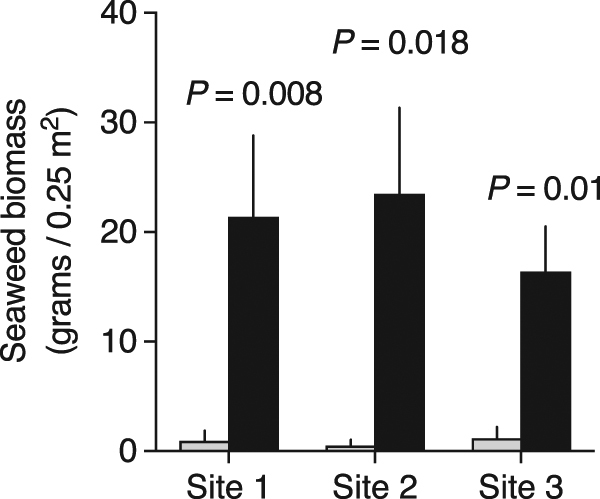
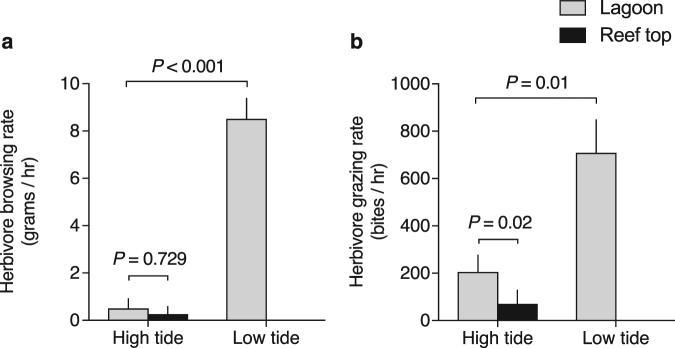
Coral reefs are among Earth's best-studied ecosystems, yet the degree to which large predators influence the ecology of coral reefs remains an open and contentious question. Recent studies indicate the consumptive effects of large reef predators are too diffuse to elicit trophic cascades. Here, we provide evidence that such predators can produce non-consumptive (fear) effects that flow through herbivores to shape the distribution of seaweed on a coral reef. This trophic cascade emerged because reef topography, tidal oscillations, and shark hunting behaviour interact to create predictable "hot spots" of fear on the reef where herbivores withhold feeding and seaweeds gain a spatial refuge. Thus, in risky habitats, sharks can exert strong ecological impacts even though they are trophic generalists that rarely feed. These findings contextualize the debate over whether predators influence coral reef structure and function and move us to ask not if, but under what specific conditions, they generate trophic cascades.
珊瑚礁是地球上研究最透彻的生态系统之一,但大型掠食者对珊瑚礁生态的影响程度仍然是一个悬而未决且有争议的问题。最近的研究表明,大型珊瑚礁掠食者的消耗性影响过于分散,无法引发营养级联。在这里,我们提供的证据表明,这些掠食者可以产生非消耗性(恐惧)效应,通过食草动物来塑造珊瑚礁上海藻的分布。这种营养级联的出现是因为珊瑚礁的地形、潮汐波动和鲨鱼的狩猎行为相互作用,在珊瑚礁上创造了可预测的“恐惧热点”,食草动物在这些地方停止进食,海藻则获得了空间避难所。因此,在危险的栖息地,鲨鱼即使是很少进食的营养一般者,也能对生态系统产生强烈的影响。这些发现使关于掠食者是否影响珊瑚礁结构和功能的争论具体化,并促使我们提出这样的问题:不是是否,而是在什么特定条件下,它们会引发营养级联。