Slavko Ekaterina, Taylor Mark S
Department of Chemistry , University of Toronto , Toronto , ON M5S 3H6 , Canada . Email:
Chem Sci. 2017 Oct 1;8(10):7106-7111. doi: 10.1039/c7sc01886j. Epub 2017 Aug 31.
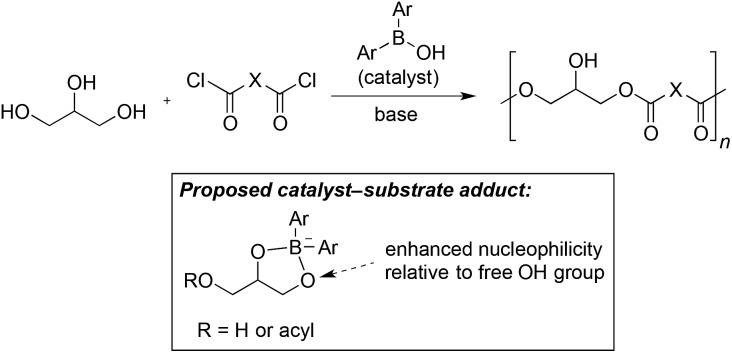
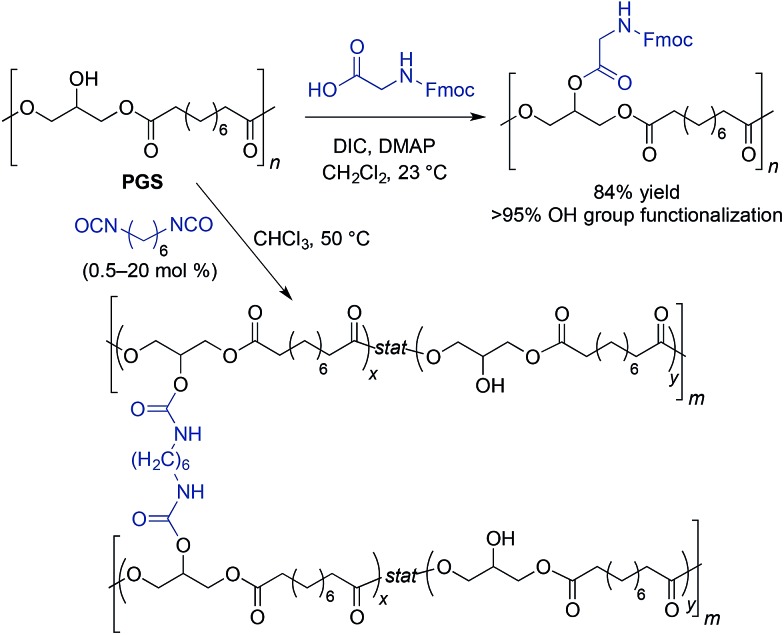
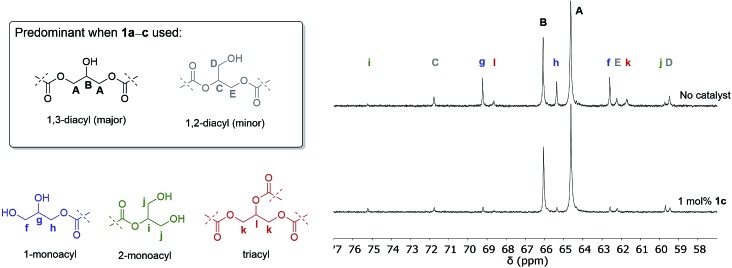
Diarylborinic acids catalyze the formation of linear polyesters from glycerol, a trifunctional, carbohydrate-based monomer. The selective activation of 1,2-diols over isolated alcohols by the organoboron catalyst results in polymers that are essentially free of branching or cross-linking and possess a high fraction of 1,3-enchained glycerol units, as assessed by H and C NMR spectroscopy. The ability to generate well-defined polyester architectures from glycerol is significant in light of the numerous applications of such macromolecules, particularly in the biomedical area. Isomerization, post-polymerization functionalization and controlled cross-linking reactions of the obtained linear poly(glycerol esters) are demonstrated.
二芳基硼酸催化由甘油(一种基于碳水化合物的三官能单体)形成线性聚酯。有机硼催化剂对1,2 -二醇的选择性活化优于孤立的醇,从而得到基本上无支化或交联的聚合物,通过氢谱和碳谱核磁共振光谱评估,这些聚合物含有高比例的1,3 - 键合甘油单元。鉴于此类大分子的众多应用,特别是在生物医学领域,能够从甘油生成结构明确的聚酯结构具有重要意义。本文展示了所得线性聚(甘油酯)的异构化、聚合后官能化及可控交联反应。