Department of Medicine, Samsung Medical Center, Sungkyunkwan University School of Medicine, 81 Irwon-ro, Gangnam-gu, Seoul, 06351, South Korea.
Department of Internal Medicine, Chung-Ang University College of Medicine, 102 Heukseok-ro, Dongjak-gu, Seoul, 06973, South Korea.
Trials. 2017 Nov 17;18(1):549. doi: 10.1186/s13063-017-2281-0.
Most international guidelines recommend triple-therapy regimens consisting of a proton pump inhibitor, clarithromycin, and amoxicillin/metronidazole for at least 7 days for the eradication of Helicobacter pylori. However, the efficacy of 7-day clarithromycin-based standard triple therapy for H. pylori infection is currently unacceptable in Korea. In this study, we will compare the efficacy and safety of 7-day standard triple therapy, 10-day sequential therapy, and 10-day concomitant therapy for the first-line treatment of H. pylori infection in Korea.
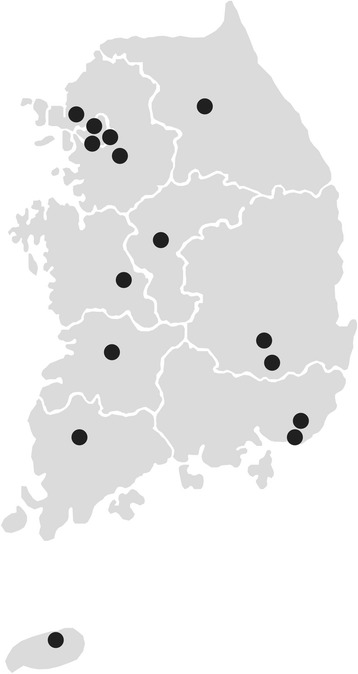
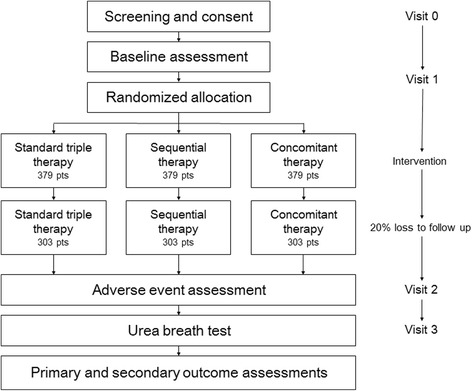
METHODS/DESIGN: In this multicenter, investigator-blinded, randomized trial we are recruiting adult patients with H. pylori infection from 15 hospitals in Korea to determine whether sequential or concomitant treatment is superior to standard triple therapy. Patients are randomly assigned to receive either standard triple therapy (lansoprazole, amoxicillin, and clarithromycin) for 7 days, or sequential treatment (lansoprazole and amoxicillin for the first 5 days, followed by lansoprazole, clarithromycin, and metronidazole for another 5 days) for 10 days, or concomitant therapy (lansoprazole, amoxicillin, clarithromycin, and metronidazole) for 10 days. The primary outcome is the rate of H. pylori eradication in the intention-to-treat population.
The results of this study will be crucial for determining the optimal regimen for the primary treatment of H. pylori infection in Korea. This study will produce vital evidence that will lead to revisions to guidelines concerning first-line treatment regimens for H. pylori infection.
Clinical Research Information Service (CRIS), Republic of Korea, KCT0001980 . Registered on 25 July 2016.
大多数国际指南建议使用质子泵抑制剂、克拉霉素和阿莫西林/甲硝唑三联疗法,疗程至少 7 天,以根除幽门螺杆菌。然而,在韩国,7 天克拉霉素为基础的标准三联疗法根除幽门螺杆菌的疗效目前无法接受。在这项研究中,我们将比较 7 天标准三联疗法、10 天序贯疗法和 10 天伴随疗法在韩国作为幽门螺杆菌感染一线治疗的疗效和安全性。
方法/设计:在这项多中心、研究者设盲、随机试验中,我们正在从韩国的 15 家医院招募幽门螺杆菌感染的成年患者,以确定序贯或伴随治疗是否优于标准三联疗法。患者被随机分配接受标准三联疗法(兰索拉唑、阿莫西林和克拉霉素)治疗 7 天,或序贯疗法(兰索拉唑和阿莫西林治疗前 5 天,然后兰索拉唑、克拉霉素和甲硝唑再治疗 5 天)治疗 10 天,或伴随疗法(兰索拉唑、阿莫西林、克拉霉素和甲硝唑)治疗 10 天。主要结局是意向治疗人群中幽门螺杆菌根除率。
这项研究的结果对于确定韩国幽门螺杆菌感染的一线治疗最佳方案至关重要。这项研究将产生重要的证据,这将导致对幽门螺杆菌感染一线治疗方案指南的修订。
韩国临床研究信息服务(CRIS),KCT0001980。注册于 2016 年 7 月 25 日。