Institute of Experimental and Clinical Pharmacology and Toxicology, Friedrich-Alexander-Universität Erlangen-Nürnberg, Erlangen, Germany
Department of Biostatistics, Boston University Schools of Public Health and Medicine, Boston, MA.
J Am Heart Assoc. 2017 Nov 18;6(11):e006224. doi: 10.1161/JAHA.117.006224.
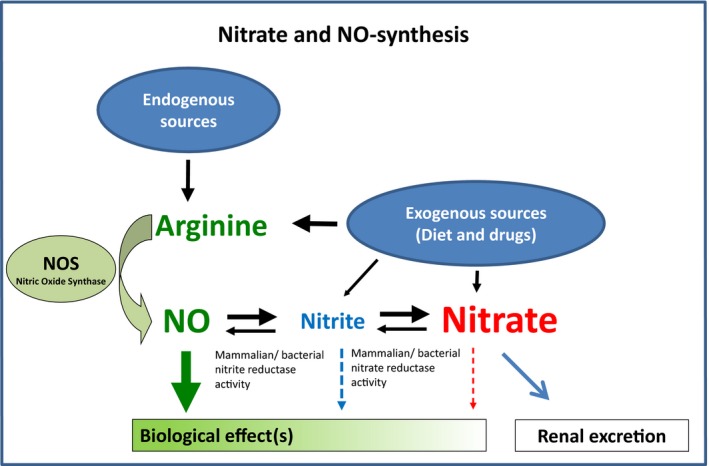
Nitrate is a dietary component as well as an endogenously formed metabolite and source of the signaling molecule nitric oxide. Harmful as well as beneficial effects of nitrate have been advocated. Data regarding the prognostic relevance of plasma nitrate are limited. The aim of this study was to evaluate the prospective association of plasma nitrate with cardiovascular disease (CVD) and all-cause mortality.
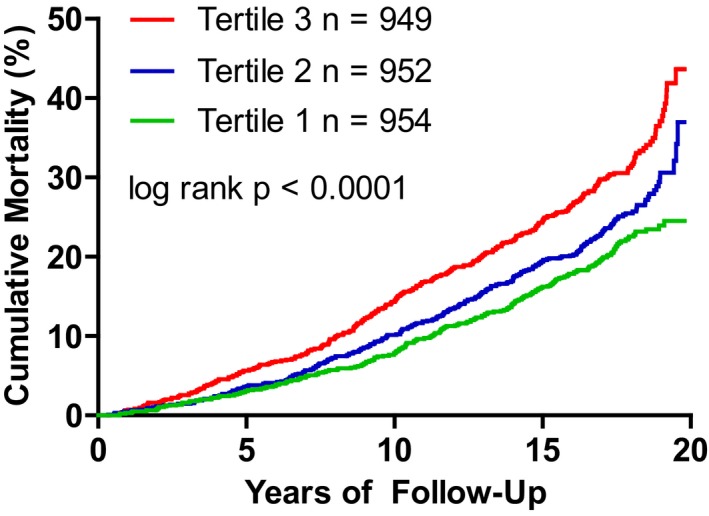
We assayed plasma nitrate in 2855 Framingham Offspring Study participants (mean age 59 years, 54% women) by gas chromatography-mass spectrometry and evaluated its association with all-cause mortality and incident CVD. On follow-up (median 17.3 years), 775 participants died and 522 developed new-onset CVD (of 2546 participants free of CVD at baseline). In multivariable models adjusting for standard risk factors, plasma nitrate was associated with an increased risk of death in participants (hazard ratio per unit increase in log-nitrate 1.21; 95% confidence interval, 1.04-1.40 [=0.015]). The strength of the association was attenuated by additional adjustment for estimated glomerular filtration rate (hazard ratio, 1.16; 95% confidence interval, 1.00-1.35 [=0.057]). In contrast, no evidence was found for an association of plasma nitrate with incident CVD (multivariable-adjusted hazard ratio per unit increase log-nitrate 1.08; 95% confidence interval, 0.89-1.31 [=0.42]).
In our prospective community-based investigation, a higher plasma nitrate concentration was associated with all-cause mortality but not with incident CVD. The association of nitrate with mortality may at least in part be attributable to its association with renal function.
硝酸盐是一种饮食成分,也是内源性形成的代谢物和信号分子一氧化氮的来源。硝酸盐既有危害又有有益的作用。关于血浆硝酸盐的预后相关性的数据有限。本研究的目的是评估血浆硝酸盐与心血管疾病(CVD)和全因死亡率的前瞻性关联。
我们通过气相色谱-质谱法检测了 2855 名弗雷明汉后代研究参与者(平均年龄 59 岁,54%为女性)的血浆硝酸盐,并评估了其与全因死亡率和新发 CVD 的关系。在随访期间(中位数 17.3 年),775 名参与者死亡,522 名参与者新发 CVD(在基线时无 CVD 的 2546 名参与者中)。在调整标准风险因素的多变量模型中,血浆硝酸盐与参与者的死亡风险增加相关(每单位对数硝酸盐增加的危险比为 1.21;95%置信区间,1.04-1.40[=0.015])。这种相关性的强度在进一步调整估计肾小球滤过率后减弱(危险比,1.16;95%置信区间,1.00-1.35[=0.057])。相比之下,没有证据表明血浆硝酸盐与新发 CVD 之间存在关联(每单位对数硝酸盐增加的多变量调整后的危险比为 1.08;95%置信区间,0.89-1.31[=0.42])。
在我们的前瞻性社区研究中,较高的血浆硝酸盐浓度与全因死亡率相关,但与新发 CVD 无关。硝酸盐与死亡率的相关性至少部分归因于其与肾功能的相关性。