Anderson Rodolfo C O, Andrade Denis V
Departamento de ZoologiaInstituto de Biociências Universidade Estadual Paulista (UNESP) Rio Claro São Paulo Brasil.
Ecol Evol. 2017 Sep 26;7(21):9066-9075. doi: 10.1002/ece3.3219. eCollection 2017 Nov.
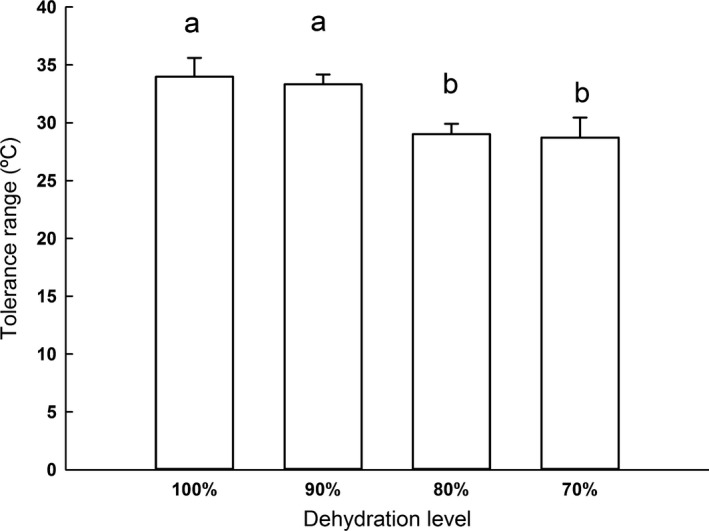
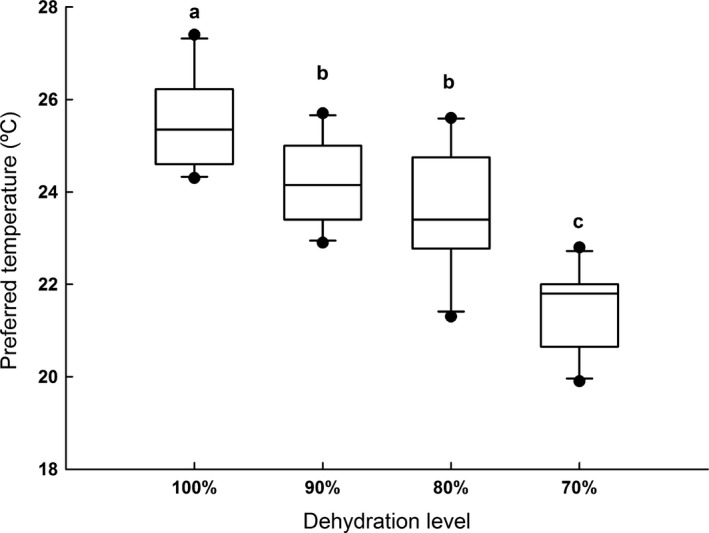
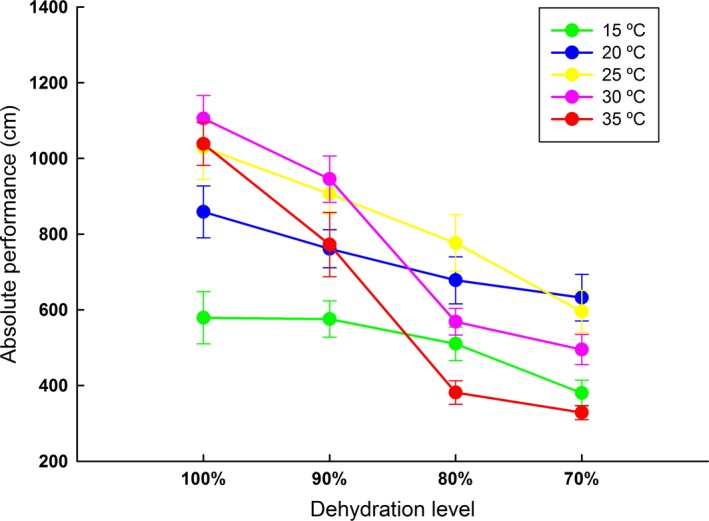
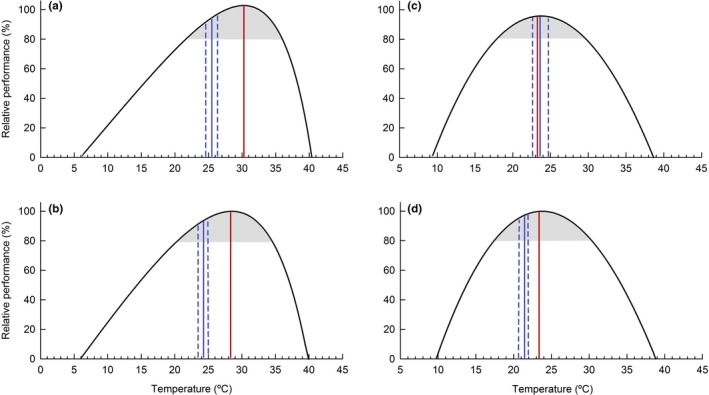
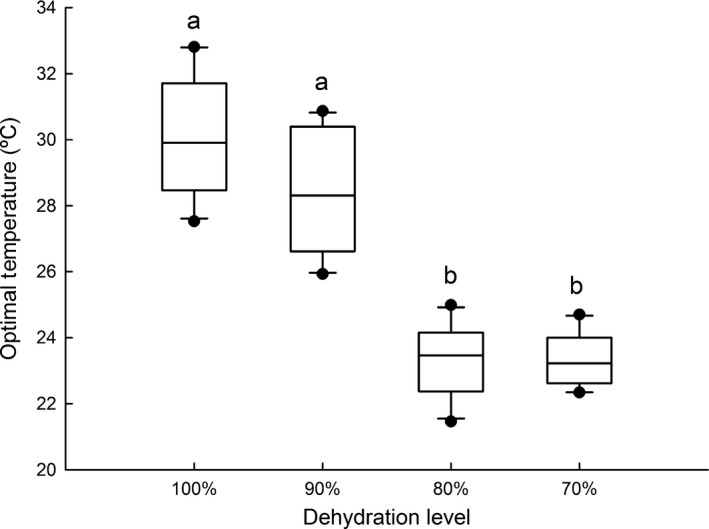
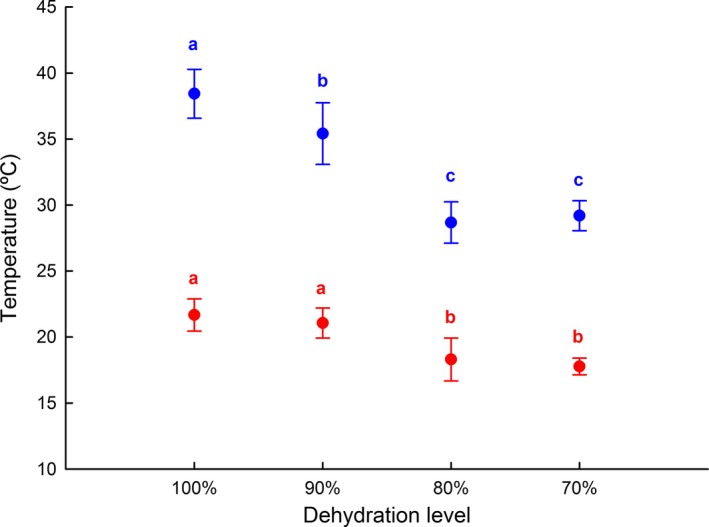
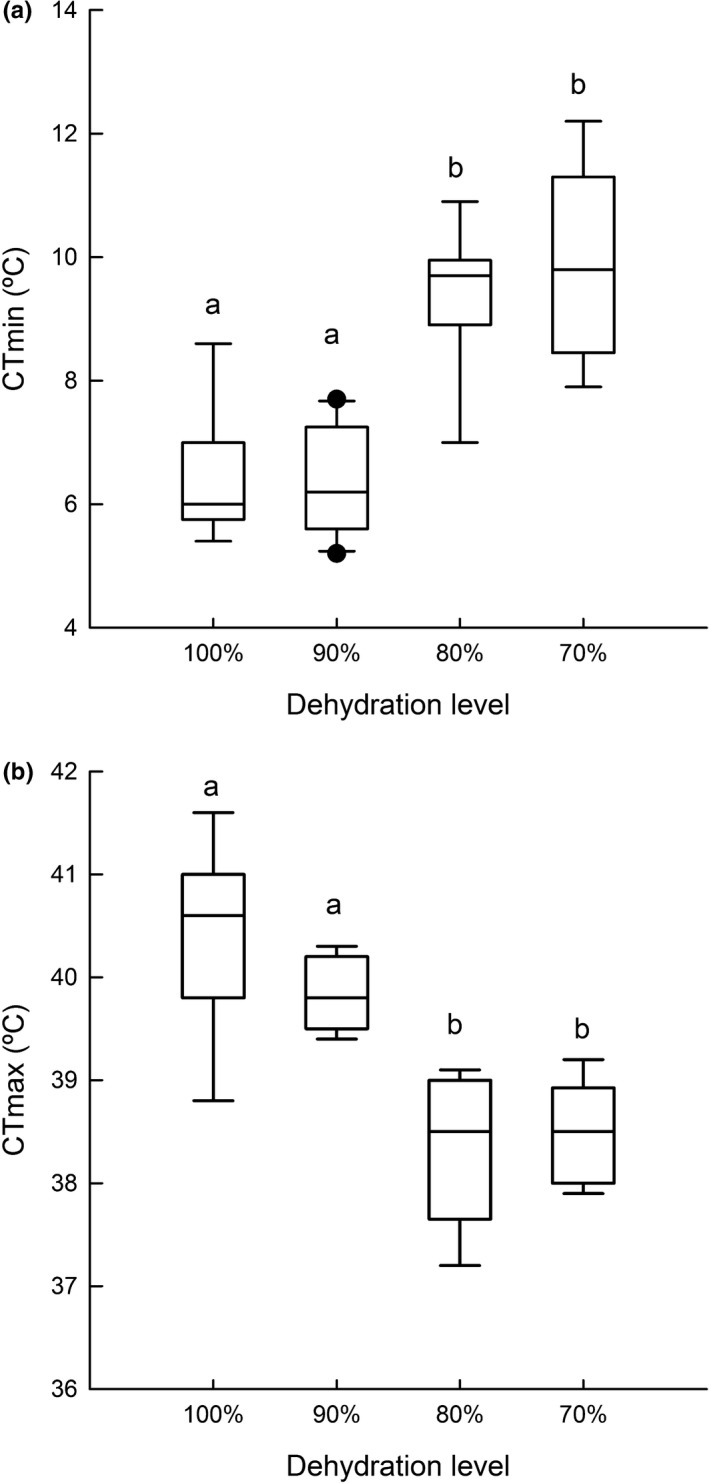
Due to their highly permeable skin and ectothermy, terrestrial amphibians are challenged by compromises between water balance and body temperature regulation. The way in which such compromises are accommodated, under a range of temperatures and dehydration levels, impacts importantly the behavior and ecology of amphibians. Thus, using the terrestrial toad as a model organism, the goals of this study were twofold. First, we determined how the thermal sensitivity of a centrally relevant trait-locomotion-was affected by dehydration. Secondly, we examined the effects of the same levels of dehydration on thermal preference and thermal tolerance. As dehydration becomes more severe, the optimal temperature for locomotor performance was lowered and performance breadth narrower. Similarly, dehydration was accompanied by a decrease in the thermal tolerance range. Such a decrease was caused by both an increase in the critical minimal temperature and a decrease in the thermal maximal temperature, with the latter changing more markedly. In general, our results show that the negative effects of dehydration on behavioral performance and thermal tolerance are, at least partially, counteracted by concurrent adjustments in thermal preference. We discuss some of the potential implications of this observation for the conservation of anuran amphibians.
由于陆生两栖动物皮肤具有高渗透性且为变温动物,它们在水分平衡和体温调节之间面临权衡挑战。在一系列温度和脱水水平下,应对这种权衡的方式对两栖动物的行为和生态有着重要影响。因此,本研究以陆生蟾蜍作为模式生物,目标有两个。其一,我们确定了脱水如何影响一个核心相关性状——运动能力——的热敏感性。其二,我们研究了相同脱水水平对热偏好和热耐受性的影响。随着脱水变得更严重,运动表现的最佳温度降低,表现范围变窄。同样,脱水伴随着热耐受范围的减小。这种减小是由临界最低温度升高和热最高温度降低共同导致的,其中后者变化更为明显。总体而言,我们的结果表明,脱水对行为表现和热耐受性的负面影响至少部分地被热偏好的同时调整所抵消。我们讨论了这一观察结果对无尾两栖动物保护的一些潜在意义。