Maternal and Fetal Health Research Centre, School of Medical Sciences, Faculty of Biology, Medicine and Health, University of Manchester, Manchester, UK.
St. Mary's Hospital, Manchester University NHS Foundation Trust, Manchester Academic Health Science Centre, Manchester, UK.
BJOG. 2018 Jan;125(2):254-262. doi: 10.1111/1471-0528.14967. Epub 2017 Nov 20.
To report maternal sleep practices in women who experienced a stillbirth compared with controls with ongoing live pregnancies at similar gestation.
Prospective case-control study.
Forty-one maternity units in the United Kingdom.
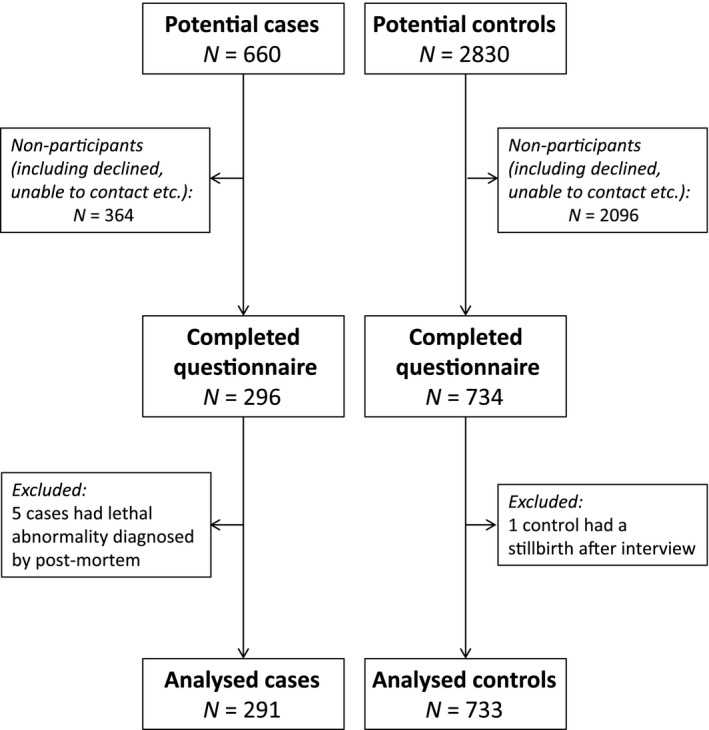
Women who had a stillbirth after ≥ 28 weeks' gestation (n = 291) and women with an ongoing pregnancy at the time of interview (n = 733).
Data were collected using an interviewer-administered questionnaire that included questions on maternal sleep practices before pregnancy, in the four weeks prior to, and on the night before the interview/stillbirth.
Maternal sleep practices during pregnancy.
In multivariable analysis, supine going-to-sleep position the night before stillbirth had a 2.3-fold increased risk of late stillbirth [adjusted Odds Ratio (aOR) 2.31, 95% CI 1.04-5.11] compared with the left side. In addition, women who had a stillbirth were more likely to report sleep duration less than 5.5 hours on the night before stillbirth (aOR 1.83, 95% CI 1.24-2.68), getting up to the toilet once or less (aOR 2.81, 95% CI 1.85-4.26), and a daytime nap every day (aOR 2.22, 95% CI 1.26-3.94). No interaction was detected between supine going-to-sleep position and a small-for-gestational-age infant, maternal body mass index, or gestational age. The population-attributable risk for supine going-to-sleep position was 3.7% (95% CI 0.5-9.2).
This study confirms that supine going-to-sleep position is associated with late stillbirth. Further work is required to determine whether intervention(s) can decrease the frequency of supine going-to-sleep position and the incidence of late stillbirth.
Supine going-to-sleep position is associated with 2.3× increased risk of stillbirth after 28 weeks' gestation.
Stillbirth, the death of a baby before birth, is a tragedy for mothers and families. One approach to reduce stillbirths is to identify factors that are associated with stillbirth. There are few risk factors for stillbirth that can be easily changed, but this study is looking at identifying how mothers may be able to reduce their risk. In this study, we interviewed 291 women who had a stillbirth and 733 women who had a live-born baby from 41 maternity units throughout the UK. The mothers who had a stillbirth were interviewed as soon as practical after their baby died. Mothers who had a live birth were interviewed during their pregnancies at the same times in pregnancy as when the stillbirths occurred. We did not interview mothers who had twins or who had a baby with a major abnormality. Mothers who went to sleep on their back had at least twice the risk of stillbirth compared with mothers who went to sleep on their left-hand side. This study suggests that 3.7% of stillbirths after 28 weeks of pregnancy were linked with going to sleep lying on the back. This study also shows that the link between going-to-sleep position and late stillbirth was not affected by the duration of pregnancy after 28 weeks, the size of the baby, or the mother's weight. Women who got up to the toilet once or more at night had a reduced risk of stillbirth. This is the largest of four similar studies that have all shown the same link between the position in which a mother goes to sleep and stillbirth after 28 weeks of pregnancy. Further studies are needed to see whether women can easily change their sleep position in late pregnancy and whether changing the position a mother goes to sleep in reduces stillbirth.
报告经历死胎的女性与同期有持续存活妊娠的对照者的睡眠习惯。
前瞻性病例对照研究。
英国 41 家产科单位。
≥28 周妊娠后死胎的女性(n=291)和接受访谈时持续妊娠的女性(n=733)。
使用经过访谈者管理的问卷调查收集数据,包括妊娠前、妊娠前四周和访谈/死胎前一天的母亲睡眠习惯问题。
妊娠期间的母亲睡眠习惯。
多变量分析显示,与左侧卧位相比,死胎前一天晚上仰卧入睡的体位与晚期死胎的风险增加 2.3 倍[校正比值比(aOR)2.31,95%置信区间(CI)1.04-5.11]。此外,与前一天晚上睡眠不足 5.5 小时(aOR 1.83,95% CI 1.24-2.68)、夜间起床去厕所一次或更少(aOR 2.81,95% CI 1.85-4.26)和每天白天小睡(aOR 2.22,95% CI 1.26-3.94)的女性相比,死胎的女性更有可能报告。仰卧入睡体位与小于胎龄儿、母亲体重指数或孕龄之间未检测到交互作用。仰卧入睡体位的人群归因风险为 3.7%(95% CI 0.5-9.2)。
本研究证实,仰卧入睡体位与晚期死胎有关。需要进一步的工作来确定干预措施是否可以减少仰卧入睡体位的频率和晚期死胎的发生率。
仰卧入睡体位与 28 周后妊娠的死产风险增加 2.3 倍相关。
死产是指婴儿在出生前死亡,这对母亲和家庭来说是一场悲剧。减少死产的一种方法是确定与死产相关的因素。虽然有一些可以轻易改变的死产风险因素,但这项研究正在寻找减少风险的方法。在这项研究中,我们采访了来自英国 41 家产科单位的 291 名死胎女性和 733 名活产女性。在婴儿死亡后,死胎母亲尽快接受了采访。活产母亲在妊娠期间的同一时间接受了采访,时间与死胎发生的时间相同。我们没有采访怀双胞胎或婴儿有重大异常的母亲。与左侧卧位相比,仰卧入睡的母亲发生死胎的风险至少增加两倍。这项研究表明,28 周后妊娠的 3.7%的死胎与仰卧入睡有关。这项研究还表明,入睡体位与晚期死胎之间的联系不受 28 周后妊娠持续时间、婴儿大小或母亲体重的影响。夜间起床上厕所一次或更多次的女性发生死胎的风险降低。这是四项类似研究中最大的一项,都表明母亲入睡时的体位与 28 周后妊娠的死胎之间存在相同的联系。需要进一步的研究来确定女性是否可以轻易改变晚期妊娠时的睡眠姿势,以及改变母亲入睡时的姿势是否可以降低死产的风险。