Division of Sleep Medicine, Department of Neurology, and Department of Obstetrics and Gynecology, Michigan Medicine, Ann Arbor, Michigan.
Mothers, Babies and Families Research Group, School of Nursing and Midwifery, University of South Australia, Adelaide, South Australia, Australia.
Birth. 2019 Jun;46(2):344-354. doi: 10.1111/birt.12416. Epub 2019 Jan 18.
Late stillbirth, which occurs ≥28 weeks' gestation, affects 1.3-8.8 per 1000 births in high-income countries. Of concern, most occur in women without established risk factors. Identification of potentially modifiable risk factors that relate to maternal behaviors remains a priority in stillbirth prevention research. This study aimed to investigate, in an international cohort, whether maternal sleep practices are related to late stillbirth.
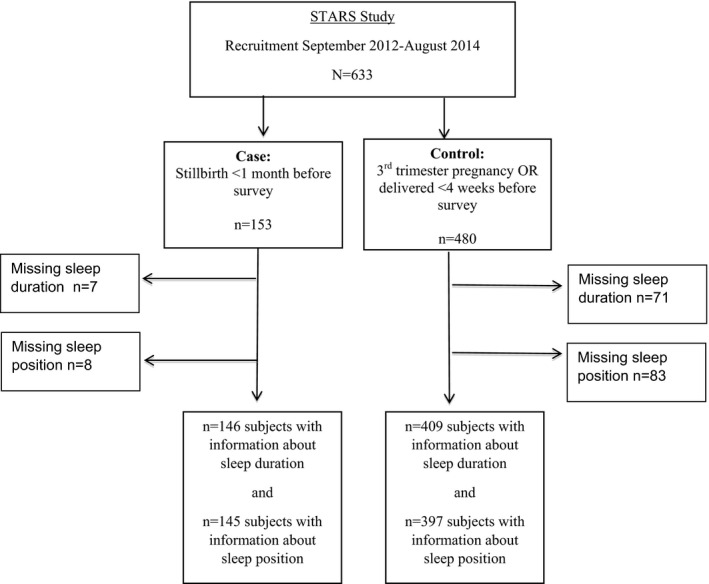
An Internet-based case-control study of women who had a stillbirth ≥28 weeks' gestation within 30 days before completing the survey (n = 153) and women with an ongoing third-trimester pregnancy or who had delivered a live born child within 30 days (n = 480). Bivariate and multivariate logistic regressions were used to determine unadjusted and adjusted odds ratios (OR and aOR, respectively) with 95% confidence intervals (95% CIs) for stillbirth.
Sleeping >9 hours per night in the previous month was associated with stillbirth (aOR 1.75 [95% CI 1.10-2.79]), as was waking on the right side (2.27 [1.31-3.92]). Nonrestless sleep in the last month was also found to be associated with stillbirth (1.73 [1.03-2.99]), with good sleep quality in the last month approaching significance (1.64 [0.98-2.75]). On the last night of pregnancy, not waking more than one time was associated with stillbirth (2.03 [1.24-3.34]). No relationship was found with going to sleep position during pregnancy, although very few women reported settling in the supine position (2.4%).
Long periods of undisturbed sleep are associated with late stillbirth. Physiological studies of how the neuroendocrine and autonomic system pathways are regulated during sleep in the context of late pregnancy are warranted.
晚发性死胎发生于妊娠 28 周及以后,在高收入国家每 1000 例活产中约有 1.3-8.8 例。值得关注的是,大多数晚发性死胎发生于没有明确危险因素的女性中。因此,确定与母体行为相关的潜在可改变的危险因素仍然是预防死产研究的重点。本研究旨在国际队列中调查母体睡眠习惯是否与晚发性死胎有关。
这是一项基于互联网的病例对照研究,纳入在完成调查前 30 天内发生妊娠 28 周及以后的死胎(n=153)和在过去 30 天内处于妊娠晚期或分娩活产儿的女性(n=480)。采用单因素和多因素逻辑回归来确定未校正和校正比值比(OR 和 aOR,分别)及其 95%置信区间(95%CI),以评估死产的风险。
与死胎相关的因素有:前一个月每晚睡眠超过 9 小时(aOR 1.75 [95%CI 1.10-2.79])、右侧卧位(2.27 [1.31-3.92])和非不安腿综合征(1.73 [1.03-2.99])。上个月睡眠质量较好也与死胎有关(aOR 1.64 [0.98-2.75])。在妊娠的最后一晚,没有醒来超过一次与死胎有关(aOR 2.03 [1.24-3.34])。在妊娠期间进入睡眠姿势与死胎无关,但很少有女性报告仰卧(2.4%)。
长时间未受干扰的睡眠与晚发性死胎有关。需要进行生理学研究以了解妊娠晚期睡眠期间神经内分泌和自主神经系统通路如何受到调节。