Clinic of General and Invasive Cardiology, University Clinical Hospital No. 1, Yerevan, Armenia.
Center for Stroke Research Berlin, Charite Universitätsmedizin Berlin, Berlin, Germany.
ESC Heart Fail. 2017 Nov;4(4):458-467. doi: 10.1002/ehf2.12184. Epub 2017 Jul 15.
Cachexia is a severe complication of cancer that adversely affects the course of the disease and is associated with high rates of mortality. Patients with cancer manifest symptoms, such as fatigue, shortness of breath, and impaired exercise tolerance, which are clinical signs of chronic heart failure. The aim of this study was to evaluate cardiac muscle wasting in cancer individuals.
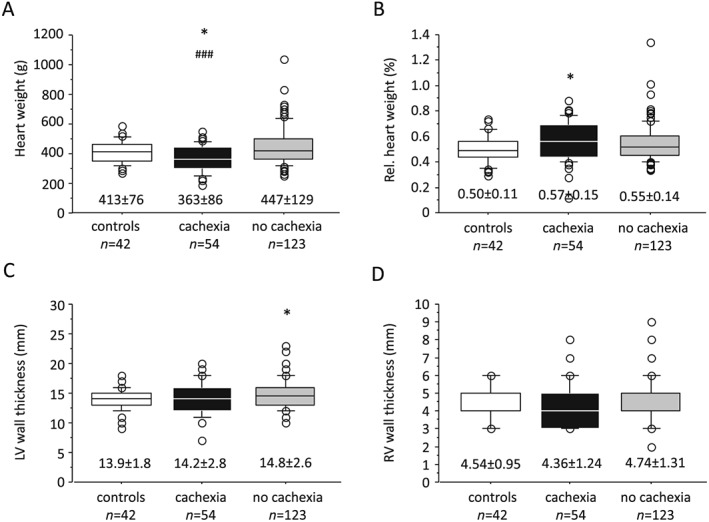
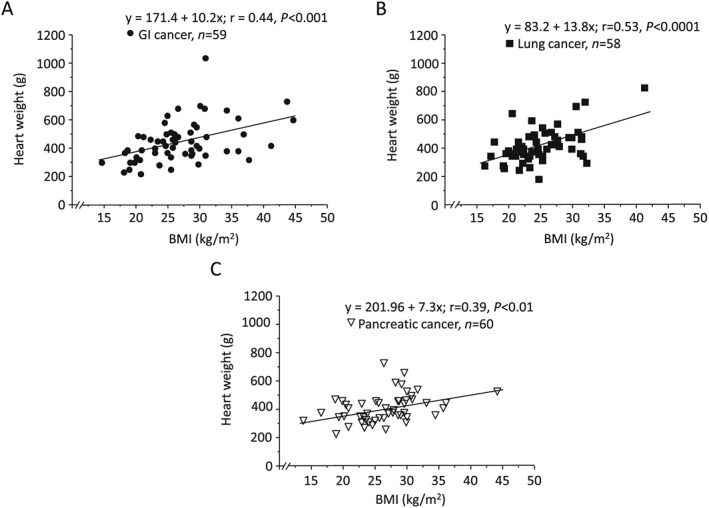
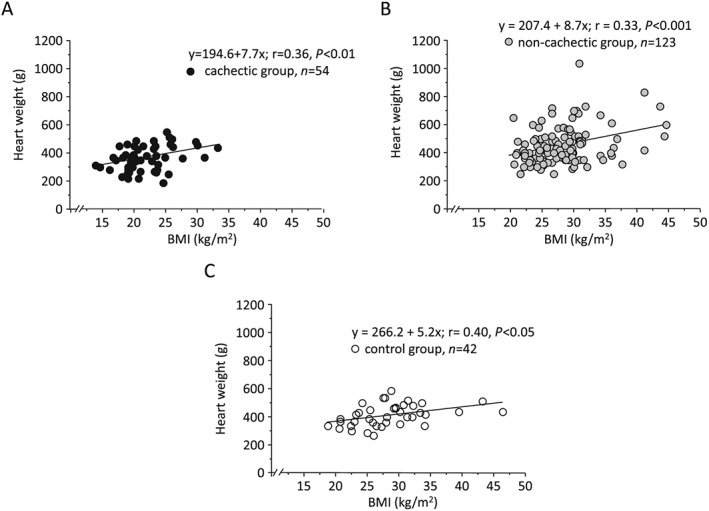
We retrospectively analysed 177 individuals who died of cancer, including 58 lung, 60 pancreatic, and 59 gastrointestinal (GI) cancers, and 42 cancer-free controls who died of other, non-cardiovascular reasons. Cancer cachexia (CC) was defined based on clinical and/or pathological diagnosis, body mass index (BMI) <20.0 kg/m and/or oedema-free body weight loss of 5.0% during the previous year or less. The pathology reports were analysed for BMI, heart weight (HW), and left and right ventricular wall thicknesses (LVWT and RVWT, respectively). The analysis of clinical data included recording of biochemical parameters and medication data of study patients. CC was detected in 54 (30.5%) subjects. Individuals with CC had a significantly lower HW than non-cachectic subjects (363.1 ± 86.2 vs. 447.0 ± 128.9 g, P < 0.001) and control group (412.9 ± 75.8 g, P < 0.05). BMI correlated with HW in cases with GI cancer (r = 0.44, P < 0.001), lung cancer (r = 0.53, P < 0.0001), and pancreatic cancer (r = 0.39, P < 0.01).
Body weight loss in individuals with lung, pancreatic, and GI cancers is accompanied by a decrease in HW. In patients with CC who receive cancer treatment, screening for cardiac muscle wasting may have clinical importance.
恶病质是癌症的一种严重并发症,会对疾病进程产生不利影响,并与高死亡率相关。患有癌症的患者会出现疲劳、呼吸急促和运动耐量受损等症状,这些都是慢性心力衰竭的临床迹象。本研究旨在评估癌症患者的心肌消耗。
我们回顾性分析了 177 名死于癌症的患者,包括 58 名肺癌、60 名胰腺癌和 59 名胃肠道(GI)癌患者,以及 42 名因其他非心血管原因死亡的无癌症对照者。癌症恶病质(CC)的定义基于临床和/或病理诊断、体重指数(BMI)<20.0kg/m2和/或前一年无水肿的体重减轻 5.0%。对病理报告进行 BMI、心脏重量(HW)以及左心室壁厚度(LVWT)和右心室壁厚度(RVWT)的分析。临床数据分析包括记录研究患者的生化参数和药物数据。在 54 名(30.5%)患者中检测到 CC。与非恶病质患者相比,CC 患者的 HW 显著降低(363.1±86.2 与 447.0±128.9g,P<0.001)和对照组(412.9±75.8g,P<0.05)。BMI 与 GI 癌(r=0.44,P<0.001)、肺癌(r=0.53,P<0.0001)和胰腺癌(r=0.39,P<0.01)患者的 HW 相关。
患有肺癌、胰腺癌和 GI 癌的患者体重减轻伴随着 HW 降低。在接受癌症治疗的 CC 患者中,筛查心肌消耗可能具有临床重要性。