Ghanouni Pejman, Kishore Sirish, Lungren Matthew P, Bitton Rachelle, Chan Lauren, Avedian Raffi, Bazzocchi Alberto, Butts Pauly Kim, Napoli Alessandro, Hovsepian David M
Department of Radiology, Stanford University, Richard M. Lucas Center for Imaging, 1201 Welch Rd., Stanford, CA 94305-5488.
Department of Radiology, Stanford University, Richard M. Lucas Center for Imaging, 1201 Welch Rd., Stanford, CA 94305-5488.
J Vasc Interv Radiol. 2017 Dec;28(12):1739-1744. doi: 10.1016/j.jvir.2017.06.002.
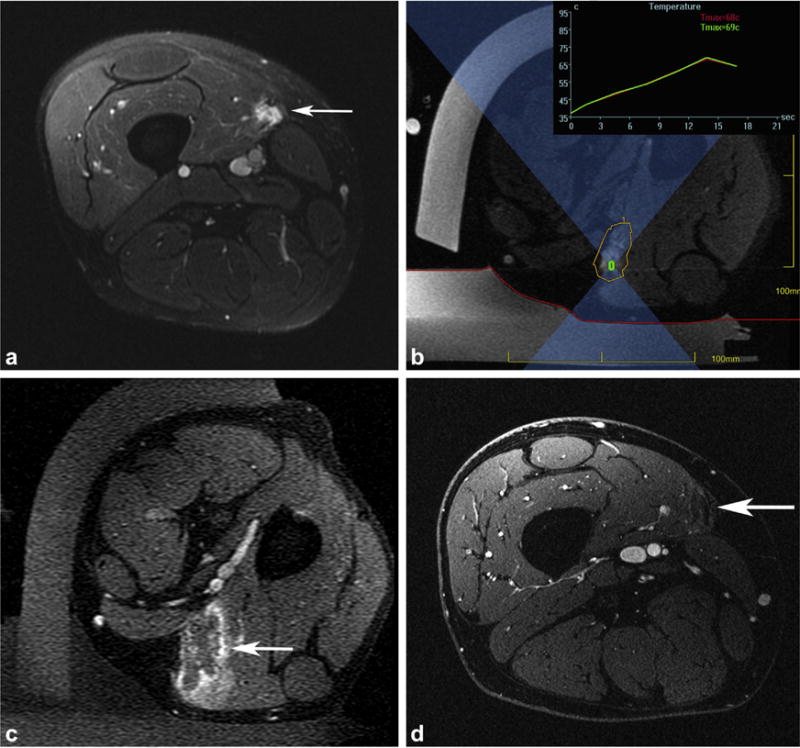
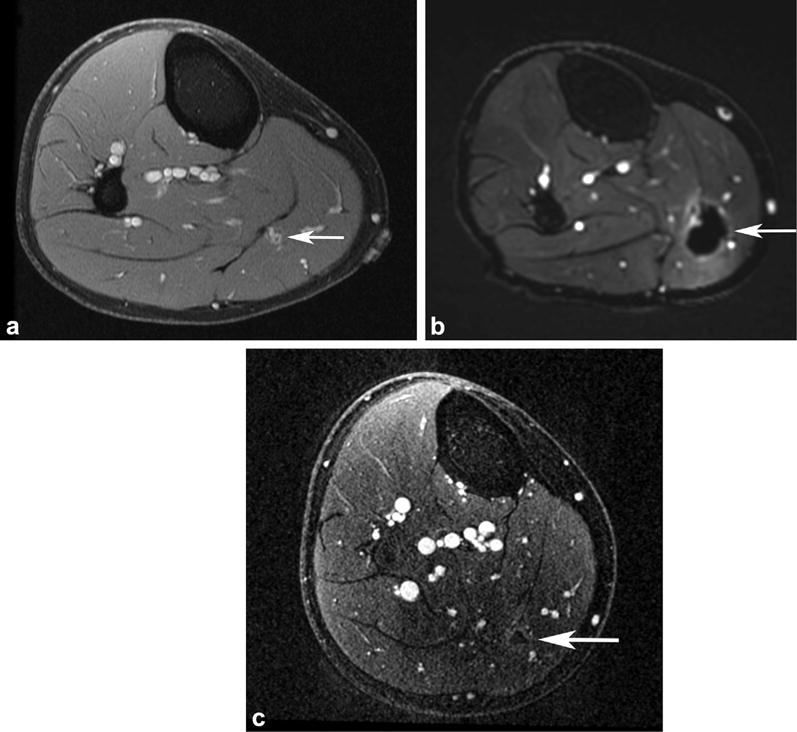
Five patients with painful vascular malformations of the extremities that were refractory to standard treatment and were confirmed as low-flow malformations on dynamic contrast-enhanced magnetic resonance (MR) imaging were treated with MR imaging-guided high intensity focused ultrasound. Daily maximum numeric rating scale scores for pain improved from 8.4 ± 1.5 to 1.6 ± 2.2 (P = .004) at a median follow-up of 9 months (range, 4-36 mo). The size of the vascular malformations decreased on follow-up MR imaging (median enhancing volume, 8.2 mL [0.7-10.1 mL] before treatment; 0 mL [0-2.3 mL] after treatment; P = .018) at a median follow-up of 5 months (range, 3-36 mo). No complications occurred.
5例四肢疼痛性血管畸形患者,对标准治疗无效,动态对比增强磁共振成像(MR)证实为低流量畸形,采用MR引导下高强度聚焦超声治疗。在中位随访9个月(范围4 - 36个月)时,每日疼痛数字评定量表最高得分从8.4±1.5改善至1.6±2.2(P = 0.004)。在中位随访5个月(范围3 - 36个月)时,随访MR成像显示血管畸形大小减小(治疗前中位强化体积为8.2 mL [0.7 - 10.1 mL];治疗后为0 mL [0 - 2.3 mL];P = 0.018)。未发生并发症。