Trépo Eric, Goossens Nicolas, Fujiwara Naoto, Song Won-Min, Colaprico Antonio, Marot Astrid, Spahr Laurent, Demetter Pieter, Sempoux Christine, Im Gene Y, Saldarriaga Joan, Gustot Thierry, Devière Jacques, Thung Swan N, Minsart Charlotte, Sersté Thomas, Bontempi Gianluca, Abdelrahman Karim, Henrion Jean, Degré Delphine, Lucidi Valerio, Rubbia-Brandt Laura, Nair Venugopalan D, Moreno Christophe, Deltenre Pierre, Hoshida Yujin, Franchimont Denis
Department of Gastroenterology, Hepatopancreatology, and Digestive Oncology, C.U.B. Hôpital Erasme, Université Libre de Bruxelles, Brussels, Belgium; Laboratory of Experimental Gastroenterology, Université Libre de Bruxelles, Brussels, Belgium.
Division of Liver Diseases, Department of Medicine, Tisch Cancer Institute, Icahn School of Medicine at Mount Sinai, New York, New York; Division of Gastroenterology and Hepatology, Geneva University Hospital, Geneva, Switzerland.
Gastroenterology. 2018 Mar;154(4):965-975. doi: 10.1053/j.gastro.2017.10.048. Epub 2017 Nov 20.
BACKGROUND & AIMS: Patients with severe alcoholic hepatitis (AH) have a high risk of death within 90 days. Corticosteroids, which can cause severe adverse events, are the only treatment that increases short-term survival. It is a challenge to predict outcomes of patients with severe AH. Therefore, we developed a scoring system to predict patient survival, integrating baseline molecular and clinical variables.
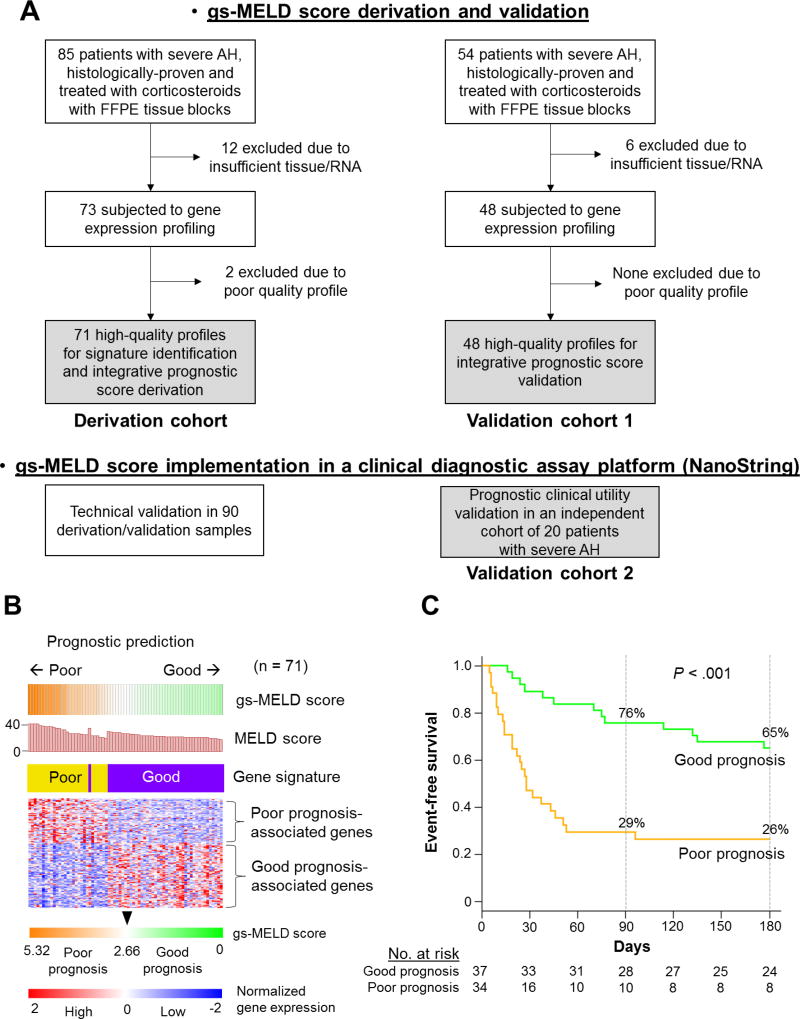
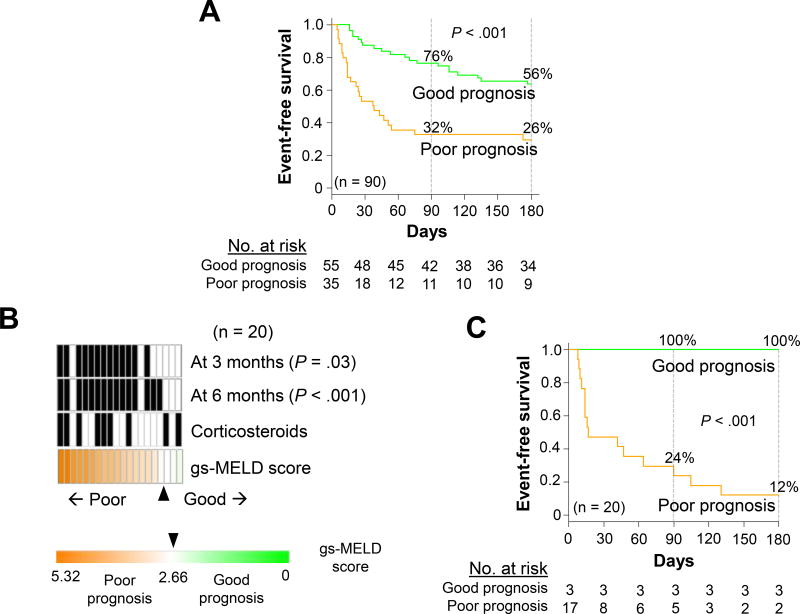
We obtained fixed liver biopsy samples from 71 consecutive patients diagnosed with severe AH and treated with corticosteroids from July 2006 through December 2013 in Brussels, Belgium (derivation cohort). Gene expression patterns were analyzed by microarrays and clinical data were collected for 180 days. We identified gene expression signatures and clinical data that are associated with survival without liver transplantation at 90 and 180 days after initiation of corticosteroid therapy. Findings were validated using liver biopsies from 48 consecutive patients with severe AH treated with corticosteroids, collected from March 2010 through February 2015 at hospitals in Belgium and Switzerland (validation cohort 1) and in liver biopsies from 20 patients (9 received corticosteroid treatment), collected from January 2012 through May 2015 in the United States (validation cohort 2).
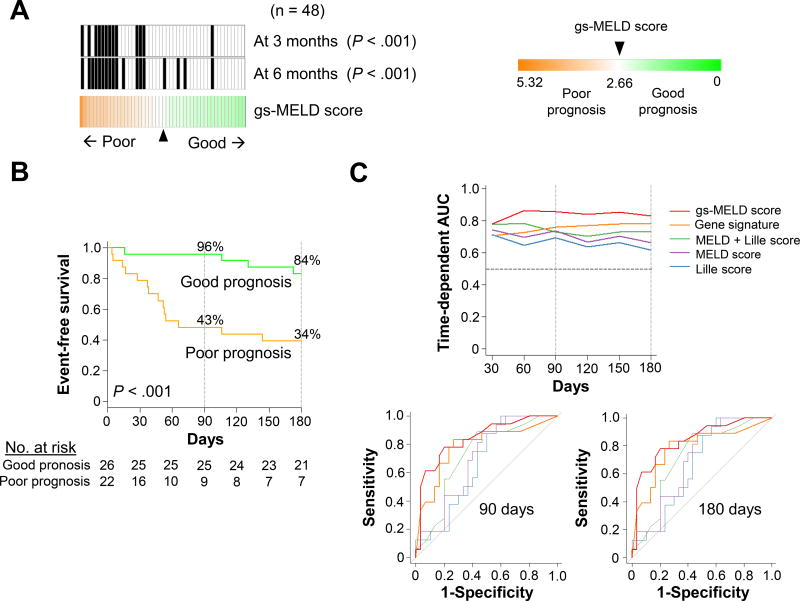
We integrated data on expression patterns of 123 genes and the model for end-stage liver disease (MELD) scores to assign patients to groups with poor survival (29% survived 90 days and 26% survived 180 days) and good survival (76% survived 90 days and 65% survived 180 days) (P < .001) in the derivation cohort. We named this assignment system the gene signature-MELD (gs-MELD) score. In validation cohort 1, the gs-MELD score discriminated patients with poor survival (43% survived 90 days) from those with good survival (96% survived 90 days) (P < .001). The gs-MELD score also discriminated between patients with a poor survival at 180 days (34% survived) and a good survival at 180 days (84% survived) (P < .001). The time-dependent area under the receiver operator characteristic curve for the score was 0.86 (95% confidence interval 0.73-0.99) for survival at 90 days, and 0.83 (95% confidence interval 0.71-0.96) for survival at 180 days. This score outperformed other clinical models to predict survival of patients with severe AH in validation cohort 1. In validation cohort 2, the gs-MELD discriminated patients with a poor survival at 90 days (12% survived) from those with a good survival at 90 days (100%) (P < .001).
We integrated data on baseline liver gene expression pattern and the MELD score to create the gs-MELD scoring system, which identifies patients with severe AH, treated or not with corticosteroids, most and least likely to survive for 90 and 180 days.
重症酒精性肝炎(AH)患者在90天内有很高的死亡风险。皮质类固醇会引发严重不良事件,是唯一能提高短期生存率的治疗方法。预测重症AH患者的预后是一项挑战。因此,我们开发了一种评分系统,将基线分子和临床变量整合起来以预测患者的生存率。
我们从2006年7月至2013年12月在比利时布鲁塞尔连续收治的71例诊断为重症AH并接受皮质类固醇治疗的患者中获取固定肝活检样本(推导队列)。通过微阵列分析基因表达模式,并收集180天的临床数据。我们确定了与皮质类固醇治疗开始后90天和180天无肝移植生存相关的基因表达特征和临床数据。研究结果在2010年3月至2015年2月期间从比利时和瑞士医院收集的48例连续接受皮质类固醇治疗的重症AH患者的肝活检样本(验证队列1)以及2012年1月至2015年5月在美国收集的20例患者(9例接受皮质类固醇治疗)的肝活检样本(验证队列2)中进行了验证。
我们整合了123个基因的表达模式数据和终末期肝病模型(MELD)评分,以便在推导队列中将患者分为生存较差组(90天生存率为29%,180天生存率为26%)和生存良好组(90天生存率为76%,180天生存率为65%)(P < 0.001)。我们将这个分组系统命名为基因特征-MELD(gs-MELD)评分。在验证队列1中,gs-MELD评分将生存较差的患者(90天生存率为43%)与生存良好的患者(90天生存率为96%)区分开来(P < 0.001)。gs-MELD评分也能区分180天生存较差的患者(生存率为34%)和180天生存良好的患者(生存率为84%)(P < 0.001)。该评分在90天生存时的受试者工作特征曲线下的时间依赖性面积为0.86(95%置信区间0.73 - 0.99),180天生存时为0.83(95%置信区间0.71 - 0.96)。在验证队列1中,该评分在预测重症AH患者生存方面优于其他临床模型。在验证队列2中,gs-MELD评分将90天生存较差的患者(生存率为12%)与90天生存良好的患者(生存率为100%)区分开来(P < 0.001)。
我们整合了基线肝基因表达模式数据和MELD评分,创建了gs-MELD评分系统,该系统可识别接受或未接受皮质类固醇治疗的重症AH患者中最有可能和最不可能在90天和180天生存的患者。