Jarić Ivan, Roberts David L, Gessner Jörn, Solow Andrew R, Courchamp Franck
Leibniz-Institute of Freshwater Ecology and Inland Fisheries, Berlin, Germany.
Biology Centre of the Czech Academy of Sciences, Institute of Hydrobiology, České Budějovice, Czech Republic.
PeerJ. 2017 Nov 14;5:e4025. doi: 10.7717/peerj.4025. eCollection 2017.
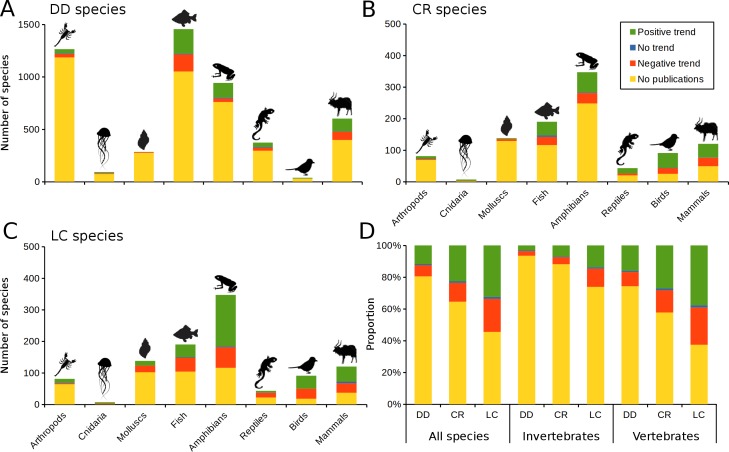
The IUCN Red List of Threatened Species is often advocated as a tool to assist decision-making in conservation investment and research focus. It is frequently suggested that research efforts should prioritize species in higher threat categories and those that are Data Deficient (DD). We assessed the linkage between IUCN listing and research effort in DD and Critically Endangered (CR) species, two groups generally advocated as research priorities. The analysis of the change in the research output following species classification indicated a listing effect in DD species, while such effect was observed in only a minority of CR species groups. DD species, while chronically understudied, seem to be recognized as research priorities, while research effort for endangered species appears to be driven by various factors other than the IUCN listing. Optimized conservation research focus would require international science planning efforts, harmonized through international mechanisms and promoted by financial and other incentives.
世界自然保护联盟濒危物种红色名录常被倡导作为一种工具,以协助在保护投资和研究重点方面进行决策。人们经常建议,研究工作应优先关注处于较高威胁类别的物种以及数据缺乏(DD)的物种。我们评估了世界自然保护联盟名录与针对数据缺乏物种和极度濒危(CR)物种的研究工作之间的联系,这两类物种通常被倡导作为研究重点。对物种分类后研究产出变化的分析表明,数据缺乏物种存在名录效应,而在只有少数极度濒危物种组中观察到这种效应。数据缺乏物种虽然长期研究不足,但似乎被视为研究重点,而对濒危物种的研究工作似乎受世界自然保护联盟名录以外的各种因素驱动。优化的保护研究重点将需要通过国际机制协调并由资金及其他激励措施推动的国际科学规划努力。