Kohnert Klaus-Dieter, Heinke Peter, Vogt Lutz, Augstein Petra, Salzsieder Eckhard
Institute of Diabetes "Gerhardt Katsch", Karlsburg, Germany.
Diabetes Service Center, Karlsburg, Germany.
J Clin Transl Endocrinol. 2014 Oct 16;1(4):192-199. doi: 10.1016/j.jcte.2014.09.003. eCollection 2014 Dec.
To determine whether characteristics of glucose dynamics are reflections of β-cell function or rather of inadequate diabetes control.
MATERIALS/METHODS: We analyzed historical liquid meal tolerance test (LMTT) and continuous glucose monitoring (CGM) data, which had been obtained from 56 non-insulin treated type 2 diabetic outpatients during withdrawal of antidiabetic drugs. Computed CGM parameters included detrended fluctuation analysis (DFA)-based indices, autocorrelation function exponent, mean amplitude of glycemic excursions (MAGE), glucose SD, and measures of glycemic exposure. The LMTT-based disposition index (LMTT-DI) calculated from the ratio of the area-under-the-insulin-curve to the area-under-the-glucose-curve and Matsuda index was used to assess relationships among β-cell function, glucose profile complexity, autocorrelation function, and glycemic variability.
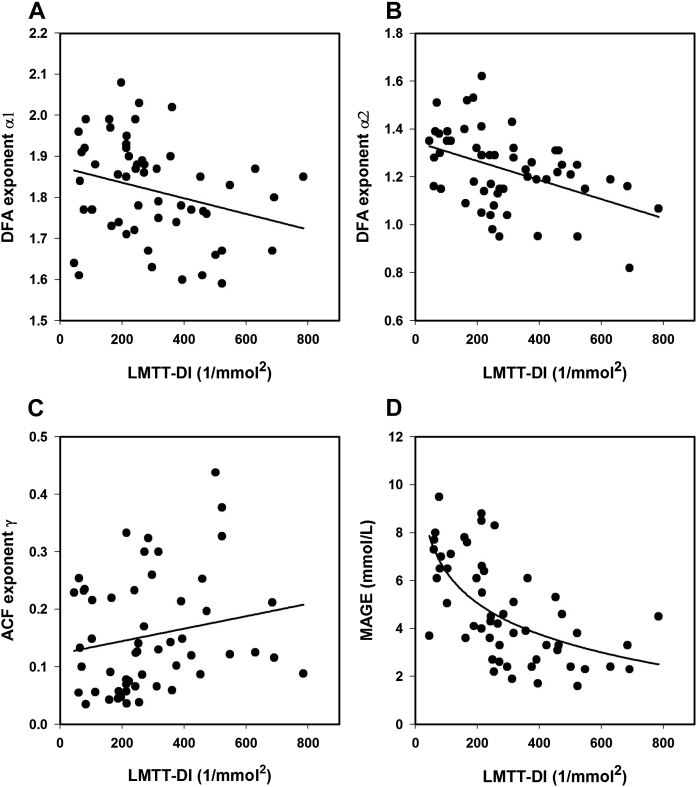
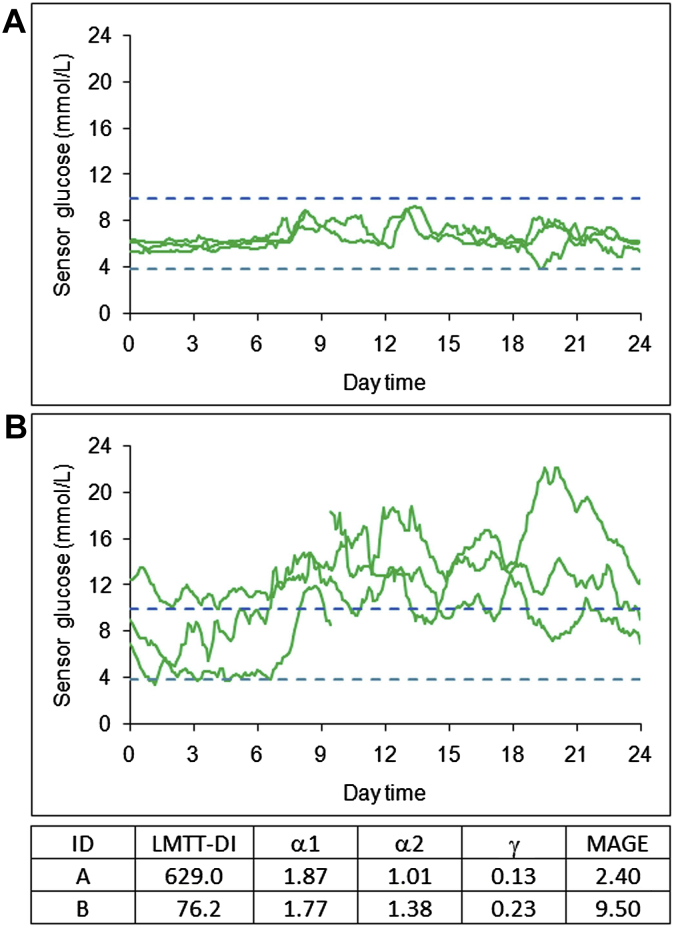
The LMTT-DI was inverse linearly correlated with the short-range α1 and long-range scaling exponent α2 ( = -0.275 and -0.441, respectively, < 0.01) such that lower glucose complexity was associated with better preserved insulin reserve, but it did not correlate with the autocorrelation decay exponent γ. By contrast, the LMTT-DI was strongly correlated with MAGE and SD ( = 0.625 and 0.646, both < 0.001), demonstrating a curvilinear relationship between β-cell function and glycemic variability. On stepwise regression analyses, the LMTT-DI emerged as an independent contributor, explaining 20, 38, and 47% (all < 0.001) of the variance in the long-range DFA scaling exponent, MAGE, and hemoglobin A1C, respectively, whereas insulin sensitivity failed to contribute independently.
Loss of complexity and increased variability in glucose profiles are associated with declining β-cell reserve and worsening glycemic control.
确定葡萄糖动态变化特征是β细胞功能的反映,还是糖尿病控制不佳的反映。
材料/方法:我们分析了历史液态餐耐量试验(LMTT)和持续葡萄糖监测(CGM)数据,这些数据来自56名非胰岛素治疗的2型糖尿病门诊患者在停用抗糖尿病药物期间。计算得到的CGM参数包括基于去趋势波动分析(DFA)的指数、自相关函数指数、血糖波动平均幅度(MAGE)、葡萄糖标准差以及血糖暴露指标。由胰岛素曲线下面积与葡萄糖曲线下面积之比计算得出的基于LMTT的处置指数(LMTT-DI)和松田指数用于评估β细胞功能、葡萄糖谱复杂性、自相关函数和血糖变异性之间的关系。
LMTT-DI与短程α1和长程标度指数α2呈负线性相关(分别为r = -0.275和-0.441,P < 0.01),因此较低的葡萄糖复杂性与更好的胰岛素储备相关,但它与自相关衰减指数γ无关。相比之下,LMTT-DI与MAGE和标准差强烈相关(r = 0.625和0.646,均P < 0.001),表明β细胞功能与血糖变异性之间存在曲线关系。在逐步回归分析中,LMTT-DI是一个独立的影响因素,分别解释了长程DFA标度指数、MAGE和糖化血红蛋白A1C变异的20%、38%和47%(均P < 0.001),而胰岛素敏感性未能独立发挥作用。
葡萄糖谱复杂性的丧失和变异性增加与β细胞储备下降和血糖控制恶化有关。