Department of Clinical Neuroscience, Institute of Neuroscience and Physiology, Sahlgrenska Academy, University of Gothenburg, Blåa stråket 7, 41345, Gothenburg, Sweden.
Department of Mathematical Sciences, Chalmers University of Technology and University of Gothenburg, Gothenburg, Sweden.
J Neurol. 2018 Jan;265(1):108-114. doi: 10.1007/s00415-017-8665-y. Epub 2017 Nov 20.
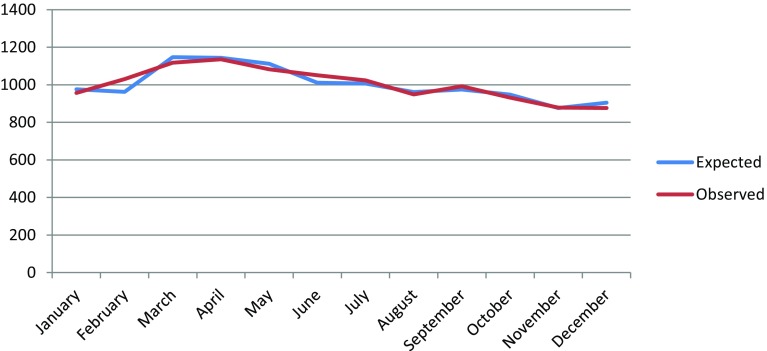
Previous studies have shown that the risk of multiple sclerosis (MS) is associated with season of birth with a higher proportion of MS patients being born in spring. However, this relationship has recently been questioned and may be due to confounding factors. Our aim was to assess the influence from season or month of birth on the risk of developing MS in Sweden and Iceland. Information about month of birth, gender, and phenotype of MS for patients born 1940-1996 was retrieved from the Swedish MS registry (SMSR), and their place of birth was retrieved from the Swedish Total Population Registry (TPR). The corresponding information was retrieved from medical journals of Icelandic MS patients born 1981-1996. The control groups consisted of every person born in Sweden 1940-1996, their gender and county of birth (TPR), and in Iceland all persons born between 1981 and 1996 and their gender (Statistics Iceland). We calculated the expected number of MS patients born during each season and in every month and compared it with the observed number. Adjustments were made for gender, birth year, and county of birth. We included 12,020 Swedish and 108 Icelandic MS patients in the analyses. There was no significant difference between expected and observed MS births related to season or month of birth in Sweden or Iceland. This was even the results before adjustments were made for birth year and birth place. No significant differences were found in subgroup analyses including data of latitude of birth, gender, clinical phenotype, and MS onset of 30 years or less. Our results do not support the previously reported association between season or month of birth and MS risk. Analysis of birth place and birth year as possible confounding factors showed no major influence of them on the seasonal MS risk in Sweden and Iceland.
先前的研究表明,多发性硬化症(MS)的发病风险与出生季节有关,较多的 MS 患者出生在春季。然而,这种关联最近受到了质疑,可能与混杂因素有关。我们的目的是评估在瑞典和冰岛出生季节或月份对 MS 发病风险的影响。从瑞典 MS 登记处(SMSR)获取了 1940 年至 1996 年出生的患者的出生月份、性别和 MS 表型信息,并从瑞典总人口登记处(TPR)获取了他们的出生地。从冰岛 1981 年至 1996 年出生的 MS 患者的医学期刊中获取了相应的信息。对照组由瑞典 1940 年至 1996 年出生的每个人组成,他们的性别和出生地县(TPR),以及冰岛所有在 1981 年至 1996 年之间出生的人及其性别(冰岛统计)。我们计算了每个季节和每个月出生的 MS 患者的预期数量,并将其与观察到的数量进行了比较。对性别、出生年份和出生地县进行了调整。我们对 12020 名瑞典 MS 患者和 108 名冰岛 MS 患者进行了分析。在瑞典或冰岛,出生季节或月份与 MS 出生之间没有显著差异。即使在没有对出生年份和出生地点进行调整之前,结果也是如此。在包括出生纬度、性别、临床表型和发病年龄在 30 岁或以下的亚组分析中,未发现显著差异。我们的结果不支持先前报告的出生季节或月份与 MS 风险之间的关联。对出生地和出生年份作为可能的混杂因素进行分析,结果表明,它们对瑞典和冰岛的季节性 MS 风险没有重大影响。