Lin Cheng-Tao, Chung Kuo-Fang
Department of Biological Resources, National Chiayi University, Chiayi, 60004, Taiwan.
Research Museum and Herbarium (HAST), Biodiversity Research Center, Academia Sinica, Taipei, 11529, Taiwan.
Bot Stud. 2017 Nov 21;58(1):52. doi: 10.1186/s40529-017-0206-6.
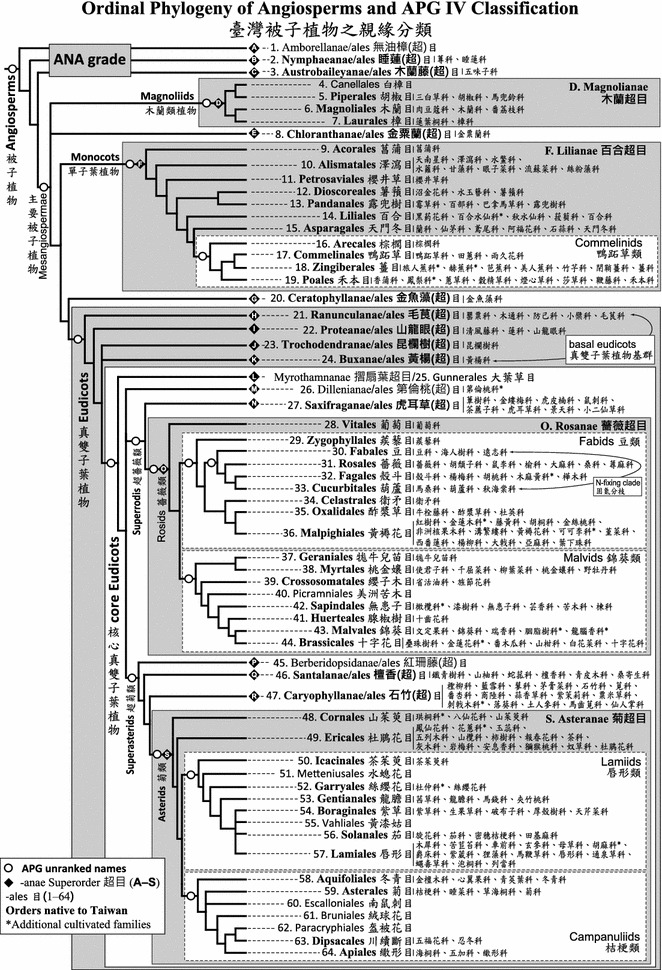
Biological classification, the hierarchical arrangement of scientific names of organisms, constitutes the core infrastructure of biological databases. For an efficient management of biological databases, adopting a stable and universal biological classification system is crucial. Currently in Taiwan Biodiversity Information Facility (TaiBIF; http://taibif.tw/ ), the national portal website that integrates Taiwan's biodiversity information databases, angiosperms are arranged according to Cronquist's System of Classification, which is not compatible with current trend of the Angiosperm Phylogeny Group (APG) classification. To consolidate the function and management of the database, TaiBIF is moving to adopt the APG IV classification and Christenhusz et al. (Phytotaxa 19:55-70, 2011)'s classification of gymnosperms, which we summarize as the Phylogenetic Classification of Seed Plants of Taiwan.
The Phylogenetic Classification of Seed Plants of Taiwan places gymnosperms in five families [vs. eight families in the Flora of Taiwan (FOT)] and angiosperms in 210 families (vs. 193 families in FOT). Three FOT gymnosperm families are synonymized in current treatment. Of the 210 APG IV families, familial circumscriptions of 114 families are identical with FOT and 50 families are recircumscription of FOT, with 46 families newly added. Of the 29 FOT families not included in current classification, two families are excluded and 27 families are synonymized.
The adoption of the Phylogenetic Classification of Seed Plants of Taiwan in TaiBIF will provide better service and efficient management of the nation's biodiversity information databases.
生物分类,即生物体科学名称的层次排列,构成了生物数据库的核心基础设施。为了高效管理生物数据库,采用稳定且通用的生物分类系统至关重要。目前在台湾生物多样性信息设施平台(TaiBIF;http://taibif.tw/ ),这个整合了台湾生物多样性信息数据库的国家门户网站中,被子植物是按照克朗奎斯特分类系统排列的,这与当前被子植物系统发育研究组(APG)的分类趋势不兼容。为了巩固数据库的功能和管理,TaiBIF正转而采用APG IV分类法以及克里斯滕胡斯等人(《植物分类群》19:55 - 70,2011)对裸子植物的分类,我们将其总结为台湾种子植物系统发育分类。
台湾种子植物系统发育分类将裸子植物置于5个科中(相比之下,《台湾植物志》中有8个科),将被子植物置于210个科中(相比之下,《台湾植物志》中有193个科)。在当前的分类处理中,《台湾植物志》中的3个裸子植物科被归为同义词。在APG IV的210个科中,114个科的科范围与《台湾植物志》相同,50个科是对《台湾植物志》的重新界定,新增了46个科。在当前分类中未包含的《台湾植物志》的29个科中,2个科被排除,27个科被归为同义词。
TaiBIF采用台湾种子植物系统发育分类将为国家生物多样性信息数据库提供更好的服务和高效管理。