Nakamura Shingo, Pourkheirandish Mohammad, Morishige Hiromi, Sameri Mohammad, Sato Kazuhiro, Komatsuda Takao
Institute of Crop Science, National Agriculture and Food Research Organization, Tsukuba, Japan.
Plant Breeding Institute, The University of Sydney, Sydney, NSW, Australia.
Front Plant Sci. 2017 Oct 30;8:1840. doi: 10.3389/fpls.2017.01840. eCollection 2017.
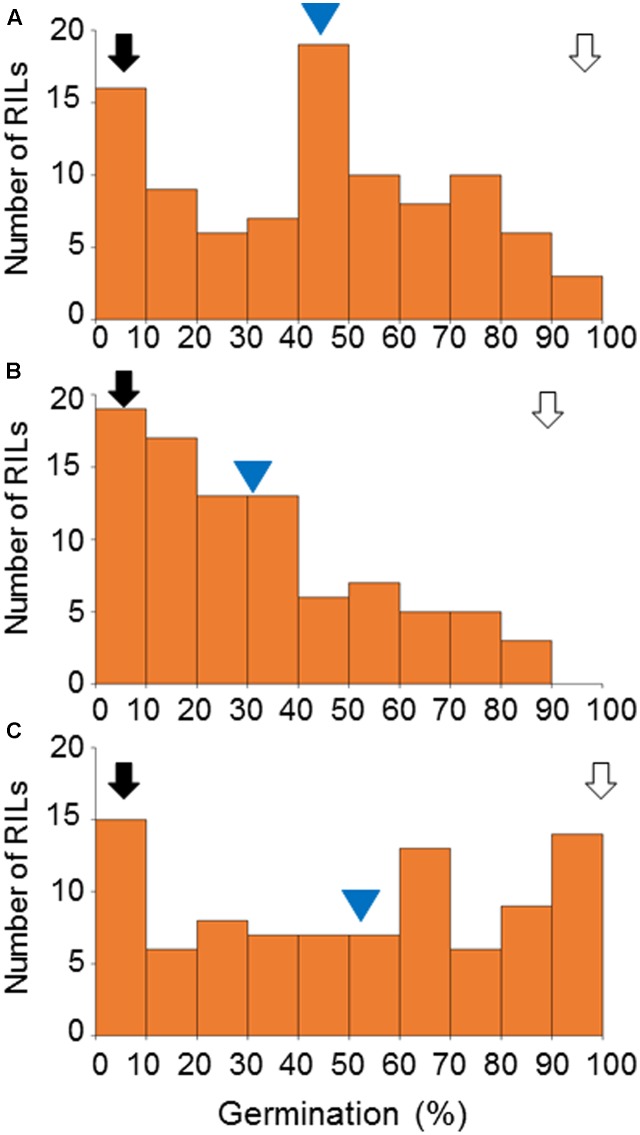
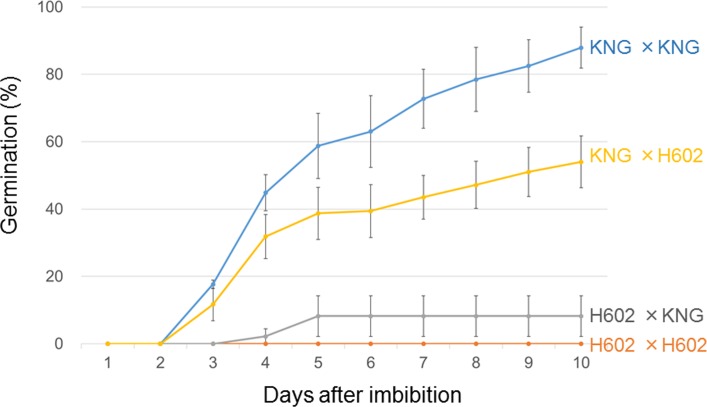
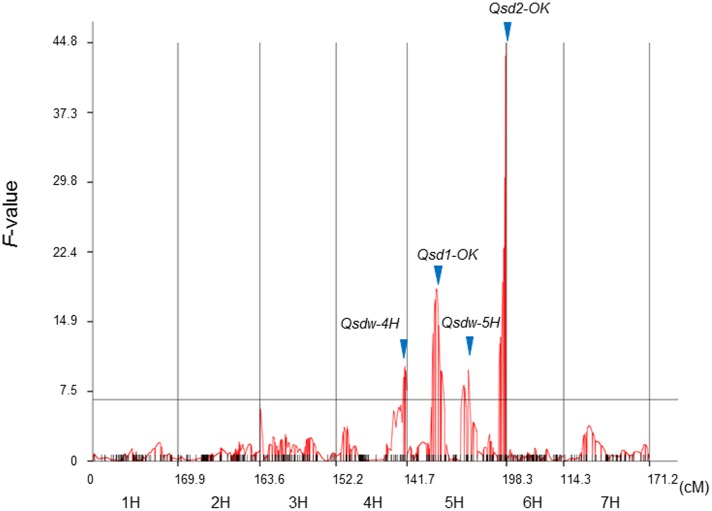
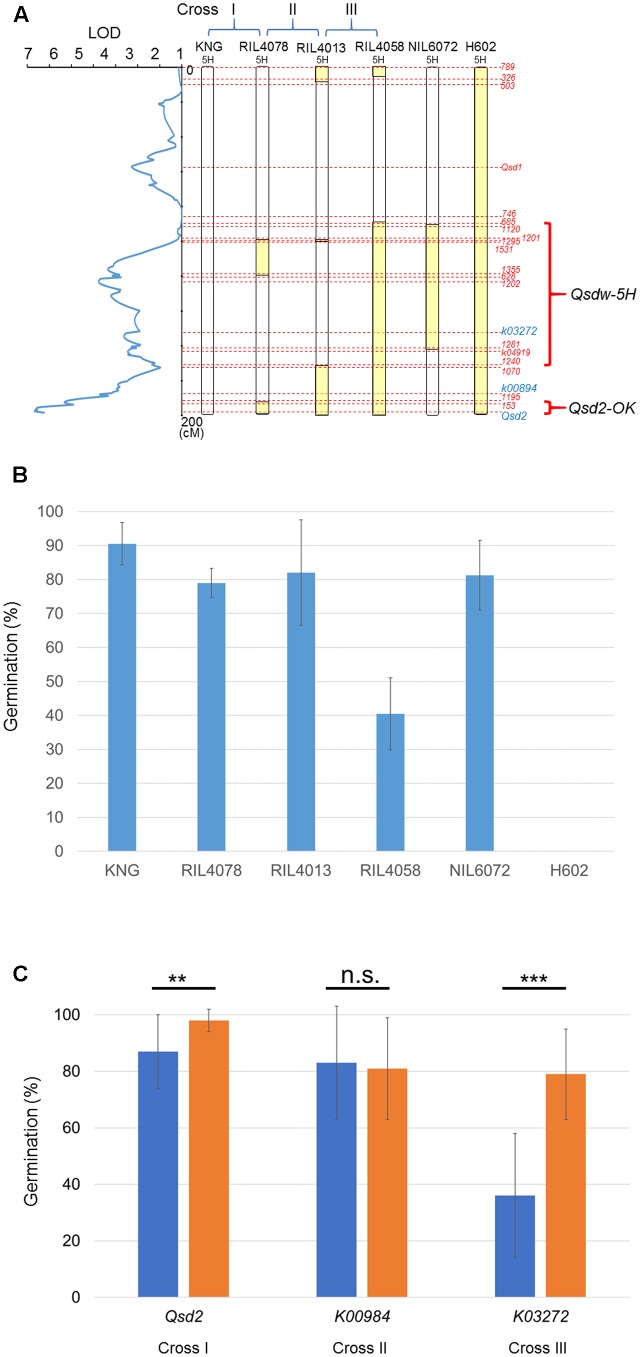
Wild barley ( ssp. ) has strong grain dormancy, a trait that may enhance its survival in non-cultivated environments; by contrast, cultivated barley ( ssp. ) has weaker dormancy, allowing uniform germination in cultivation. Malting barley cultivars have been bred for especially weak dormancy to optimize their use in malt production. Here, we analyzed the genetic mechanism of this difference in seed dormancy, using recombinant inbred lines (RILs) derived from a cross between the wild barley accession 'H602' and the malting barley cultivar 'Kanto Nakate Gold (KNG)'. Grains of H602 and KNG harvested at physiological maturity and dried at 30°C for 7 days had germination of approximately 0 and 100%, respectively. Analysis of quantitative trait loci (QTL) affecting grain dormancy identified the well-known major dormancy QTL and (located near the centromeric region and at the distal end of the long arm of chromosome 5H, respectively), and QTL at the end of the long arm of chromosome 4H and in the middle of the long arm of chromosome 5H. We designated these four QTL , , , and , and they explained approximately 6, 38, 3, and 13% of the total phenotypic variation, respectively. RILs carrying H602 alleles showed increased dormancy levels for all QTL. The QTL acted additively and did not show epistasis or QTL-environment interactions. Comparison of QTL locations indicated that all QTL except are likely the same as the QTL previously detected in the doubled haploid population from a cross between the malting cultivar 'Haruna Nijo' and 'H602.' We further examined and by analyzing the segregation of phenotypes and genotypes of F progenies derived from crosses between RILs carrying specific segments of chromosome 5H from H602 in the KNG background. This analysis confirmed that the two genomic regions corresponding to these QTL are involved in the regulation of grain dormancy. Germination tests of F grains derived from reciprocal crosses between H602 and KNG revealed that the H602 strong dormancy phenotype shows maternal inheritance with incomplete dominance. These results provide new insight into the mechanisms regulating grain dormancy in barley.
野生大麦(亚种)具有很强的种子休眠特性,这一特性可能会增强其在非栽培环境中的生存能力;相比之下,栽培大麦(亚种)的休眠特性较弱,以便在栽培过程中实现均匀发芽。用于制麦芽的大麦品种经过选育,其种子休眠特性特别弱,以优化它们在麦芽生产中的应用。在此,我们利用野生大麦种质‘H602’与制麦芽大麦品种‘关东中田黄金(KNG)’杂交产生的重组自交系(RIL),分析了种子休眠差异的遗传机制。生理成熟时收获的H602和KNG种子,在30°C下干燥7天,其发芽率分别约为0%和100%。对影响种子休眠的数量性状位点(QTL)进行分析,确定了两个著名的主要休眠QTL(分别位于5H染色体着丝粒区域附近和长臂末端),以及位于4H染色体长臂末端和5H染色体长臂中部的QTL。我们将这四个QTL分别命名为、、和,它们分别解释了约6%、38%、3%和13%的总表型变异。携带H602等位基因的RIL在所有QTL上均表现出更高的休眠水平。这些QTL表现为加性效应,未表现出上位性或QTL与环境的互作。QTL位置比较表明,除之外的所有QTL可能与之前在制麦芽品种‘春名二号’和‘H602’杂交产生的双单倍体群体中检测到的QTL相同。我们通过分析在KNG背景下携带来自H602的5H染色体特定片段的RIL之间杂交产生的F子代的表型和基因型分离情况,进一步研究了和。该分析证实,与这些QTL对应的两个基因组区域参与了种子休眠的调控。对H602和KNG正反交产生的F种子进行发芽试验,结果表明H602的强休眠表型表现为母性遗传且不完全显性。这些结果为大麦种子休眠调控机制提供了新的见解。