Lee Hyun-Ju, Kim Sung-Soo
Department of Health Administration, Jungwon University, Goesan, Korea.
Department of Healthcare Management, Cheongju University, Cheongju, Korea.
Osong Public Health Res Perspect. 2017 Oct;8(5):342-350. doi: 10.24171/j.phrp.2017.8.5.08. Epub 2017 Oct 31.
Cancer has attracted worldwide attention. The incidence and prevalence are increasing, and it is the main cause of death. The purpose of this study was to identify the characteristics of hospitalized cancer patients.
This study is a secondary data study using the Korean National Hospital Discharge In-depth Injury Survey Data conducted annually by the Korea Centers for Disease Control and Prevention. Using these data, we extracted inpatients who principal diagnosis is cancer for nine years from 2005 to 2013.
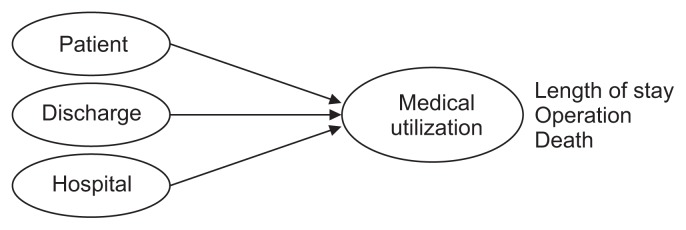
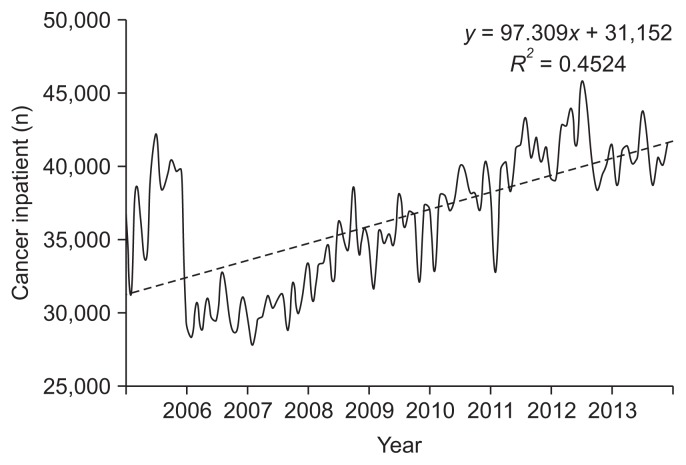
According to the analysis, the annual trend of cancer inpatients is steadily increasing. In 2025, it is expected to increase to about 670,000 inpatients. A cancer diagnosis created a change in medical utilization depending on the characteristics of patients and hospital. Men are more at risk of cancer than women. The number of hospital beds and hospital days were inversely proportional to cancer inpatients. There was also a difference in the equity of medical utilization by region. Other cancer management policies should be based on sex.
Populations between the ages of 45 and 64 years should be a priority in cancer policy. Because of the long-term hospitalization of patients with death as the outcome, a terminal cancer patient care facility is needed. These conclusions can provide a basis for various health policies.
癌症已引起全球关注。其发病率和患病率不断上升,是主要死因。本研究旨在确定住院癌症患者的特征。
本研究是一项二次数据研究,使用韩国疾病控制与预防中心每年开展的韩国全国医院出院深度伤害调查数据。利用这些数据,我们提取了2005年至2013年九年间主要诊断为癌症的住院患者。
分析显示,癌症住院患者的年度趋势呈稳步上升。预计到2025年,住院患者人数将增至约67万。癌症诊断会根据患者和医院的特征导致医疗利用情况发生变化。男性患癌症的风险高于女性。病床数量和住院天数与癌症住院患者呈负相关。不同地区在医疗利用公平性方面也存在差异。其他癌症管理政策应基于性别制定。
45至64岁人群应成为癌症政策的重点关注对象。鉴于以死亡为结局的患者长期住院情况,需要设立晚期癌症患者护理机构。这些结论可为各项卫生政策提供依据。