Movsas Tammy Z, Weiner Rebecca L, Greenberg M Banks, Holtzman David M, Galindo Rafael
Zietchick Research Institute, Plymouth, MI, United States.
Department of Pediatrics and Human Development, Michigan State University College of Human Medicine, East Lansing, MI, United States.
Front Pediatr. 2017 Nov 3;5:232. doi: 10.3389/fped.2017.00232. eCollection 2017.
Though the human fetus is exposed to placentally derived human chorionic gonadotropin (hCG) throughout gestation, the role of hCG on the fetal brain is unknown. Review of the available literature appears to indicate that groups of women with higher mean levels of hCG during pregnancy tend to have offspring with lower cerebral palsy (CP) risk. Given that newborn cerebral injury often precedes the development of CP, we aimed to determine whether hCG may protect against the neurodegenerative effects of neonatal brain injury.
We utilized the Rice-Vannucci model of neonatal cerebral hypoxia-ischemia (HI) in postnatal day 7 mice to examine whether intraperitoneal administration of hCG 15-18 h prior, 1 h after or immediately following HI decrease brain tissue loss 7 days after injury. We next studied whether hCG has pro-survival and trophic properties in neurons by exposing immature cortical and hippocampal neurons to hCG and examining neurite sprouting and neuronal survival prior and after glutamate receptor-mediated excitotoxic injury.
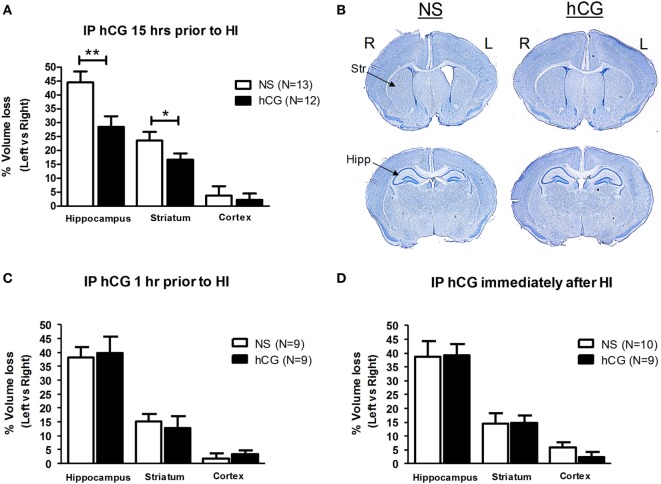
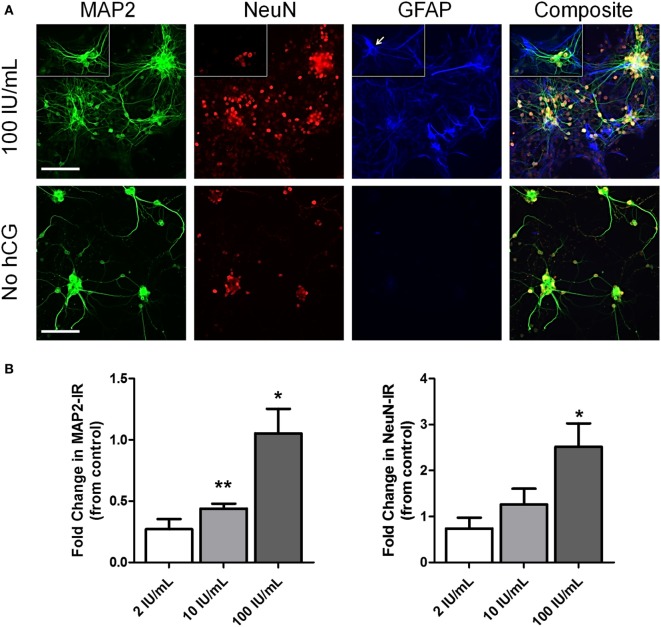
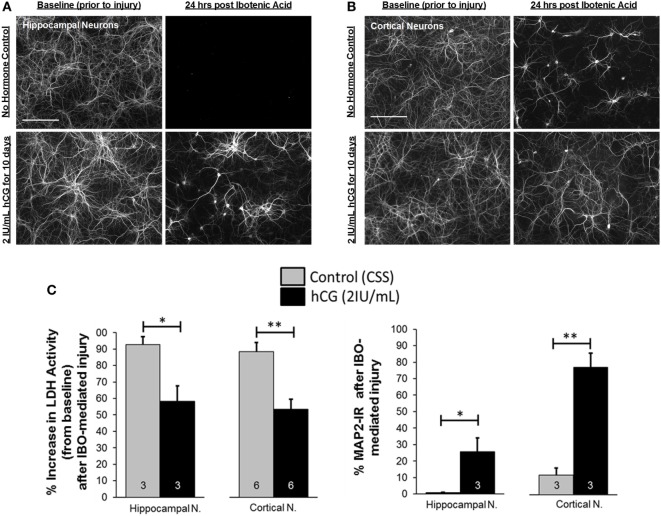
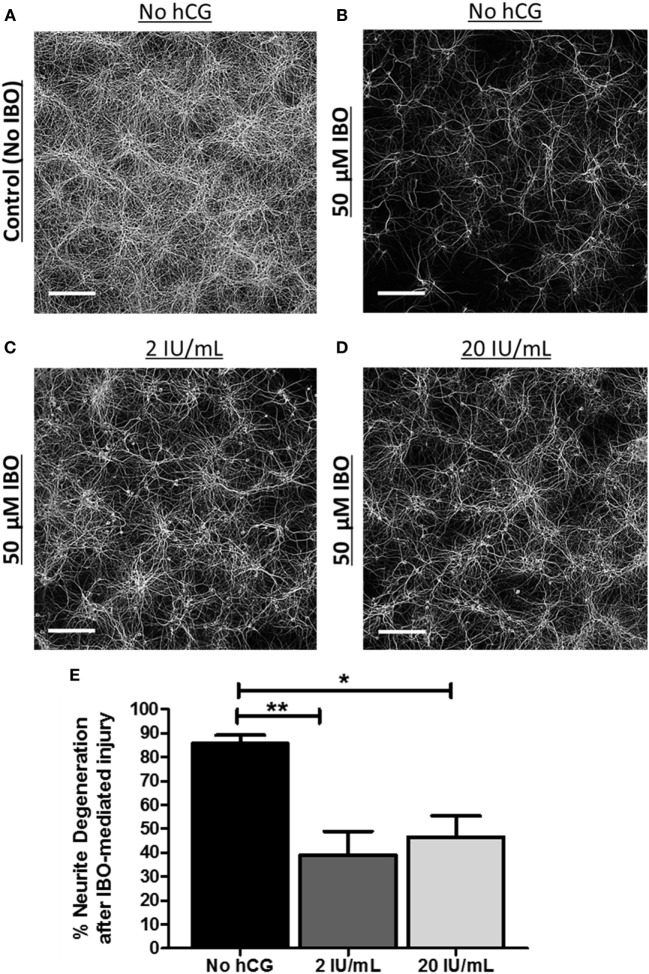
We found that intraperitoneal injection of hCG 15 h prior to HI, but not at or 1 h after HI induction, resulted in a significant decrease in hippocampal and striatal tissue loss 7 days following brain injury. Furthermore, hCG reduced -methyl-d-aspartate (NMDA)-mediated neuronal excitotoxicity when neurons were continuously exposed to this hormone for 10 days or when given at the time and following neuronal injury. In addition, continuous administration of hCG for 6-9 days increased neurite sprouting and basal neuronal survival as assessed by at least a 1-fold increase in MAP2 immunoreactivity and a 2.5-fold increase in NeuN + immunoreactivity.
Our findings suggest that hCG can decrease HI-associated immature neural degeneration. The mechanism of action for this neuroprotective effect may partly involve inhibition of NMDA-dependent excitotoxic injury. This study supports the hypothesis that hCG during pregnancy has the potential for protecting the developing brain against HI, an important CP risk factor.
尽管人类胎儿在整个妊娠期都暴露于胎盘来源的人绒毛膜促性腺激素(hCG)中,但hCG对胎儿大脑的作用尚不清楚。对现有文献的回顾似乎表明,孕期平均hCG水平较高的女性群体,其后代患脑瘫(CP)的风险较低。鉴于新生儿脑损伤往往先于CP的发生,我们旨在确定hCG是否可以预防新生儿脑损伤的神经退行性影响。
我们利用出生后第7天小鼠的新生儿脑缺氧缺血(HI)的赖斯-万努奇模型,来研究在HI前15 - 18小时、HI后1小时或HI后立即腹腔注射hCG,是否能减少损伤7天后的脑组织损失。接下来,我们通过将未成熟的皮质和海马神经元暴露于hCG,并在谷氨酸受体介导的兴奋性毒性损伤前后检查神经突萌发和神经元存活情况,研究hCG在神经元中是否具有促存活和营养特性。
我们发现,在HI前15小时腹腔注射hCG,而不是在HI诱导时或HI后1小时注射,可导致脑损伤7天后海马和纹状体组织损失显著减少。此外,当神经元连续10天暴露于该激素时,或在神经元损伤时及损伤后给予hCG,hCG可降低N-甲基-D-天冬氨酸(NMDA)介导的神经元兴奋性毒性。另外,连续6 - 9天给予hCG可增加神经突萌发和基础神经元存活,这通过微管相关蛋白2(MAP2)免疫反应性至少增加1倍和神经元核抗原(NeuN)+免疫反应性增加2.5倍来评估。
我们的研究结果表明,hCG可以减少HI相关的未成熟神经变性。这种神经保护作用的作用机制可能部分涉及抑制NMDA依赖性兴奋性毒性损伤。本研究支持这样的假设,即孕期hCG有可能保护发育中的大脑免受HI影响,HI是CP的一个重要风险因素。