Choi Bo Ram, Kim Hye Kyung, Park Jong Kwan
Department of Urology, Research Institute of Clinical Medicine, Biomedical Research Institute, and Clinical Trial Center of Medical Device, Chonbuk National University Medical School, Jeonju, Korea.
College of Pharmacy, Kyungsung University, Busan, Korea.
World J Mens Health. 2017 Dec;35(3):196-204. doi: 10.5534/wjmh.17023. Epub 2017 Nov 21.
The objective of this study was to evaluate the relaxant effect of scoparone from Artemisia capillaris on rabbit penile corpus cavernosum smooth muscle (PCCSM) and to elucidate the mechanism of action of scoparone for the treatment of erectile dysfunction (ED).
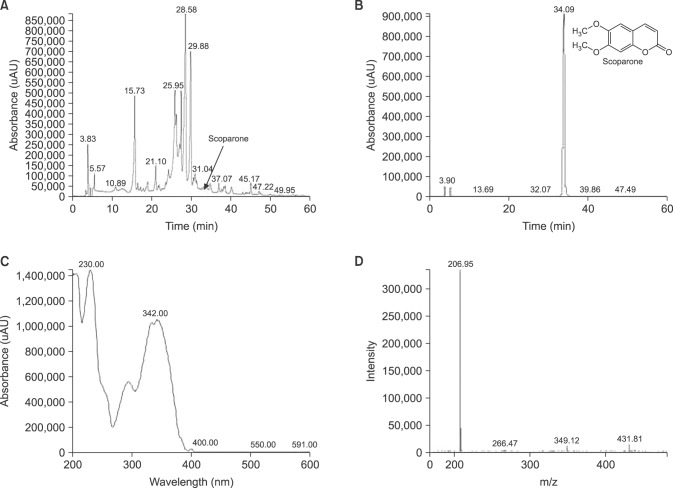
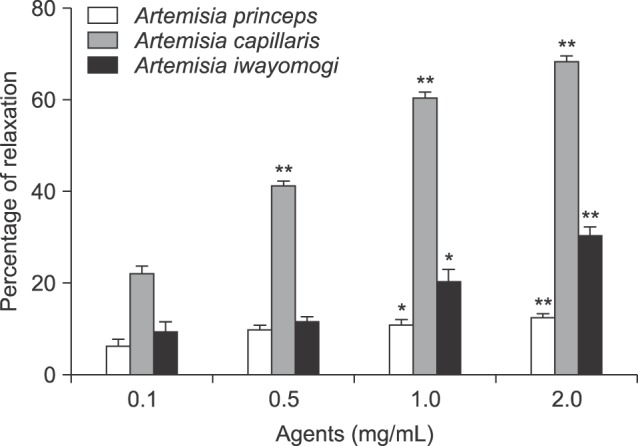
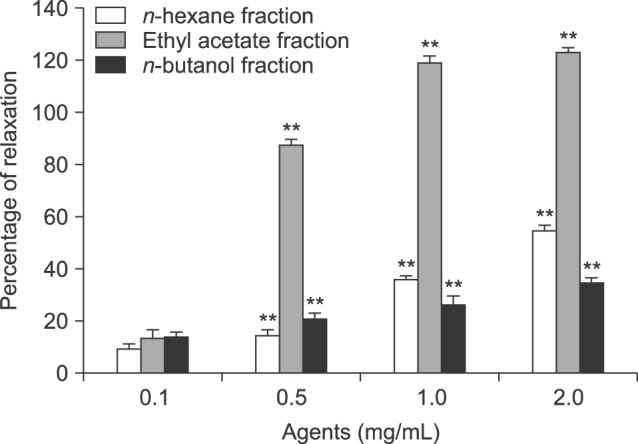
PCCSM that had been precontracted with phenylephrine was treated with 3 Artemisia herbs (A. princeps, A. capillaris, and A. iwayomogi) and 3 fractions (n-hexane, ethyl acetate, and n-butanol) with different concentrations (0.1, 0.5, 1.0, and 2.0 mg/mL). Four components (esculetin, scopoletin, capillarisin, and scoparone) isolated from A. capillaris were also evaluated. The PCCSM was preincubated with Nω-nitro-L-arginine methyl ester hydrochloride (L-NAME) and 1H-[1,2,4] oxadiazolo [4,3-a]quinoxalin-1-one (ODQ). Cyclic nucleotides in the perfusate were measured by a radioimmunoassay. The interactions of scoparone with udenafil and rolipram were also evaluated.
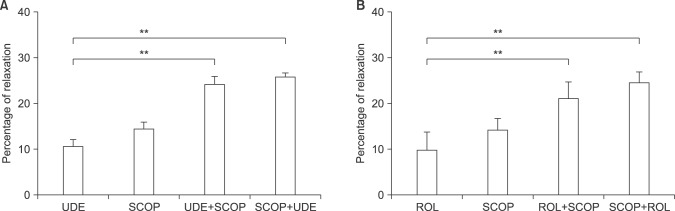
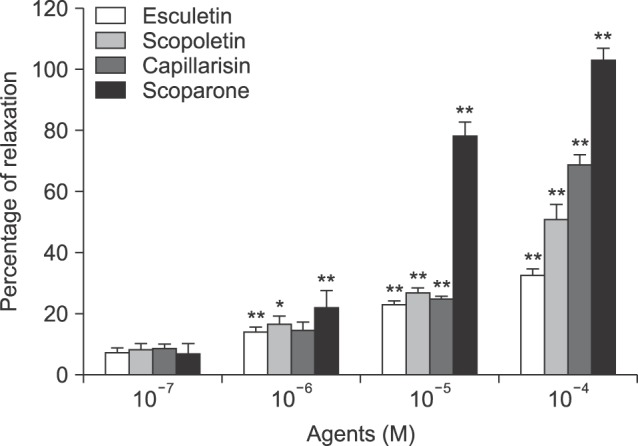
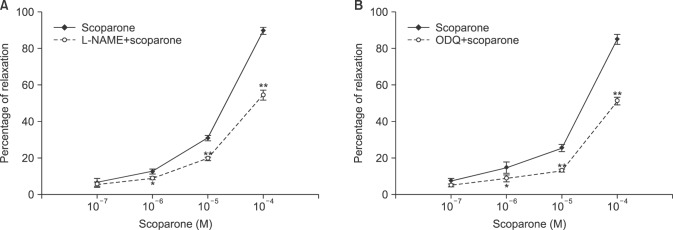
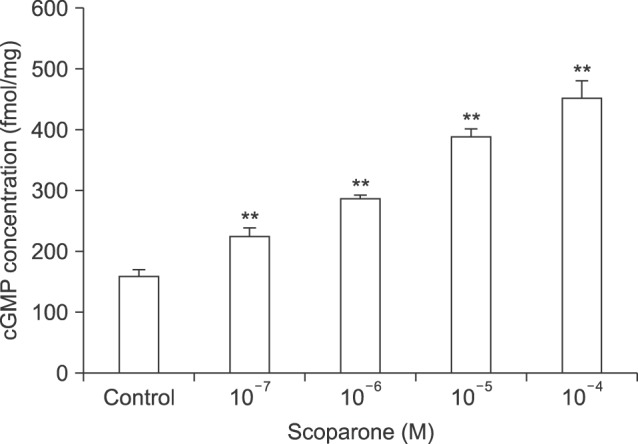
A. capillaris extract relaxed PCCSM in a concentration-dependent manner. Scoparone had the highest relaxant effect on PCCSM among the 4 components (esculetin, scopoletin, capillarisin, and scoparone) isolated from the ethyl acetate fraction. The application of scoparone on PCCSM pretreated with L-NAME and ODQ led to significantly less relaxation. Scoparone also increased the cyclic guanosine monophosphate (cGMP) levels in the perfusate in a concentration-dependent manner. Furthermore, scoparone enhanced udenafil- and rolipram-induced relaxation of the PCCSM.
Scoparone relaxed the PCCSM mainly by activating the nitric oxide-cGMP signaling pathway, and it may be a new promising treatment for ED patients who do not completely respond to udenafil.
本研究旨在评估茵陈蒿中滨蒿内酯对兔阴茎海绵体平滑肌(PCCSM)的舒张作用,并阐明滨蒿内酯治疗勃起功能障碍(ED)的作用机制。
用去氧肾上腺素预收缩的PCCSM分别用3种茵陈属草药(魁蒿、茵陈蒿和湿地蒿)及3种不同浓度(0.1、0.5、1.0和2.0mg/mL)的馏分(正己烷、乙酸乙酯和正丁醇)进行处理。还对从茵陈蒿中分离出的4种成分(秦皮乙素、滨蒿素、茵陈色原酮和滨蒿内酯)进行了评估。PCCSM先用盐酸Nω-硝基-L-精氨酸甲酯(L-NAME)和1H-[1,2,4]恶二唑并[4,3-a]喹喔啉-1-酮(ODQ)预孵育。通过放射免疫分析法测定灌流液中的环核苷酸。还评估了滨蒿内酯与伐地那非和咯利普兰的相互作用。
茵陈蒿提取物以浓度依赖性方式舒张PCCSM。在从乙酸乙酯馏分中分离出的4种成分(秦皮乙素、滨蒿素、茵陈色原酮和滨蒿内酯)中,滨蒿内酯对PCCSM的舒张作用最强。将滨蒿内酯应用于用L-NAME和ODQ预处理的PCCSM时,舒张作用明显减弱。滨蒿内酯还以浓度依赖性方式提高灌流液中环鸟苷单磷酸(cGMP)水平。此外,滨蒿内酯增强了伐地那非和咯利普兰诱导的PCCSM舒张作用。
滨蒿内酯主要通过激活一氧化氮-cGMP信号通路舒张PCCSM,对于对伐地那非治疗不完全反应的ED患者可能是一种有前景的新治疗方法。