Boccolini Cristiano Siqueira, Boccolini Patricia de Moraes Mello, Monteiro Fernanda Ramos, Venâncio Sonia Isoyama, Giugliani Elsa Regina Justo
Laboratório de Informações em Saúde. Instituto de Comunicação e Informação Científica e Tecnologia em Saúde. Fundação Oswaldo Cruz. Rio de Janeiro, RJ, Brasil.
Faculdade de Medicina de Petrópolis. Faculdade Arthur Sá Earp Neto. Petropolis, RJ, Brasil.
Rev Saude Publica. 2017;51:108. doi: 10.11606/S1518-8787.2017051000029. Epub 2017 Nov 17.
Update breastfeeding indicators trend in Brazil for the last three decades, incorporating more up-to-date information from the National Health Survey.
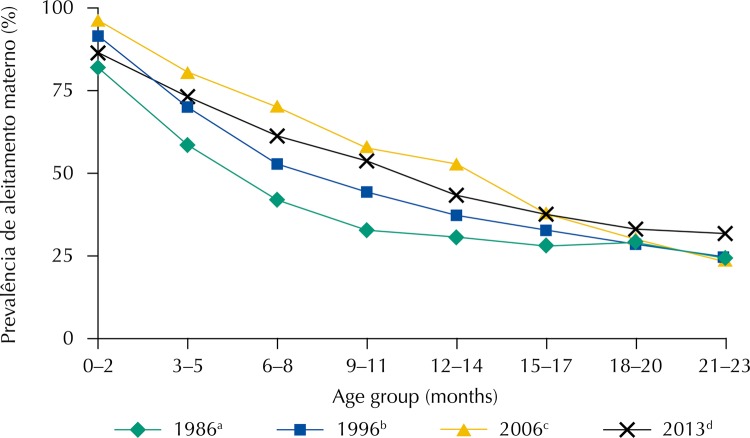
We used secondary data from national surveys with information on breastfeeding (1986, 1996, 2006, and 2013) to construct the time series of prevalence for the following indicators: exclusive breastfeeding in children under six months of age (EBF6m), breastfeeding in toddlers under 2 years of age (BF), continued breastfeeding at one year of age (BF1year), and continued breastfeeding at two years of age (BF2years).
The prevalence of EBF6m, BF, and BF1year increased until 2006 (rising from 4.7%, 37.4%, and 25.5% in 1986 to 37.1%, 56.3%, and 47.2% in 2006, respectively). For these three indicators, there was relative stabilization between 2006 and 2013 (36.6%, 52.1%, and 45.4%, respectively). The BF2years indicator had a distinct behavior - relatively stable prevalence, around 25% between 1986 and 2006, and a subsequent increase, reaching 31.8% in 2013.
The time series of breastfeeding indicators in Brazil shows an upward trend until 2006, stabilizing from that date onwards on three of the four indicators evaluated. This result, which can be considered as a warning sign, requires evaluation and revision of policies and programs to promote, protect and support breastfeeding, strengthening existing ones and proposing new strategies so that the prevalence of breastfeeding indicators returns to an upwards trend.
更新巴西过去三十年的母乳喂养指标趋势,纳入来自全国健康调查的更多最新信息。
我们使用了全国调查的二手数据,这些数据包含母乳喂养信息(1986年、1996年、2006年和2013年),以构建以下指标患病率的时间序列:六个月以下儿童纯母乳喂养(EBF6m)、两岁以下幼儿母乳喂养(BF)、一岁时持续母乳喂养(BF1year)以及两岁时持续母乳喂养(BF2years)。
EBF6m、BF和BF1year的患病率在2006年之前有所上升(分别从1986年的4.7%、37.4%和25.5%升至2006年的37.1%、56.3%和47.2%)。对于这三个指标,2006年至2013年期间相对稳定(分别为36.6%、52.1%和45.4%)。BF2years指标表现不同——患病率相对稳定,1986年至2006年期间约为25%,随后有所上升,2013年达到31.8%。
巴西母乳喂养指标的时间序列显示,到2006年呈上升趋势,从该日期起,在所评估的四个指标中的三个上趋于稳定。这一结果可被视为一个警示信号,需要对促进、保护和支持母乳喂养的政策和项目进行评估和修订,加强现有政策和项目并提出新策略,以使母乳喂养指标的患病率恢复上升趋势。