Alfawaz Hanan, Khan Nasiruddin, Alfaifi Aziza, Shahrani Fatima M, Al Tameem Huda M, Al Otaibi Seetah F, Abudigin Weaam I, Al-Shayaa Mohammad S, Al-Ghanim Saad A, Al-Daghri Nasser M
College of Food Science & Agriculture, Department of Food Science & Nutrition, King Saud University, Riyadh, Saudi Arabia.
Prince Mutaib Chair for Biomarkers of Osteoporosis, Biochemistry Department, King Saud University, Riyadh, 11451, Saudi Arabia.
BMC Womens Health. 2017 Nov 22;17(1):116. doi: 10.1186/s12905-017-0475-y.
The economic boom in Saudi Arabia indirectly prompted the use of dietary supplements in the last two decades. Our aim is to investigate the prevalence of dietary supplement use and its association with sociodemographic/lifestyle characteristics among Saudi female students.
In this cross-sectional study, 534 female participants (≥19 years of age) completed a self-administered questionnaire that include sociodemographic and lifestyle characteristics, perceived health status, dietary supplement use, general awareness, attitudes and behavior.
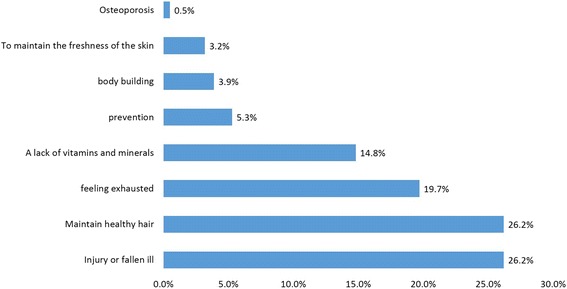
In all participants, the prevalence of dietary supplement use was 76.6% (n = 409). High level of education (p = 0.002) and more physical activity (p = 0.008) exhibited a significant positive association with users than to non-users. The frequency showed that beta-carotene (54.2%), chamomile (54.2%), and glucosamine (53.8%) were the most preferred diet supplements under the category "when needed". Cod liver oil (71.3%), omega 3 (68.3%), multi-vitamins (61.5%), ginseng (60%), and vitamin A (60%), were mostly used "from time to time". Multi-minerals (34.4%) were the preferred choice when it comes to daily use. The main reasons for supplement use were to "maintain healthy hair" and "injury and illness" (both 26.2%). About 38.4% were not aware and 30.3% disagree on differences taking supplements with or without consulting a medical professional. About 36.7% lack information about side effects while, 35.0% were unaware about any health effect of dietary supplements.
The prevalence of dietary supplement use was high in Saudi female students and was significantly associated with sociodemographic and lifestyle factors.
沙特阿拉伯的经济繁荣在过去二十年中间接促使了膳食补充剂的使用。我们的目的是调查沙特女学生中膳食补充剂的使用 prevalence 及其与社会人口统计学/生活方式特征的关联。
在这项横断面研究中,534 名年龄≥19 岁的女性参与者完成了一份自我管理的问卷,该问卷包括社会人口统计学和生活方式特征、感知健康状况、膳食补充剂使用情况、一般认知、态度和行为。
在所有参与者中,膳食补充剂的使用 prevalence 为 76.6%(n = 409)。与非使用者相比,高学历(p = 0.002)和更多的体育活动(p = 0.008)与使用者呈现出显著的正相关。频率显示,在“需要时”类别下,β-胡萝卜素(54.2%)、洋甘菊(54.2%)和氨基葡萄糖(53.8%)是最受欢迎的膳食补充剂。鳕鱼肝油(71.3%)、ω-3(68.3%)、多种维生素(61.5%)、人参(60%)和维生素 A(60%)大多“偶尔”使用。在每日使用方面,多种矿物质(34.4%)是首选。使用补充剂的主要原因是“保持头发健康”和“受伤与疾病”(均为 26.2%)。约 38.4%的人不知道,30.3%的人不同意在服用补充剂时是否咨询医疗专业人员存在差异。约 36.7%的人缺乏关于副作用的信息,而 35.0%的人不知道膳食补充剂的任何健康影响。
沙特女学生中膳食补充剂的使用 prevalence 很高,且与社会人口统计学和生活方式因素显著相关。