Department of Medicine, the Graduate School of Yonsei University, 50 Yonsei-ro, 03722, Seodaemun-gu, Seoul, South Korea.
Department of Preventive Medicine, Yonsei University College of Medicine, 50-1 Yonsei-ro, 03722, Seodaemun-gu, Seoul, South Korea.
Lipids Health Dis. 2017 Nov 22;16(1):221. doi: 10.1186/s12944-017-0615-2.
Several studies have examined tracking pattern of blood lipids level during long follow-up periods in Western countries. However, there have been few such studies in Asian populations.
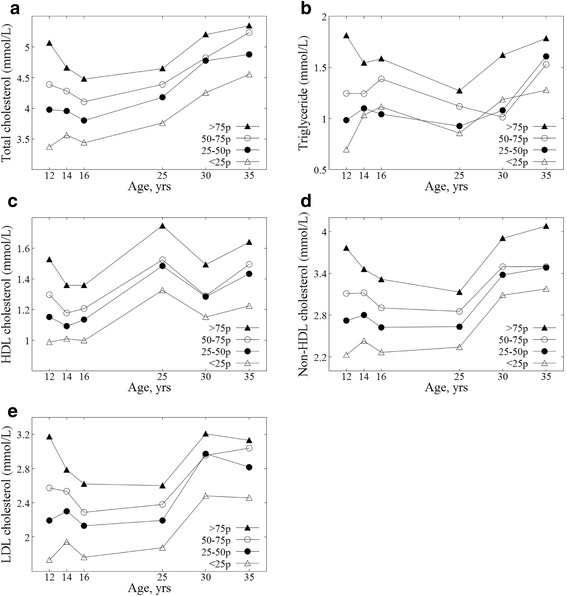
The Kangwha Study is a community-based prospective cohort study that started in 1986 on Kangwha Island, South Korea. A total of 432 participants (47% men) were enrolled in the study, during which serum total cholesterol, triglycerides, and high-density lipoprotein (HDL) cholesterol levels were measured for each participant at least once during adolescence (12-16 years of age) and again at least once during adulthood (25-35 years of age). The tracking patterns of the blood lipid levels were determined using Spearman correlation coefficients and tracking coefficients from generalized estimating equations.
The Spearman correlation coefficients between lipid measurements ranged from 0.12 to 0.73 depending on the lipid profile and measurement time interval; all were significant (p < 0.05). The magnitude of the coefficients tended to decrease as the time interval increased. When adjusted for age, sex, body mass index, and blood pressure, the tracking coefficients were 0.58 (95% confidence interval [CI]: 0.54-0.63) for total cholesterol, 0.39 (95% CI: 0.31-0.48) for triglycerides, and 0.51 (95% CI: 0.47-0.56) for HDL cholesterol. In a subgroup analysis by sex, the tracking coefficients were higher for women than for men, except for HDL cholesterol.
The tracking patterns of blood lipids from adolescence to adulthood were notable. This study supports the importance of measuring lipids during adolescence for identifying high-risk individuals.
已有几项研究在西方国家对血脂水平的长期随访过程中的跟踪模式进行了检查。然而,在亚洲人群中,这样的研究很少。
康华研究是一项基于社区的前瞻性队列研究,于 1986 年在韩国康华岛启动。共有 432 名参与者(47%为男性)参与了该研究,在研究期间,对每个参与者进行了至少一次青少年(12-16 岁)和至少一次成年期(25-35 岁)的血清总胆固醇、甘油三酯和高密度脂蛋白(HDL)胆固醇水平测量。使用 Spearman 相关系数和广义估计方程的跟踪系数来确定血脂水平的跟踪模式。
根据血脂谱和测量时间间隔,脂质测量之间的 Spearman 相关系数范围为 0.12 至 0.73;所有均具有统计学意义(p<0.05)。随着时间间隔的增加,系数的大小趋于减小。在校正年龄、性别、体重指数和血压后,总胆固醇的跟踪系数为 0.58(95%置信区间[CI]:0.54-0.63),甘油三酯为 0.39(95% CI:0.31-0.48),HDL 胆固醇为 0.51(95% CI:0.47-0.56)。按性别进行亚组分析时,女性的跟踪系数高于男性,除了 HDL 胆固醇。
从青春期到成年期的血脂跟踪模式明显。这项研究支持在青春期测量血脂对于识别高危个体的重要性。