McConnell Hannah, White Rachel, Maher Jane
Macmillan Cancer Support, London, UK.
Mount Vernon Cancer Centre, Northwood, Middlesex, UK.
BMJ Open. 2017 Nov 22;7(11):e016797. doi: 10.1136/bmjopen-2017-016797.
The aim of this study is to categorise cancers into broad groups based on clusters of common treatment aims, experiences and outcomes to provide a numerical framework for understanding the services required to meet the needs of people with different cancers. This framework will enable a high-level overview of care and support requirements for the whole cancer population.
People in the UK with 1 of 20 common cancers; an estimated 309 000 diagnoses in 2014, 1 679 000 people diagnosed in a 20-year period and still living in 2010 and 135 000 cancer deaths in 2014.
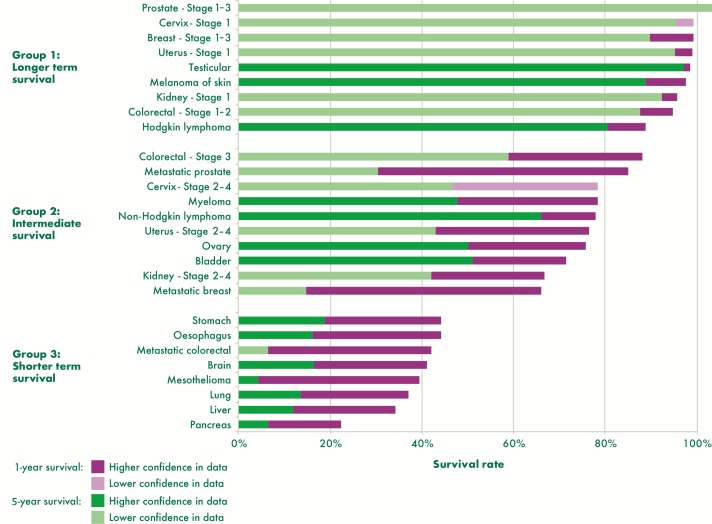
Survival and stage at diagnosis data were reviewed alongside clinically led assumptions to identify commonalities and cluster cancer types into three groups. The three cancer groups were then described using incidence, prevalence and mortality data collected and reported by UK cancer registries. This was then reviewed, validated and refined following consultation.
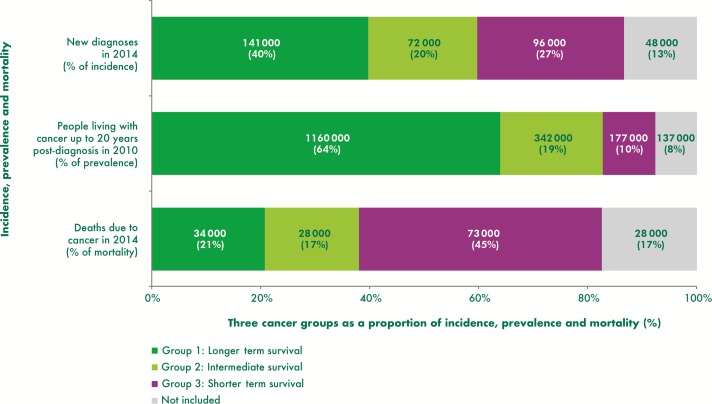
Group 1 includes cancers with the highest survival; 5-year survival is over 80%. Group 3 cancers have shorter term survival. Five-year survival is not >20% for any cancer in this group and many do not survive over a year. Group 2 includes cancers where people typically live more than a year but are less likely to live >5 years. We estimate that the majority (64%) of people living with cancer (20 year prevalence) have a cancer type in group 1 'longer term survival', but significant minorities of people have cancers in group 2 'intermediate survival' (19%) and group 3 'shorter term survival' (10%).
Every person with cancer has unique needs shaped by a multitude of factors including comorbidities, treatment regimens, patient preferences, needs, attitudes and behaviours. However, to deliver personalised care, there needs to be a high-level view of potential care requirements to support service planning.
本研究的目的是根据常见治疗目标、经历和结果的聚类,将癌症分为宽泛的类别,以提供一个数字框架,用于理解满足不同癌症患者需求所需的服务。该框架将能对整个癌症群体的护理和支持需求进行高层次概述。
英国患有20种常见癌症之一的人群;2014年估计有30.9万例诊断病例,20年期间有167.9万人被诊断出患有癌症且在2010年仍存活,2014年有13.5万例癌症死亡病例。
对诊断时的生存情况和分期数据进行了审查,并结合临床主导的假设,以识别共性并将癌症类型聚类为三组。然后使用英国癌症登记处收集和报告的发病率、患病率和死亡率数据对这三组癌症进行描述。之后在咨询后对其进行审查、验证和完善。
第1组包括生存率最高的癌症;5年生存率超过80%。第3组癌症的短期生存率较低。该组中任何一种癌症的5年生存率均不超过20%,许多患者存活时间不超过一年。第2组包括患者通常能存活一年以上但存活超过5年可能性较小的癌症。我们估计,大多数(64%)癌症患者(20年患病率)患有第1组“长期生存”类型的癌症,但也有相当一部分患者患有第2组“中期生存”(19%)和第3组“短期生存”(10%)类型的癌症。
每一位癌症患者都有由多种因素塑造的独特需求,这些因素包括合并症、治疗方案、患者偏好、需求、态度和行为。然而,要提供个性化护理,需要对潜在护理需求有一个高层次的认识,以支持服务规划。