Christoforou Marina, Sáez Fonseca José Andrés, Tsakanikos Elias
Division of Psychiatry, University College London, London, United Kingdom.
Department of Psychology, University of Roehampton, London, United Kingdom.
J Med Internet Res. 2017 Nov 24;19(11):e398. doi: 10.2196/jmir.7747.
Despite the large body of literature demonstrating the effectiveness of cognitive behavioral treatments for agoraphobia, many patients remain untreated because of various barriers to treatment. Web-based and mobile-based interventions targeting agoraphobia may provide a solution to this problem, but there is a lack of research investigating the efficacy of such interventions.
The objective of our study was to evaluate for the first time the effectiveness of a self-guided mobile-based intervention primarily targeting agoraphobic symptoms, with respect to a generic mobile app targeting anxiety.
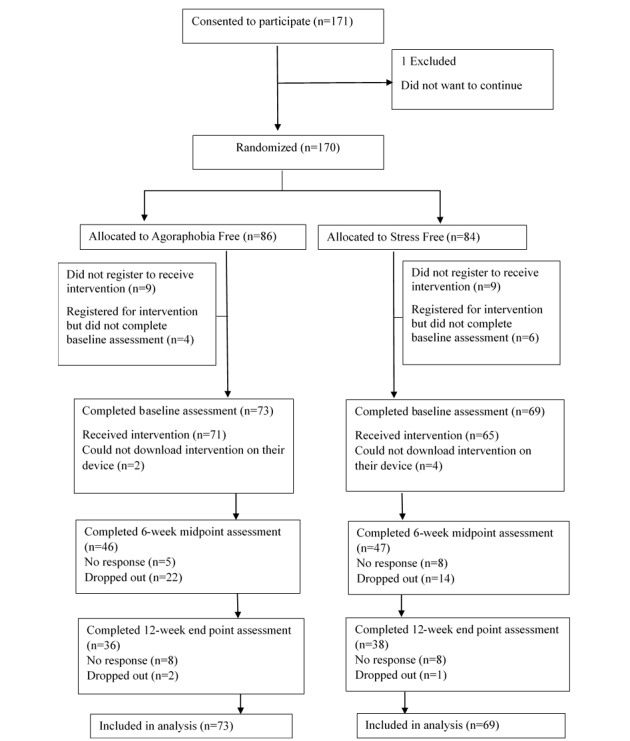
A Web-based randomized controlled trial (RCT) compared a novel mobile app designed to target agoraphobia (called Agoraphobia Free) with a mobile app designed to help with symptoms of anxiety in general (called Stress Free). Both interventions were based on established cognitive behavioral principles. We recruited participants (N=170) who self-identified as having agoraphobia and assessed them online at baseline, midpoint, and end point (posttreatment) over a period of 12 weeks. The primary outcome was symptom severity measured by the Panic and Agoraphobia Scale.
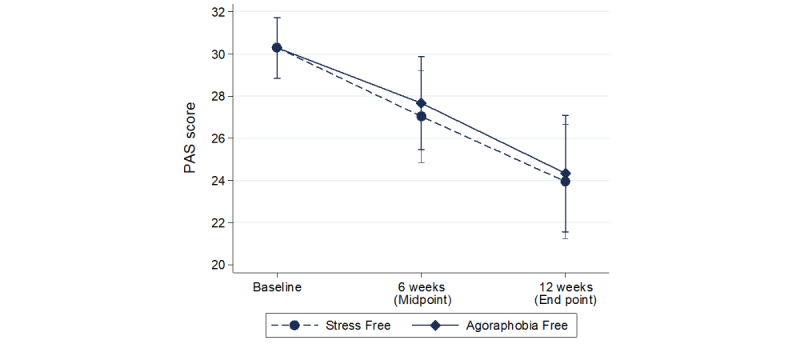
Both groups had statistically significant improvements in symptom severity over time (difference -5.97, 95% CI -8.49 to -3.44, P<.001 for Agoraphobia Free and -6.35, 95% CI -8.82 to -3.87, P<.001 for Stress Free), but there were no significant between-group differences on the primary outcome (difference 0.38, 95% CI -1.96 to 3.20, P=.64).
This is, to our knowledge, the first RCT to provide evidence that people who identify as having agoraphobia may equally benefit from a diagnosis-specific and a transdiagnostic mobile-based intervention. We also discuss clinical and research implications for the development and dissemination of mobile mental health apps.
International Standard Randomized Controlled Trial Number (ISRCTN): 98453199; http://www.isrctn.com /ISRCTN98453199 (Archived by WebCite at http://www.webcitation.org/6uR5vsdZw).
尽管大量文献表明认知行为疗法对广场恐惧症有效,但由于各种治疗障碍,许多患者仍未得到治疗。针对广场恐惧症的基于网络和移动设备的干预措施可能为解决这一问题提供方案,但缺乏对这类干预措施疗效的研究。
我们研究的目的是首次评估一种主要针对广场恐怖症状的自助式移动干预措施相对于一款针对焦虑症的通用移动应用程序的有效性。
一项基于网络的随机对照试验(RCT)将一款专门针对广场恐惧症设计的新型移动应用程序(名为“摆脱广场恐惧症”)与一款旨在帮助缓解一般焦虑症状的移动应用程序(名为“摆脱压力”)进行了比较。两种干预措施均基于既定的认知行为原则。我们招募了自我认定患有广场恐惧症的参与者(N = 170),并在12周的时间内,于基线、中点和终点(治疗后)对他们进行在线评估。主要结局指标是通过惊恐和广场恐惧症量表测量的症状严重程度。
随着时间的推移,两组的症状严重程度均有统计学意义上的显著改善(“摆脱广场恐惧症”组差异为-5.97,95%置信区间为-8.49至-3.44,P <.001;“摆脱压力”组差异为-6.35,95%置信区间为-8.82至-3.87,P <.001),但在主要结局指标上两组之间没有显著差异(差异为0.38,95%置信区间为-1.96至3.20,P =.64)。
据我们所知,这是第一项提供证据表明自我认定患有广场恐惧症的人可能同样受益于针对特定诊断和跨诊断的基于移动设备的干预措施的随机对照试验。我们还讨论了移动心理健康应用程序开发和传播的临床及研究意义。
国际标准随机对照试验编号(ISRCTN):98453199;http://www.isrctn.com /ISRCTN98453199(由WebCite存档于http://www.webcitation.org/6uR5vsdZw)