Pflugfelder Daniel, Metzner Ralf, van Dusschoten Dagmar, Reichel Rüdiger, Jahnke Siegfried, Koller Robert
Institute of Bio- and Geosciences, IBG-2: Plant Sciences, Forschungszentrum Jülich GmbH, Wilhelm-Johnen- Str., 52425 Jülich, Germany.
Institute of Bio- and Geosciences, IBG-3: Agrosphere, Forschungszentrum Jülich GmbH, Wilhelm-Johnen- Str., 52425 Jülich, Germany.
Plant Methods. 2017 Nov 17;13:102. doi: 10.1186/s13007-017-0252-9. eCollection 2017.
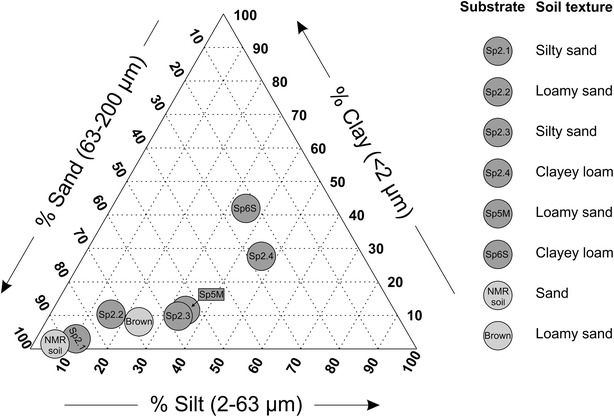
Root systems are highly plastic and adapt according to their soil environment. Studying the particular influence of soils on root development necessitates the adaptation and evaluation of imaging methods for multiple substrates. Non-invasive 3D root images in soil can be obtained using magnetic resonance imaging (MRI). Not all substrates, however, are suitable for MRI. Using barley as a model plant we investigated the achievable image quality and the suitability for root phenotyping of six commercially available natural soil substrates of commonly occurring soil textures. The results are compared with two artificially composed substrates previously documented for MRI root imaging.
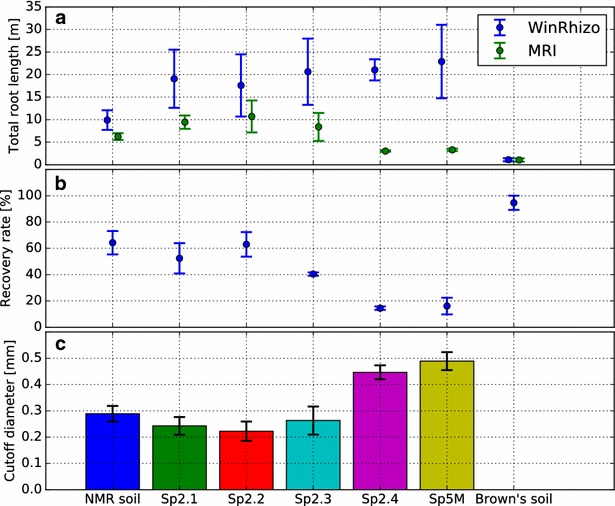
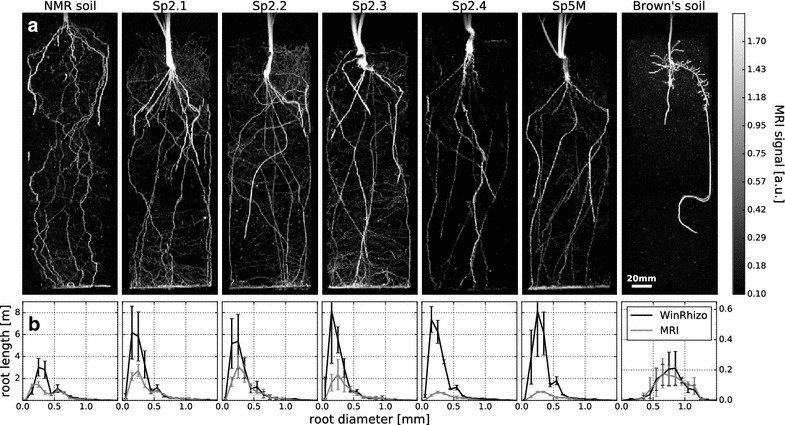
In five out of the eight tested substrates, barley lateral roots with diameters below 300 µm could still be resolved. In two other soils, only the thicker barley seminal roots were detectable. For these two substrates the minimal detectable root diameter was between 400 and 500 µm. Only one soil did not allow imaging of the roots with MRI. In the artificially composed substrates, soil moisture above 70% of the maximal water holding capacity (WHC) impeded root imaging. For the natural soil substrates, soil moisture had no effect on MRI root image quality in the investigated range of 50-80% WHC.
Almost all tested natural soil substrates allowed for root imaging using MRI. Half of these substrates resulted in root images comparable to our current lab standard substrate, allowing root detection down to a diameter of 300 µm. These soils were used as supplied by the vendor and, in particular, removal of ferromagnetic particles was not necessary. With the characterization of different soils, investigations such as trait stability across substrates are now possible using noninvasive MRI.
根系具有高度可塑性,会根据土壤环境进行适应。研究土壤对根系发育的特定影响需要针对多种基质调整和评估成像方法。利用磁共振成像(MRI)可获取土壤中非侵入性的三维根系图像。然而,并非所有基质都适用于MRI。我们以大麦作为模式植物,研究了六种常见土壤质地的市售天然土壤基质的成像质量及根系表型分析的适用性。将结果与之前记录的两种用于MRI根系成像的人工合成基质进行了比较。
在八种测试基质中的五种中,直径小于300μm的大麦侧根仍可分辨。在另外两种土壤中,仅能检测到较粗的大麦胚根。对于这两种基质,最小可检测根直径在400至500μm之间。只有一种土壤无法用MRI对根系成像。在人工合成基质中,土壤湿度超过最大持水量(WHC)的70%会妨碍根系成像。对于天然土壤基质,在50 - 80% WHC的研究范围内,土壤湿度对MRI根系图像质量没有影响。
几乎所有测试的天然土壤基质都可用于MRI根系成像。其中一半基质所得到的根系图像与我们当前实验室标准基质相当,能够检测到直径低至300μm的根系。这些土壤按供应商提供的原样使用,尤其无需去除铁磁性颗粒。通过对不同土壤的特性描述,现在可以使用非侵入性MRI进行跨基质性状稳定性等研究。