Dudbridge Frank, Pashayan Nora, Yang Jian
Department of Health Sciences, University of Leicester, Leicester, United Kingdom.
Department of Non-Communicable Disease Epidemiology, London School of Hygiene and Tropical Medicine, London, United Kingdom.
Genet Epidemiol. 2018 Feb;42(1):4-19. doi: 10.1002/gepi.22092. Epub 2017 Nov 26.
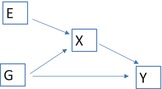
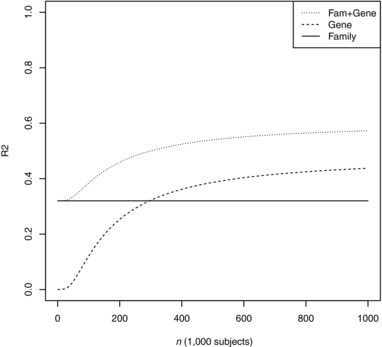
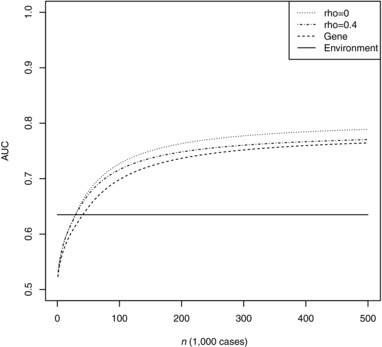
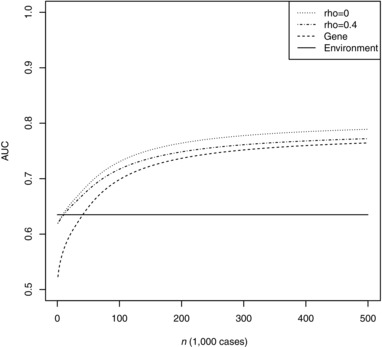
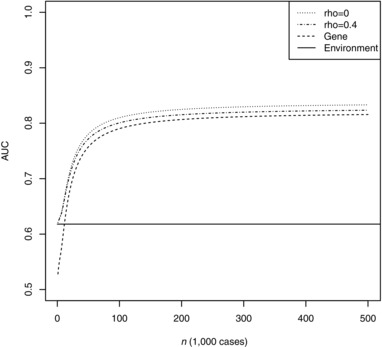
The substantial heritability of most complex diseases suggests that genetic data could provide useful risk prediction. To date the performance of genetic risk scores has fallen short of the potential implied by heritability, but this can be explained by insufficient sample sizes for estimating highly polygenic models. When risk predictors already exist based on environment or lifestyle, two key questions are to what extent can they be improved by adding genetic information, and what is the ultimate potential of combined genetic and environmental risk scores? Here, we extend previous work on the predictive accuracy of polygenic scores to allow for an environmental score that may be correlated with the polygenic score, for example when the environmental factors mediate the genetic risk. We derive common measures of predictive accuracy and improvement as functions of the training sample size, chip heritabilities of disease and environmental score, and genetic correlation between disease and environmental risk factors. We consider simple addition of the two scores and a weighted sum that accounts for their correlation. Using examples from studies of cardiovascular disease and breast cancer, we show that improvements in discrimination are generally small but reasonable degrees of reclassification could be obtained with current sample sizes. Correlation between genetic and environmental scores has only minor effects on numerical results in realistic scenarios. In the longer term, as the accuracy of polygenic scores improves they will come to dominate the predictive accuracy compared to environmental scores.
大多数复杂疾病具有较高的遗传度,这表明基因数据可用于进行有效的风险预测。到目前为止,遗传风险评分的表现尚未达到遗传度所暗示的潜力,但这可以通过估计高度多基因模型时样本量不足来解释。当基于环境或生活方式的风险预测指标已经存在时,有两个关键问题:增加基因信息能在多大程度上改进这些指标,以及基因与环境风险评分相结合的最终潜力是什么?在此,我们扩展了之前关于多基因评分预测准确性的研究,纳入了一个可能与多基因评分相关的环境评分,例如当环境因素介导遗传风险时。我们推导出了预测准确性和改进的常用度量,它们是训练样本量、疾病的芯片遗传度、环境评分以及疾病与环境风险因素之间的遗传相关性的函数。我们考虑了两种评分的简单相加以及考虑它们相关性的加权和。通过心血管疾病和乳腺癌研究的实例,我们表明,判别能力的提高通常较小,但在当前样本量下可以实现合理程度的重新分类。在实际情况下,基因评分与环境评分之间的相关性对数值结果的影响较小。从长远来看,随着多基因评分准确性的提高,与环境评分相比,它们将在预测准确性方面占据主导地位。