Department of Behavioural Science and Health, Institute of Epidemiology and Health Care, University College London, 1-19 Torrington Place, Gower Street, London, UK.
Department of Biostatistics and Health Informatics, Institute of Psychiatry, Psychology and Neuroscience, King's College London, London, UK.
Sci Rep. 2021 Oct 13;11(1):20276. doi: 10.1038/s41598-021-99332-7.
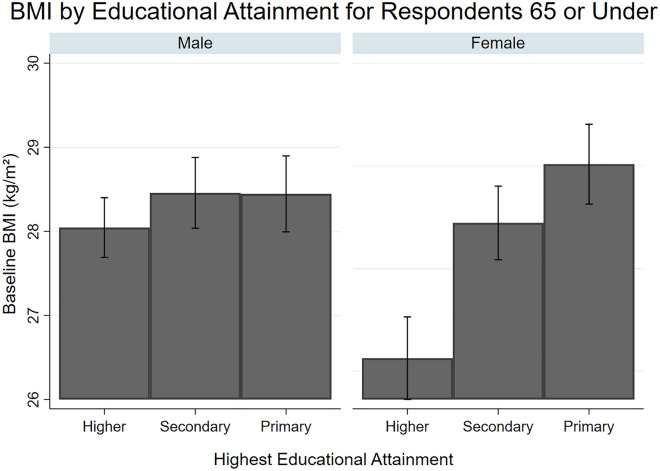
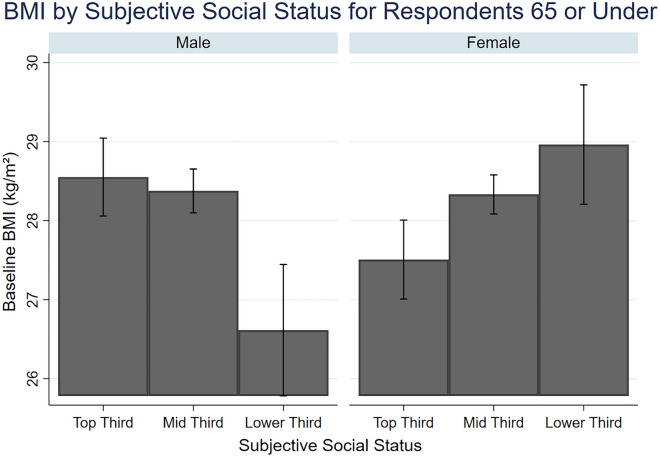
Identifying how socioeconomic positioning and genetic factors interact in the development of obesity is imperative for population-level obesity prevention strategies. The current study investigated whether social positioning, either independently or through interaction with a polygenic score for Body Mass Index (BMI-PGS), influences BMI trajectories across older adulthood. Data were analysed from 7,183 individuals from the English Longitudinal Study of Aging (ELSA). Interactions between the BMI-PGS and; lower educational attainment, self-perceived social status (SSS), and income, on BMI trajectories over 12 years across older adulthood were investigated through linear mixed effects models. Lower educational attainment, SSS and income were each associated with a higher baseline BMI for women, but not for men. There were interaction effects between BMI-PGS and social positioning such that men aged > 65 with a lower educational attainment (β = 0.62; 95%CI 0.00 - 1.24, p < 0.05), men aged ≤ 65 of a lower income (β = - 0.72, 95%CI - 1.21 - - 0.23, p < 0.01) and women aged ≤ 65 of lower SSS (β = - 1.41; 95%CI - 2.46 - 0.36, p < 0.01) showed stronger associations between the BMI-PGS and baseline BMI. There were few associations between markers of socioeconomic position and rate of change in BMI over the follow-up period. In sum, lower socioeconomic positioning showed adverse associations with women's BMI in older adulthood. Moreover, the expression of the BMI-PGS, or extent to which it translates to a higher BMI, was subtly influenced by socioeconomic standing in both women and in men.
确定社会经济地位和遗传因素在肥胖发展中的相互作用对于人群层面的肥胖预防策略至关重要。本研究调查了社会定位(无论是独立的还是通过与身体质量指数(BMI)多基因评分(BMI-PGS)的相互作用)是否会影响老年人的 BMI 轨迹。数据分析来自英国老龄化纵向研究(ELSA)的 7183 名个体。通过线性混合效应模型,研究了 BMI-PGS 与较低的教育程度、自我感知的社会地位(SSS)和收入之间的相互作用,以及它们对老年人 12 年期间 BMI 轨迹的影响。较低的教育程度、SSS 和收入均与女性的较高基线 BMI 相关,但与男性无关。BMI-PGS 与社会定位之间存在相互作用效应,即年龄超过 65 岁的男性教育程度较低(β=0.62;95%CI 0.00-1.24,p<0.05)、年龄≤65 岁的男性收入较低(β=-0.72,95%CI -1.21 - -0.23,p<0.01)和年龄≤65 岁的女性 SSS 较低(β=-1.41;95%CI -2.46 - 0.36,p<0.01)的男性和女性与 BMI-PGS 和基线 BMI 之间的关联更强。在随访期间,社会经济地位标志物与 BMI 变化率之间的关联较少。总之,较低的社会经济地位与女性在老年时的 BMI 呈不利关联。此外,BMI-PGS 的表达或其转化为更高 BMI 的程度在女性和男性中都受到社会经济地位的微妙影响。