Lee Ji Ho, Kim Su Chin, Choi Hyunna, Jung Chang Gyu, Ban Ga Young, Shin Yoo Seob, Nahm Dong Ho, Park Hae Sim, Ye Young Min
Department of Allergy and Clinical Immunology, Ajou University School of Medicine, Suwon, Korea.
Clinical Trial Center, Ajou University Medical Center, Suwon, Korea.
Allergy Asthma Immunol Res. 2018 Jan;10(1):18-24. doi: 10.4168/aair.2018.10.1.18.
House dust mites (HDM) are major allergens that cause allergic rhinitis (AR). Allergen-specific subcutaneous immunotherapy (SCIT) has been shown to be clinically beneficial in many clinical trials. Such trials, however, are not reflective of all patient populations. The aim of this study was to describe the efficacy and safety of SCIT in routine clinical practice in Korean adults with AR sensitized to HDM.
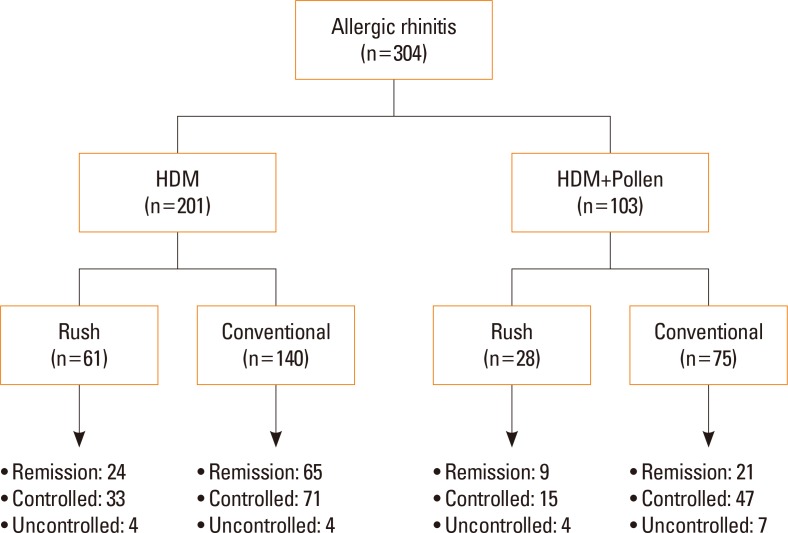
We reviewed medical records of 304 patients with AR treated at an allergy clinic of a tertiary hospital using SCIT with aluminum hydroxide-adsorbed allergen extract targeting HDM alone or with pollens for at least 1 year from 2000 to 2012. Patients with asthma were excluded. Rates of remission, defined as no further requirement of maintenance medication, over time were determined by means of life tables and extension of survival analysis. Specific immunoglobulin E (IgE) levels to HDM were categorized into 6 classes.
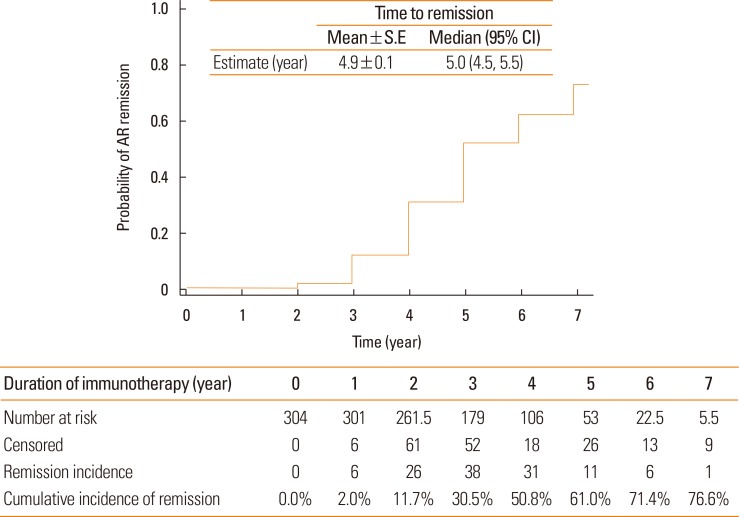
The mean time until achieving remission was 4.9±0.1 years, and the cumulative incidence of remission from AR was 76.6%. Severe AR (odds ratio [OR], 0.40; 95% confidence interval [CI], 0.23-0.69; P=0.001), specific IgE levels to HDM ≥17.5 kU/L (OR, 1.85; 95% CI, 1.01-3.37; P=0.045), and duration of immunotherapy ≥3 years (OR, 7.37; 95% CI, 3.50-15.51; P<0.001) were identified as significant predictors of clinical remission during SCIT for patients with AR sensitized to HDM. Overall, 73 patients (24.0%) experienced adverse reactions to SCIT, and only 1 case of anaphylaxis (0.3%) developed.
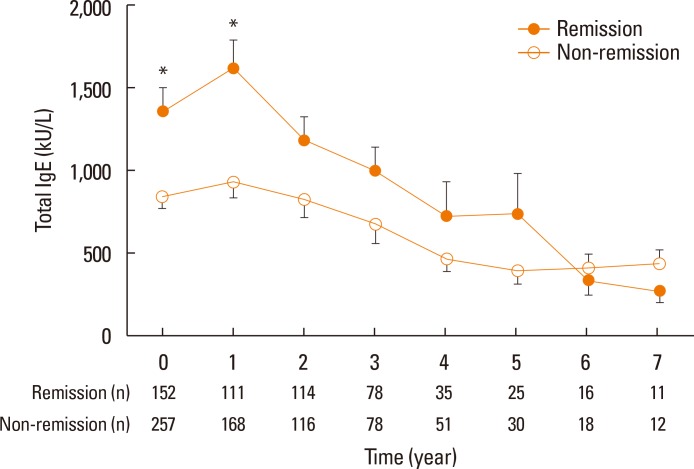
SCIT with HDM was found to be effective and safe for patients with AR. Specific IgE levels to HDM and a duration of SCIT ≥3 years may be predictors of clinical responses to SCIT in AR patients.
屋尘螨(HDM)是引起变应性鼻炎(AR)的主要变应原。变应原特异性皮下免疫疗法(SCIT)在许多临床试验中已显示出临床益处。然而,此类试验并不能反映所有患者群体。本研究的目的是描述SCIT在韩国对HDM致敏的成年AR患者的常规临床实践中的疗效和安全性。
我们回顾了2000年至2012年期间在一家三级医院过敏门诊接受SCIT治疗的304例AR患者的病历,这些患者使用仅针对HDM或联合花粉的氢氧化铝吸附变应原提取物进行治疗,疗程至少1年。排除哮喘患者。通过生命表和生存分析的扩展来确定随着时间推移达到缓解(定义为不再需要维持药物治疗)的发生率。针对HDM的特异性免疫球蛋白E(IgE)水平分为6类。
达到缓解的平均时间为4.9±0.1年,AR缓解的累积发生率为76.6%。重度AR(优势比[OR],0.40;95%置信区间[CI],0.23 - 0.69;P = 0.001)、针对HDM的特异性IgE水平≥17.5 kU/L(OR,1.85;95% CI,1.01 - 3.37;P = 0.045)以及免疫治疗疗程≥3年(OR,7.37;95% CI,3.50 - 15.51;P < 0.001)被确定为对HDM致敏的AR患者在SCIT期间临床缓解的显著预测因素。总体而言,73例患者(24.0%)经历了SCIT的不良反应,仅发生1例过敏反应(0.3%)。
发现HDM的SCIT对AR患者有效且安全。针对HDM的特异性IgE水平和SCIT疗程≥3年可能是AR患者对SCIT临床反应的预测因素。