Department of Molecular Biology, Graduate School of Pharmaceutical Sciences, Nagoya City University, 3-1 Tanabe-dori, Mizuho-ku, Nagoya, Aichi, 467-8603, Japan.
Sci Rep. 2017 Nov 27;7(1):16365. doi: 10.1038/s41598-017-16555-3.
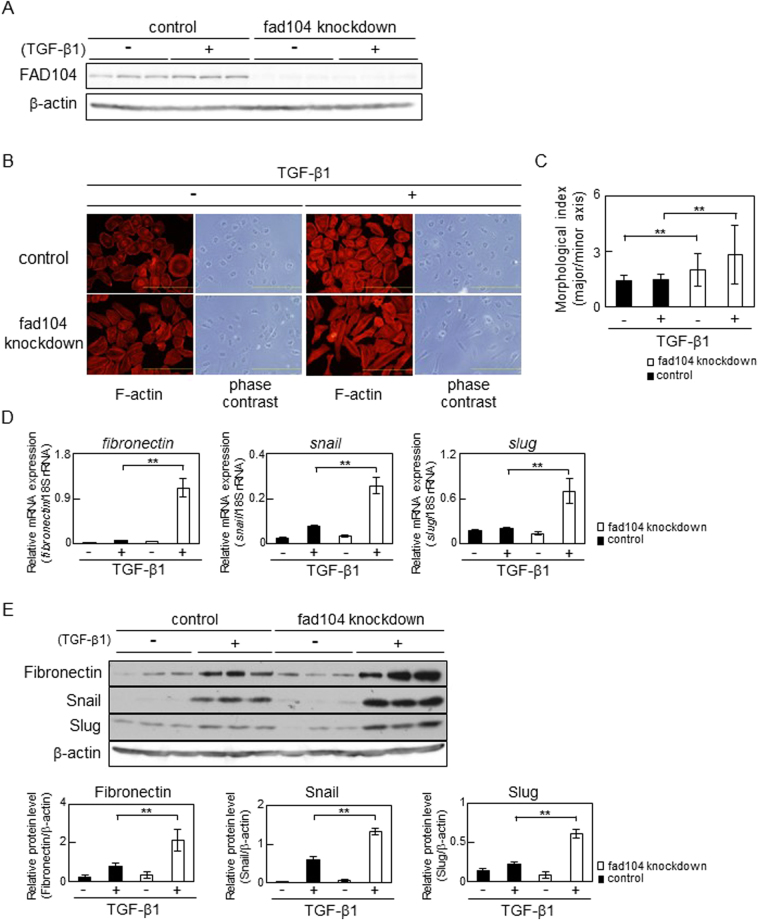
Epithelial-to-mesenchymal transition (EMT) is a biological process in which epithelial cells translate into a mesenchymal phenotype with invasive capacities, contributing to tumour progression, metastasis, and the acquisition of chemotherapy resistance. To identify new therapeutic targets for cancers, it is important to clarify the molecular mechanism of induction of EMT. We have previously reported that fad104, a positive regulator of adipocyte differentiation, suppressed the invasion and metastasis of melanoma and breast cancer cells. In this study, we showed that FAD104 functions as a novel suppressor of transforming growth factor-β (TGF-β)-mediated EMT in cervical cancer cells. Expression of FAD104 is upregulated during TGF-β-mediated EMT in human cervical cancer HeLa cells. Reduction of fad104 expression enhanced TGF-β-mediated EMT and migration in HeLa cells. Conversely, overexpression of FAD104 suppressed TGF-β-induced EMT. In addition, we showed that FAD104 negatively regulated phosphorylation of Smad2 and Smad3 but positively regulated phosphorylation of Smad1/5/8 via treatment with TGF-β. These findings demonstrate that FAD104 is a novel suppressor of TGF-β signalling and represses TGF-β-mediated EMT in cervical cancer cells.
上皮间质转化(EMT)是一种生物学过程,其中上皮细胞转化为具有侵袭能力的间充质表型,有助于肿瘤的进展、转移和获得化疗耐药性。为了确定癌症的新治疗靶点,阐明 EMT 诱导的分子机制非常重要。我们之前曾报道过,脂肪细胞分化的正向调节剂 fad104 抑制了黑色素瘤和乳腺癌细胞的侵袭和转移。在这项研究中,我们表明 FAD104 作为转化生长因子-β(TGF-β)介导的宫颈癌细胞 EMT 的新型抑制因子发挥作用。在人宫颈癌 HeLa 细胞中,FAD104 的表达在 TGF-β 介导的 EMT 过程中上调。减少 fad104 的表达增强了 HeLa 细胞中 TGF-β 介导的 EMT 和迁移。相反,过表达 FAD104 抑制了 TGF-β 诱导的 EMT。此外,我们还表明,FAD104 通过 TGF-β 处理负调控 Smad2 和 Smad3 的磷酸化,但正调控 Smad1/5/8 的磷酸化。这些发现表明,FAD104 是 TGF-β 信号的新型抑制剂,可抑制宫颈癌细胞中的 TGF-β 介导的 EMT。