Department of Computer Science, New York Genome Center, New York, United States.
New York Genome Center, New York, United States.
Elife. 2017 Nov 28;6:e27798. doi: 10.7554/eLife.27798.
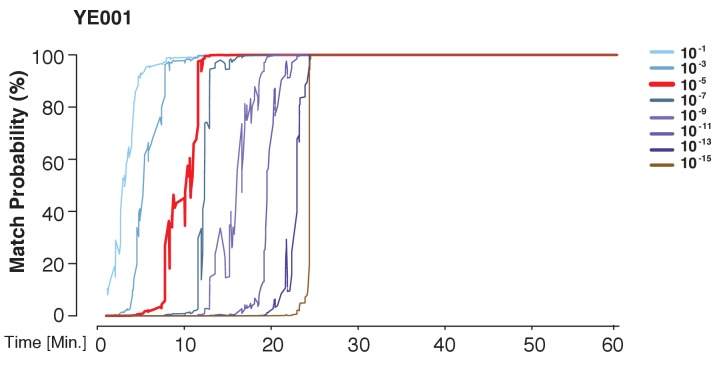
DNA re-identification is used for a broad suite of applications, ranging from cell line authentication to forensics. However, current re-identification schemes suffer from high latency and limited access. Here, we describe a rapid, inexpensive, and portable strategy to robustly re-identify human DNA called 'MinION sketching'. MinION sketching requires as few as 3 min of sequencing and 60-300 random SNPs to re-identify a sample enabling near real-time applications of DNA re-identification. Our method capitalizes on the rapidly growing availability of genomic reference data for cell lines, tissues in biobanks, and individuals. This empowers the application of MinION sketching in research and clinical settings for periodic cell line and tissue authentication. Importantly, our method enables considerably faster and more robust cell line authentication relative to current practices and could help to minimize the amount of irreproducible research caused by mix-ups and contamination in human cell and tissue cultures.
DNA 重新鉴定被广泛应用于从细胞系鉴定到法医学等领域。然而,目前的重新鉴定方案存在延迟高和访问受限的问题。在这里,我们描述了一种快速、廉价且便携的重新鉴定人类 DNA 的策略,称为“MinION 草图”。MinION 草图仅需 3 分钟的测序时间和 60-300 个随机 SNP 即可重新鉴定一个样本,从而实现 DNA 重新鉴定的近乎实时应用。我们的方法利用了细胞系、生物库中的组织以及个体的基因组参考数据的快速增长。这使得 MinION 草图可以在研究和临床环境中用于定期的细胞系和组织鉴定。重要的是,与当前的实践相比,我们的方法能够实现更快、更稳健的细胞系鉴定,有助于减少由于细胞和组织培养中混淆和污染而导致的不可重复研究的数量。