Center for Depression Research and Clinical Care, University of Texas Southwestern Medical Center, Dallas, Texas.
Department of Clinical Sciences, University of Texas Southwestern Medical Center, Dallas, Texas.
Int J Neuropsychopharmacol. 2018 Apr 1;21(4):325-332. doi: 10.1093/ijnp/pyx097.
We report on the psychometric properties of the 16-item Concise Associated Symptom Tracking Scale self-report scale and its clinical utility.
The 5-domain (irritability, anxiety, mania, insomnia, and panic) structure of Concise Associated Symptom Tracking Scale was validated with confirmatory factor analysis in Combining Medications to Enhance Depression Outcomes trial participants at baseline (n=664). Correlations with other clinical measures were used for convergent and divergent validity. In participants with at least one postbaseline visit (n=630), worsening in each Concise Associated Symptom Tracking Scale domain was defined as ≥1.28 SD increase from baseline for each visit (weeks 1, 2, 4, and 6) only. Worsening in any domain (except mania) was defined as overall worsening. Association of domain-specific and overall worsening with remission was tested with logistic regression analyses.
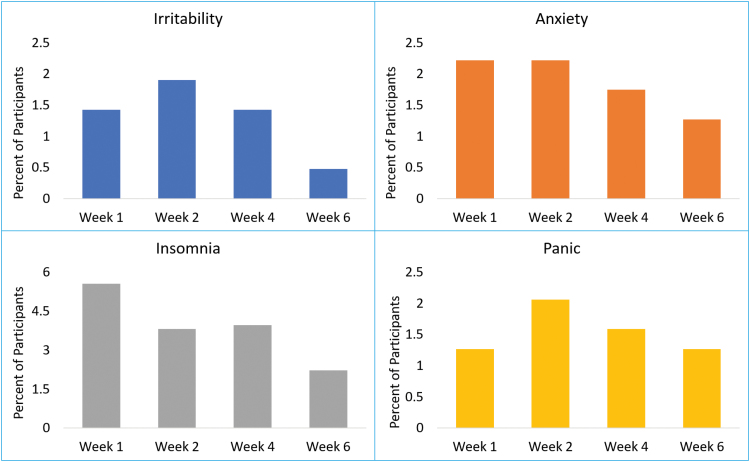
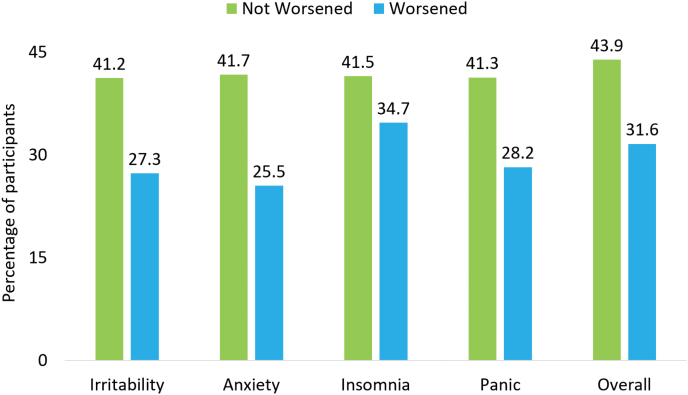
The 5-domain structure had adequate model fit on confirmatory factor analysis (GFI=0.93, CFI=0.89, and RMSEA=0.07). Scores on anxiety, panic, insomnia, and mania significantly correlated with Hamilton Rating Scale for Depression anxiety subscale (rs=0.27), Psychiatric Diagnostic Screening Questionnaire-panic scale (rs=0.35), sum of 3 Quick Inventory of Depressive Symptomatology Self-Report insomnia items (rs=0.55), and Altman Self-Rating Mania scale (rs=0.41), respectively. From baseline to week 6, 5.2%, 7.5%, 47.6%, 15.6%, 6.2%, and 27.6% participants (n=630) experienced irritability, anxiety, mania, insomnia, panic, and overall worsening, respectively. Participants with overall worsening were less likely to remit (31.6%) than those without any worsening (43.9%; odds ratio=0.53, 95% CI=0.36, 0.78).
The 16-item Concise Associated Symptom Tracking Scale self-report has acceptable psychometric properties. Clinically significant worsening of irritability, anxiety, insomnia, or panic with antidepressant treatment is associated with poorer outcomes.
我们报告了 16 项简明关联症状跟踪量表自评量表的心理测量学特性及其临床实用性。
在合并用药以改善抑郁结局试验参与者中,使用验证性因子分析验证简明关联症状跟踪量表的 5 个领域(易怒、焦虑、躁狂、失眠和惊恐)结构,基线时(n=664)。与其他临床测量的相关性用于收敛和发散效度。在至少有一次基线后就诊的参与者中(n=630),每个简明关联症状跟踪量表领域的恶化定义为每次就诊(第 1、2、4 和 6 周)时基线增加≥1.28 标准差。任何领域(除了躁狂)的恶化定义为整体恶化。使用逻辑回归分析测试特定领域和整体恶化与缓解的关系。
验证性因子分析的 5 个领域结构具有适当的模型拟合(GFI=0.93,CFI=0.89,RMSEA=0.07)。焦虑、惊恐、失眠和躁狂得分与汉密尔顿抑郁量表焦虑亚量表(rs=0.27)、精神病诊断筛查问卷惊恐量表(rs=0.35)、3 项简明抑郁症状自评量表失眠项目总和(rs=0.55)和 Altman 自评躁狂量表(rs=0.41)显著相关。从基线到第 6 周,5.2%、7.5%、47.6%、15.6%、6.2%和 27.6%的参与者(n=630)分别经历了易怒、焦虑、躁狂、失眠、惊恐和整体恶化。整体恶化的参与者缓解的可能性较小(31.6%),而非任何恶化的参与者(43.9%;比值比=0.53,95%CI=0.36,0.78)。
16 项简明关联症状跟踪量表自评量表具有可接受的心理测量学特性。抗抑郁治疗时易怒、焦虑、失眠或惊恐的临床显著恶化与预后较差相关。