Su Hui, Xiao Li, Ren Yue, Xie Hui, Sun Xiang-Hong
Sleep Medicine Center, Shengjing Hospital of China Medical University, Shenyang 110004, Liaoning Province, China.
World J Clin Cases. 2021 Oct 16;9(29):8740-8748. doi: 10.12998/wjcc.v9.i29.8740.
Insomnia is the most common sleep disorder. It disrupts the patient's life and work, increases the risk of various health issues, and often requires long-term intervention. The financial burden and inconvenience of treatments discourage patients from complying with them, leading to chronic insomnia.
To investigate the long-term home-practice effects of mindful breathing combined with a sleep-inducing exercise as adjunctive insomnia therapy.
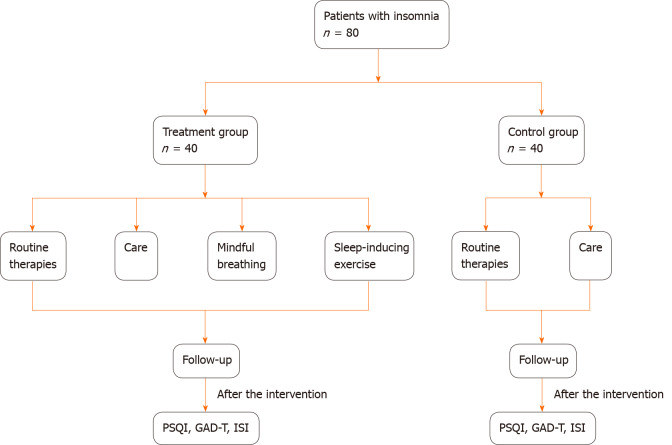
A quasi-experimental design was used in the present work, in which the patients with insomnia were included and grouped based on hospital admission: 40 patients admitted between January and April 2020 were assigned to the control group, and 40 patients admitted between May and August 2020 were assigned to the treatment group. The control group received routine pharmacological and physical therapies, while the treatment group received instruction in mindful breathing and a sleep-inducing exercise in addition to the routine therapies. The Pittsburgh Sleep Quality Index (PSQI), Generalized Anxiety Disorder 7-item (GAD-7) scale, and Insomnia Severity Index (ISI) were utilized to assess sleep-quality improvement in the patient groups before the intervention and at 1 wk, 1 mo, and 3 mo postintervention.
The PSQI, GAD-7, and ISI scores before the intervention and at 1 wk postintervention were not significantly different between the groups. However, compared with the control group, the treatment group exhibited significant improvements in sleep quality, daytime functioning, negative emotions, sleep latency, sleep duration, sleep efficiency, anxiety level, and insomnia severity at 1 and 3 mo postintervention ( < 0.05). The results showed that mindful breathing combined with the sleep-inducing exercise significantly improved the long-term effectiveness of insomnia treatment. At 3 mo, the PSQI scores for the treatment the control group were as follows: Sleep quality 0.98 ± 0.48 1.60 ± 0.63, sleep latency 1.98 ± 0.53 2.80 ± 0.41, sleep duration 1.53 ± 0.60 2.70 ± 0.56, sleep efficiency 2.35 ± 0.58 1.63 ± 0.49, sleep disturbance 1.68 ± 0.53 2.35 ± 0.53, hypnotic medication 0.53 ± 0.64 0.93 ± 0.80, and daytime dysfunction 1.43 ± 0.50 2.48 ± 0.51 (all < 0.05). The GAD-7 scores were 2.75 ± 1.50 7.15 ± 2.28, and the ISI scores were 8.68 ± 2.26 3.38 ± 1.76 for the treatment the control group, respectively (all < 0.05).
These simple, cost-effective, and easy-to-implement practices used in clinical or home settings could have profound significance for long-term insomnia treatment and merit wide adoption in clinical practice.
失眠是最常见的睡眠障碍。它扰乱患者的生活和工作,增加各种健康问题的风险,并且常常需要长期干预。治疗的经济负担和不便使得患者不愿依从治疗,从而导致慢性失眠。
探讨正念呼吸结合助眠运动作为辅助性失眠治疗的长期家庭实践效果。
本研究采用准实验设计,纳入失眠患者并根据入院时间分组:2020年1月至4月入院的40例患者被分配至对照组,2020年5月至8月入院的40例患者被分配至治疗组。对照组接受常规药物和物理治疗,而治疗组除常规治疗外,还接受正念呼吸和助眠运动指导。采用匹兹堡睡眠质量指数(PSQI)、广泛性焦虑障碍7项(GAD-7)量表和失眠严重程度指数(ISI)评估干预前及干预后1周、1个月和3个月时两组患者睡眠质量的改善情况。
干预前及干预后1周时,两组的PSQI、GAD-7和ISI评分无显著差异。然而,与对照组相比,治疗组在干预后1个月和3个月时睡眠质量、日间功能、负面情绪、入睡潜伏期、睡眠时间、睡眠效率、焦虑水平和失眠严重程度均有显著改善(P<0.05)。结果表明,正念呼吸结合助眠运动显著提高了失眠治疗的长期效果。在3个月时,治疗组与对照组的PSQI评分如下:睡眠质量0.98±0.48对1.60±0.63,入睡潜伏期1.98±0.53对2.80±0.41,睡眠时间1.53±0.60对2.70±0.56,睡眠效率2.35±0.58对1.63±0.49,睡眠障碍1.68±0.53对2.35±0.53,催眠药物使用0.53±0.64对0.93±0.80,日间功能障碍1.43±0.50对2.48±0.51(均P<0.05)。治疗组与对照组的GAD-7评分分别为2.75±1.50对7.15±2.28,ISI评分分别为8.68±2.26对3.38±1.76(均P<0.05)。
这些在临床或家庭环境中使用的简单、经济有效且易于实施的方法对长期失眠治疗具有深远意义,值得在临床实践中广泛采用。